The History of United States Coinage As Illustrated by the Garrett Collection
Q.David Bowers
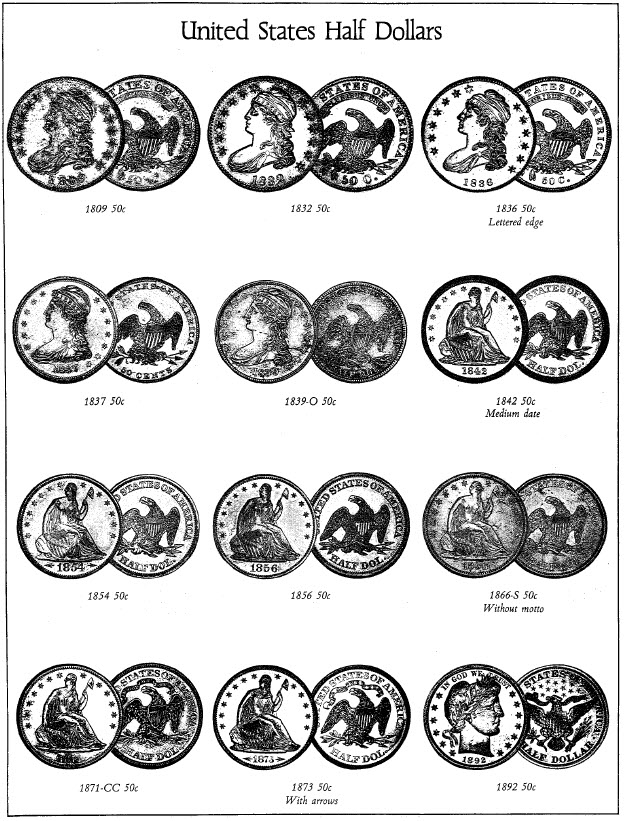
Among early half dollars, the first year of issue, 1794, is elusive in all grades. As noted, the draped bust half dollars with small eagle reverse minted only in 1796 and 1797 are rare. Other scarce issues include 1815/2, 1817/4, and 1836 with reeded edge. 1838-O is a major rarity. Struck in the first year of operation of the New Orleans Mint, this coin was apparently produced to the extent of only 20 pieces.
Gobrecht's Liberty seated design with obverse stars made its appearance in 1839. With modifications, the type was continued through 1891. In 1853 arrowheads were added near the date and an aura of rays was added to the reverse. The following two years, 1854 and 1855, were produced with arrowheads at the date, but the rays were discontinued. Prior to the use of the dies with arrowheads and rays the New Orleans Mint early in 1853 coined a very small number of half dollars without these features. These are recognized as major rarities.
In 1866 the motto IN GOD WE TRUST was added to the reverse. 1873 and 1874 saw the addition of arrowheads near the date to signify a weight change. As was the case with quarters during the same period, half dollars of 1879-1890 were of severely reduced mintages due to the preoccupation at the Philadelphia Mint with the tremendously expanded coinage of silver dollars.
In 1892 Charles E. Barber's Liberty head design made its appearance. The type was continued through 1915.
Adolph A. Weinman's Liberty walking design was issued from 1916 through 1947. Collectors today recognize a number of scarce issues in the series, including pieces struck at Philadelphia, Denver, and San Francisco in 1921. Throughout the series many issues are weakly struck.
In 1948 the Franklin design of Mint engraver John R. Sinnock was selected for the half dollar, despite strong objections of the Commission of Fine Arts. The Franklin type was minted from 1948 to 1963. Beginning in 1964 the Kennedy half dollar, with the obverse design by Gilroy Roberts and the reverse by Frank Gasparro, made its appearance. To celebrate the bicentennial of American independence a special 1776-1976 Kennedy half dollar was made with a reverse design by Seth Huntington which showed Independence Hall, a design not much different from that used on the commemorative quarter eagle minted in 1926 for the 150th anniversary of independence.
Silver Dollars (1794 to date)
Although the term silver dollars has traditionally been used to describe these large coins, the use of silver metal was discontinued (except for special pieces made for collectors) in 1971. Since that time "silver dollars" have been made of other alloys.
The first United States silver dollar made its appearance in 1794. Portraying Robert Scot's flowing hair design of Liberty on the obverse and a perched eagle with delicate wings on the reverse, this style was continued through part of 1795 as well. During the first year, 1794, 1,758 dollars were minted. An article which appeared in The New Hampshire Gazette, December 2, 1794, noted:
Some of the dollars now coining at the Mint of the United States have found their way to this town. A correspondent put one in the editor's hand yesterday. Its weight is equal to that of a Spanish dollar, but the metal appears finer. One side bears a head, with flowing tresses encircled by fifteen stars, and has the word "Liberty" at the top, and the date, 1794, at the bottom. On the reverse is the bald eagle, enclosed in an olive branch, around which are the words "United States of America." The edge is well indented, in which are the words "one dollar, or unit. Hundred cents." The tout ensemble has a pleasing effect to a connoisseur; but the touches of the graver are too delicate and there is a want of that boldness of execution which is necessary to durability and currency.
The 1794 dollar has always been a famous coin in numismatics. Walter Breen, Jack Collins, and others have studied surviving examples, which number close to 100.
Writing in 1861, James Ross Snowden credited the artist Gilbert Stuart with the inspiration for the draped bust design engraved in 1795 by Robert Scot:
The head of Liberty of the dollar of 1795 was designed by Stuart, the celebrated portrait painter, at the request of the Director, as we learned from a relation of the family, Stuart facetiously remarking that "Liberty on the other coins had run mad," referring to the disheveled hair on the previous coins. "We will bind it up and thus render her a steady matron."