The History of United States Coinage As Illustrated by the Garrett Collection
Q.David Bowers
In 1864 the thin bronze Indian cent became a reality, and millions were struck for circulation. Toward the end of the same year a small refinement was made to the Indian design. The initialL, for Longacre, was added in an almost imperceptible location on the ribbon below the lowest feather in the Indian headdress. Coinage of the Indian cent continued through 1909.
In 1877 coinage of cents was halted because of prevailing nationwide economic problems and because the director of the Mint believed that a nickel-alloy format would be approved to replace the bronze standard. Total cent production for the 1877 year was just 852,500 pieces, a record low for the era. Although nickel was not popular with Mint officials, production of nickel-alloy trial pieces continued in the cent series throughout the late 1860s and 1870s. Undoubtedly some of these were made as curiosities for collectors.
In 1908 the San Francisco Mint struck 1,115,000 cents, marking the first production of a minor coin at a mint other than Philadelphia.
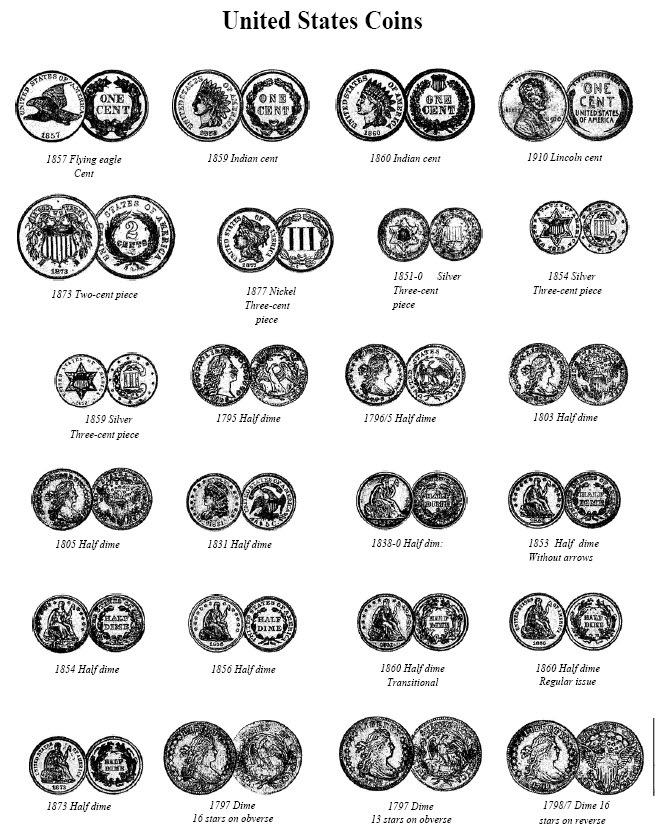
In 1908 Victor D. Brenner, a sculptor who had earlier prepared a medal and plaque of Lincoln, proposed to President Theodore Roosevelt that Lincoln be used on a coin. Although Washington and Lincoln had appeared on pattern issues of the 1860s, as of 1908 no American president had ever appeared on a coin made for regular circulation. Roosevelt was intrigued with the idea and suggested that Brenner prepare designs. By early 1909 models had been submitted, and the Mint was busy at work on a new cent. Originally a reverse was proposed featuring a design with a single sprig in the center, inspired by the French two-franc piece. Another idea proposed the standing figure of Liberty, also modeled after a French coin. These were rejected, and a reverse depicting two symmetrically-arranged wheat stalks was used. In honor of the designer the initials V.D.B. were placed at the bottom of the reverse. Pieces were subsequently struck for circulation. On August 2, 1909, Lincoln cents were introduced to the public. The Numismatist, official journal of the American Numismatic Association, described what happened:
Some day in the far distant future the numismatist may oc-casionally have to answer: "Say, Mister, how much will you give me for one of those rare Lincoln cents made way back in 1909 when the United States were in America-it's the rare kind with V.D.B. on it?" But today, and for untold days, so frequent will be the question that it seems advisable for the coin merchant to have in constant operation a phonograph that will grind out, "No premium on Lincoln cents with V.D.B. on them, or with anything else on or off them."
No new coin type has ever commanded the interest of the public and editorial reference and news space in the general press as has the Lincoln cent. Heralded long in advance, it was issued to an expectant populace on August 2nd. About 25 million had been coined and distributed to various subtreasuries and banks throughout the country so that distribution could commence in all parts on the same day. As soon as it became known that a new coin had been issued places of distribution were besieged, particularly in New York, Boston, Philadelphia, Chicago, and St. Louis, where long lines formed leading to sub-treasuries, and continued each day until August 5th, when the sign was displayed "N 0 More Lincoln Pennies."
Those not content to stand in line and obtain a supply at face value (one hundred was the most that would be supplied an individual), offered to purchase at a premium, and for a few days newsboys, messengers, and street fakirs had a harvest in selling the new coins at two or three for five cents. When no more were obtainable at Government supply places, stories in explanation were invented, "going to be called in," etc., and prices soared in different sections, as much as a dollar each being paid for specimens.
Favorable comment on the design, the artist, and the interest of the public appeared in the first day's papers, many illustrating the new type ... but the next day, and for several succeeding days, the papers turned to adverse criticism, and about everything denunciatory that is possible to say in relation to a coin was published, even stating that you could not spend them, which was the claim of some slot machine operators.
The origin of these criticisms has been traced to Philadelphia and Washington, from sources where selfish comments are not unknown when a coin type has been issued other than that produced by a government employee. Sifting all the criticisms, there was but one for which a just claim could be made, the designer's mark (initials V.D.B.) appeared a little more prominent than on the coins now in use. This was brought to the attention of the Secretary of the Treasury, who, we are informed, without question as to custom or propriety of designer's marks, ordered the coinage stopped. It was then announced that the letter B, to denote the engraver, would appear on the coins. Evidently, from the fact that the immediate demand was great and that it would require considerable time to produce dies with the letter B properly centered or inconspicuously placed, everything to indicate the designer was removed from the dies and in a few days the coins were in plentiful supply with the initials removed.