The History of United States Coinage As Illustrated by the Garrett Collection
Q.David Bowers
While mintage can be a key to rarity, it is only one indication. Was a given issue hoarded, exported, or melted? These and other questions must be considered.
In his 1883 monograph Newlin considered the 1802 half dime to be the most desirable rarity in the American silver eeries. Indeed, contemporary auction catalogues and sale reports would devote close attention to the offering of an example.
After 1805 half dime coinage was suspended for more than two decades. When specimens were struck again in 1829, the design was by John Reich and followed the style of the half dollar motif first introduced in 1807. This style, called the capped bust type, was produced through 1837. In the latter year Gobrecht's Liberty seated design made its appearance. Specimens of the Liberty seated motif, without stars on the obverse, were coined in 1837 at the Philadelphia Mint and in 1838 at the New Orleans facility.
In the following year, 1838, stars were added to the obverse. This design was continued through 1859. Examples dated 1853-1855 show arrowheads to each side of the date, symbolizing the weight reduction which first took effect at that time. The curious 1858 over inverted date variety can probably be attributed to James B. Longacre's carelessness. The date was first punched into the die upside down, and then it was corrected.
In 1860 the design was modified. UNITED STATES OF AMERICA was transferred from the reverse to the obverse. The wreath on the reverse and certain other features were changed as well. This style remained in effect until the last year of half dime coinage, 1873.
In 1860 Director James Ross Snowden caused a transitional "pattern" to be made. The obverse was of the style in use the preceding year, with stars, but the reverse was of the 1860 type. Interestingly, this unusual combination of dies produced a coin which did not mention the country of origin. He announced that just 100 pieces were struck. The number of specimens extant today suggests that this figure was publicized in order to help promote sales of the piece; several hundred would be a better production estimate.
The half dime denomination has possessed a special charm for several leading numismatists, among them Newlin and, in the 20th century, Dr. W. E. Caldwell.
Dimes (1796 to Date)
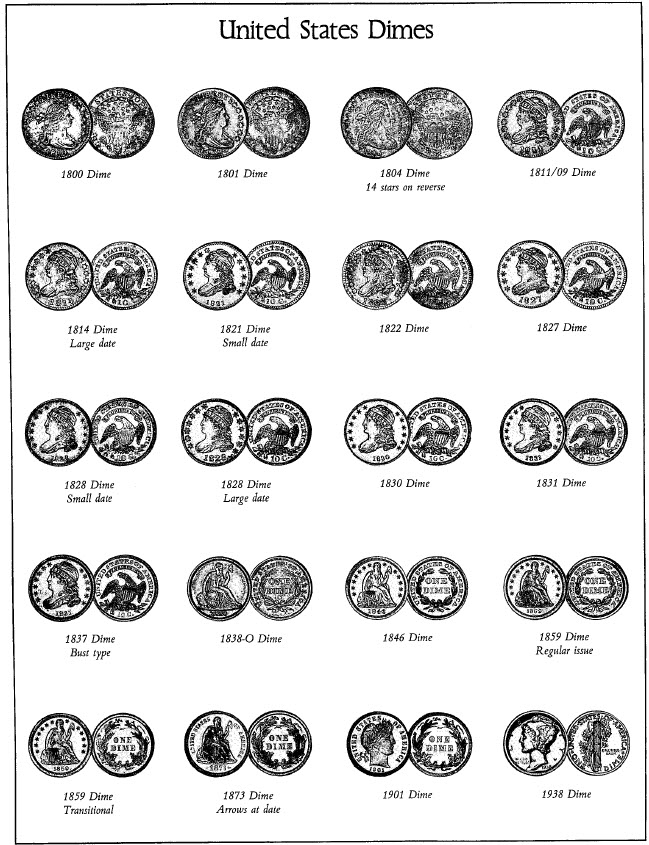
Following the establishment of the Philadelphia Mint in 1792, it was contemplated to issue copper, silver, and gold coins. High surety bonds in the amount of $10,000 each were required of certain Mint officials before silver and gold could be struck, with the result that the first year, 1793, paw the production of only copper. Later the bond Was reduced, and in 1794 the first silver issues made their appearance, followed in 1795 by the first gold coins. The first 10-cent pieces, or dimes, were struck in 1796. The design, similar to the half dime of the same period, features on the obverse the draped bust style and on the reverse a small eagle perched on a cloud. In 1798 the reverse was changed to the heraldic eagle format, a style which was continued through 1807.
Among early dimes are several interesting varieties. 1797 pieces are found with 13 stars or 16 stars on the obverse. 1798 varieties are found with 13 stars or 16 stars on the reverse. One variety of 1804, the 14-star reverse, was struck from the identical reverse die used in the same year to make gold quarter eagles.
No dimes were struck in 1808. In the following year, 1809, John Reich's capped bust design was employed, This style was continued through 1827. In 1828 the diameter was reduced slightly and other minor modifications were made. As was the ease with certain other denominations, coinage was intermittent. For example, no dimes were coined bearing the dates 1810, 1812, 1813, 1815-1819, or 1826.
In 1837 Gobrecht's Liberty seated design was used for the first time. This style, made in 1837 at Philadelphia and in 1838 at New Orleans, is without stars in the field, the samestyle as used on the half dimes, but not on other silver issues made for circulation. In 1838 stars were added to the obverse, a format that was continued through 1860. Arrows appear at the date of certain 1853 issues and all dated 1854 and 1855, signifying a weight reduction initiated during that time.
In 1860 UNITED STATES OF AMERICA was transferred from the reverse to the obverse of the dime. Other changes were made as well. This style was Continued through 1891. Arrows appear at the date of certain 1873 issues and all of 1874, signifying a change in the standard weight begun at that time.
In 1892 Charles E. Barber's Liberty head design made its appearance. Without change this style was continued through 1916. In the latter year the Liberty head style designed by Adolph A. Weinman made its appearance. For many years numismatists had been sharply critical of America's silver coin designs. Barber's dime, quarter, and half dollar were disliked as was Morgan's dollar. So, the advent of the new issue, soon called the "Mercury" dime, created considerable excitement.