The History of United States Coinage As Illustrated by the Garrett Collection
Q.David Bowers
The 1792 half disme is discussed together with 1792 issues elsewhere in this book. The first half dimes struck at the Philadelphia Mint (the 1792 half dismes were struck in nearby facilities outside of the Mint) were dated 1794, although the first pieces bearing this date were not struck until February of the next year. 1794 and 1795 half dimes are of the flowing hair style and are believed to have been the work of Robert Scot. No mark of denomination appears on the coin, either on the faces or the edge.
In 1796 the draped bust design made its appearance, a style which was continued for two years. The reverse of this style displays a small eagle perched on a cloud, encircled by a wreath. Varieties of 1797 were made with 13, 15, and 16 stars on the obverse. It has been postulated that as additional states joined the Union the Mint considered increasing the number of stars on the coins accordingly, but when the designs seemed crowded the original 13 stars were used.
No half dimes were coined in 1798 or 1799. The following year, 1800, marked the introduction of a new reverse, the heraldic eagle style. Based upon the Great Seal of the United States, the motif displayed an eagle with wings spread upward and with a shield on its breast. This reverse style, in combination with the draped bust obverse introduced earlier, was continued through 1805.
Included among half dimes of the period is one of the greatest rarities in the American silver coinage, the 1802. Don Taxay, in Scott's Catalogue & Encyclopedia of United States Coins, gives a mintage figure of just 3,060 pieces for the issue. The Guide Book of United States Coins lists a mintage of 13,110. During the early years of the Mint coinage records were kept on a fiscal (July to July) basis rather than on a calendar system. As a result, mintages listed for any given year in the official Mint reports are apt to pertain to pieces which were dated otherwise. Complicating the problem is the early Mint practice of keeping usable dies of earlier years on hand until they could be utilized. A study of Mint records shows that deliveries of copper, silver, and gold coins were made only at intervals throughout the year. That is, deliveries were not made from the Mint on a daily basis. In some instances coins of a given denomination might be shipped on, say, February 15th, October 1st, and December 15th of a certain year. U sing the relative rarity of varieties as studied by numismatists today, students have attempted to isolate certain deliveries as being from certain dies or as representing certain types. For example, if in the hypothetical mint year given above the coin in question is very rare today, but coins of the year before are common, and if the first mint delivery given above on February 15th is a large quantity, and the other mint deliveries are small quantities, it might be inferred that the February delivery represents coins dated a year earlier. This type of procedure is guesswork as, with certain exceptions, mint records do not list design types.
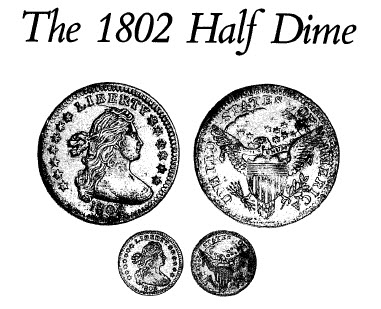
The 1802 half dime has always been considered a major rarity among early United States silver coins. Mint statistics indicate that 13,010 pieces were struck during the 1802 fiscal year, but apparently only a few bore the 1802 date. In the early years it was the custom at the mint to keep serviceable dies on hand until they became unfit for use, either through wear or breakage. It is probable that most of the half dimes reported coined in 1802 actually bore the date 1801 or possibly also 1800.
Harold P. Newlin, a Philadelphia attorney with offices in the Supreme Court Rooms, was an active numismatist during the 1870s and 1880s. He assembled a choice grouping of United States coins in various series including copper, silver, and gold. Although Newlin was the owner of many rarities, his favorite coin was the 1802 half dime.
When John W. Haseltine sold the Newlin Collection at auction in 1883 the purchaser of the 1802 half dime was T. Harrison Garrett. Newlin, recognizing Garrett's eye for quality, began in that year a lengthy series of correspondence which resulted in his selling many outstanding pieces to Garrett. His correspondence which is excerpted in detail in an appendix in this book, reveals that in certain series, gold coins in particular, some of the finest examples were not included in the auction sale. On May 3, 1883, Newlin wrote to Garrett:
"I have been making a list of 1802 half dimes, the number known, their condition when sold, and prices realized. I have also examined several specimens and have either seen or have photographs of the finest, and I hesitantly say that I believe without doubt that your specimen [the one purchased by Garrett in the Newlin Collection auction] is the finest known. If you care to clean your piece it will come out nearly a Proof ... "
Harold P. Newlin's comprehensive study of half dimes was published in the same year, 1883, by John W. Haseltine. The reference was entitled A Classification of the Early Half Dimes of the United States. It was 24 pages in length, plus covers, and was printed to the extent of just 100 copies.
Newlin, who was a student and connoisseur of United States coins, felt that the half dime denomination had been neglected while certain other series, particularly large copper cents, had been studied in detail and received much attention from numismatists.
Accordingly, his monograph sought to give the half dimes their share of attention. From 1883 until D. W. Valentine produced The United States Half Dimes in 1931, the Newlin reference was the only detailed work on the subject.
The introduction to Newlin's work reflects the author's feeling, indeed affection, for the half dime series.
"In an exhaustive search to determine the varieties of the early Half-dimes the numismatist encounters two very serious obstacles; the extreme difficulty of securing a sufficient number of the rare dates to classify with much accuracy their varieties and their respective degrees of rarity, and the further difficulty of obtaining the different specimens and conditions suitable for illustration upon place. The writer contributes the following article, entirely conscious that it possesses little or no merit, in the hope that it may awaken an interest in the subject, and that at no far distant day, a numismatist, eminently better qualified for the work, will give to the fraternity the benefit of his researches.