The History of United States Coinage As Illustrated by the Garrett Collection
Q.David Bowers
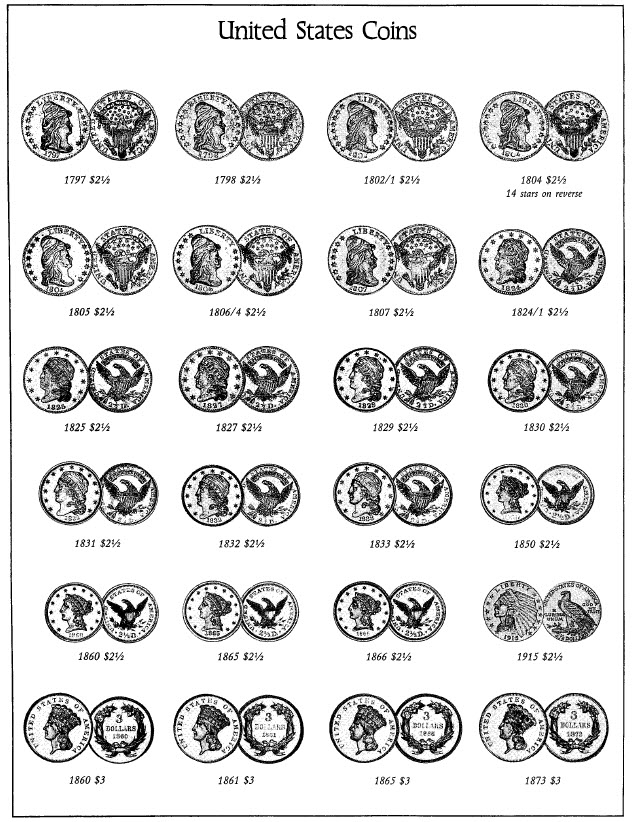
Three-Dollar Gold Pieces (1854-1889)
The $3 gold piece, authorized by Congress on February 21, 1853, made its debut in 1854. Mint records reveal that on April 28, 1854, in advance of the regular coinage, 15 Proof coins were sent by James Ross Snowden to the secretary of the Treasury.
The obverse of the $3 piece bears the portrait of an Indian princess with plumed headdress. The reverse bearsan inscription within an agricultural wreath. The basic design remained constant from the first year of issue, 1854, until the last, 1889. Specimens were struck continuously during this span at the Philadelphia Mint. Pieces were struck at Dahlonega and New Orleans in 1854 only. San Francisco coinage was accomplished in 1855,1856,1857,1860, and 1870. Of the 1870-S, two were struck and just one is known today. Other rare dates in the series include the 1854-D, 1875 (struck only in Proof condition, recorded mintage 20 pieces), and 1876 (struck only in Proof, 45 pieces made).
After the first several years $3 pieces lost favor with the public, with the result that examples struck later did not circulate to any significant extent. Due to the relatively low mintages throughout the entire series, no $3 pieces are plentiful. All are considered scarce.
Four-Dollar Gold Stellas (1879-1880)
In 1879 and 1880 pattern $4 gold pieces, called stellas from the five-pointed star design on the reverse, were struck. Two types were produced, the flowing hair style by Charles E. Barber (copying a design made by his father William for a pattern $5 of 1878), and the coiled hair design by George T. Morgan. Fifteen examples of the 1879 flowing hair design were struck in the year dated. In the following year, 1880, due to the demand for them, an additional 400 were made. The mintage of the 1879 coiled hair, 1880 flowing hair, and 1880 coiled hair pieces is not known with certainty but is estimated to be less than two dozen pieces of each variety. Apparently a large number of 1879 flowing hair pieces went into the hands of congressmen and other legislators.
Despite their status as patterns, the short-lived $4 stellas have been adopted into the collections of many numismatists who display them with the regular series. Specimens of all varieties are highly prized today.
Half Eagles (1795-1929)
The first gold coins struck at the Philadelphia Mint were the half eagles of 1795. The initial designs featured on the obverse Robert Scot's capped bust to right design, an obverse style that was continued through 1807. The reverse showed an eagle perched on an olive branch and holding a wreath aloft in its beak. Beginning in 1798 the heraldic eagle reverse style was adopted. However, the Mint paid little attention to the dates on dies during the period, so around that time 1795 and 1797 obverses were used in combination with the heraldic eagle reverse.
Examples of the small eagle reverse exist of the years 1795, 1796, 1797, and 1798. The 1798 small eagle is one of America's greatest gold coin rarities. Only about a half dozen are known to exist.
Heraldic half eagles are known of the dates 1795, 1797, and then 1798, with the intermission of 1801, through 1807. In the latter year John Reich's capped draped bust to left style was adopted, a format which was continued through 1812. In 1813 Reich's capped head to left style made its debut. This format was continued in use through 1834. Beginning in 1829 the diameter of the half eagle was reduced slightly and other minor changes were made. The 1829 large date half eagle is of the early style, while the 1829 small date half eagle is of the reduced-diameter configuration.