The History of United States Coinage As Illustrated by the Garrett Collection
Q.David Bowers
The Numismatist commented on the new 1932 quarter when it appeared:
The new Washington quarter dollar was officially placed in circulation August 1, and for a few days afterward they were handed out sparingly through the banks of the country to those who applied for them. The purpose of this is not clear. It was announced that only a few would be allowed anyone person, the object being to prevent, if possible, their being sold at a premium. But as a matter of fact the policy of making them scarce and difficult to get encourages their sale at a profit. During June and July 6,248,800 quarters were struck, and it is expected the Philadelphia Mint at least will continue their coinage in corresponding quantities for some time, and in a few weeks everybody will be able to secure all they want at any bank.
It should be remembered that, although the coin commemorates the two-hundredth anniversary of the birth of Washington, it is not a commemorative coin as the term is generally used by collectors. It is a regular government issue of a new design and supplants the design first issued late in 1916 along with the new designs for the 50 cents and the dime ...
An almost universal objection to the design just discontinued [the standing Liberty motif] was that after a little wear the date on the obverse became almost obliterated. This objection was partly overcome a few years ago, and the Washington bicentennial offered an opportunity to adopt an entirely new design. The objection to the old design must have been in Mr. Flanagan's mind while preparing his model, for he has placed the date between the truncation of the bust and the rim of the coin, both of which are considerably higher than the figures in the date, giving it ample protection from wear.
All in all, it is an attractive coin. The bust of Washington stands out in strong relief in contrast to the reverse, which appears somewhat crowded, particularly the part above the eagle's head. But sculptors are better judges of such things than laymen.
When sculptors were asked to submit designs for the new coin, one of the considerations named was that the bust of Washington must be modelled along the lines of the celebrated Houdon bust.
Jean Antoine Houdon, a French sculptor, was commissioned in 1785 to model a bust of Washington. He had recently executed a statue of Benjamin Franklin while the latter was staying in Paris. On Franklin's return to the United States he was accompanied by Houdon, who visited Washington at Mount Vernon, where he modelled a marble bust of him. A short time later he decided to return to Paris, taking the model with him for completion.
Washington quarters have been produced from 1932 onward. 1932-D and 1932-S, produced at Denver and San Francisco during the first year of the design, have been considered scarce ever since they were first released. Relatively few were saved by collectors at the time of issue.
For the bicentennial of American independence a special 1776-1976 quarter was prepared. This issue featured a reverse design by Jack L. Ahr which depicted a colonial drummer.
Half Dollars (1794 to date)
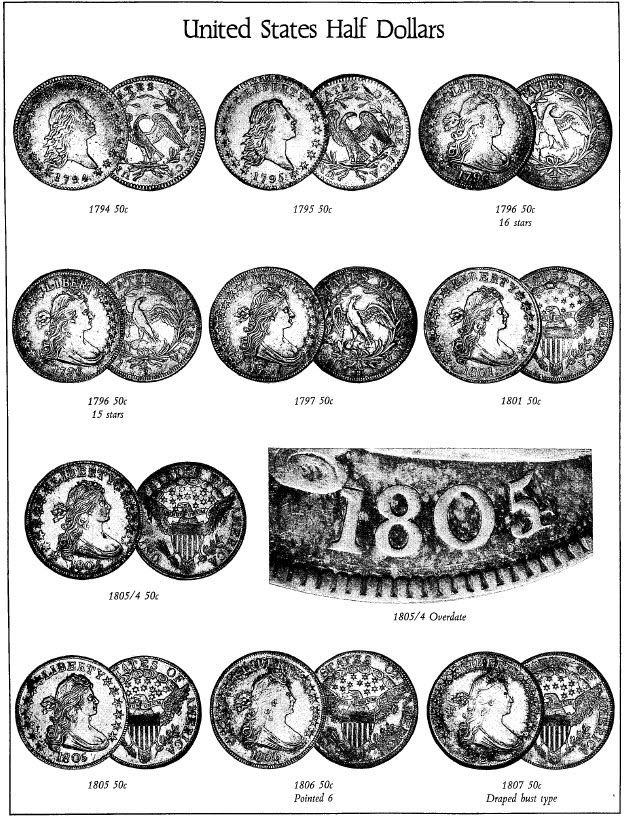
The first United States half dollars, minted in December 1794, were of the flowing hair design by Robert Scot. This style, which was continued in 1795, matched that used on the half dimes and dollars of the same dates.
In 1796 the style was changed to the draped bust configuration. The reverse depicted a small eagle perched on a cloud. This design, minted in very limited quantities in 1796 and 1797, is considered to be the rarest major half dollar type.
No half dollars were coined with dates 1798 to 1800.
In 1801 the half dollar again appeared. The design featured Scot's draped bust on the obverse. The reverse was of the heraldic eagle style. This was continued through 1807. In that year John Reich's capped bust type, often referred to as the Turban Head, was initiated, a style which continued, with modifications, through 1839. From 1807 to 1836 specimens were made of large diameter. The denomination was lettered on the edge: FIFTY CENTS OR HALF A DOLLAR. In December 1836 a new design, smaller in diameter and with a reeded edge, appeared. The obverse featured Christian Gobrecht's adaptation of Reich's capped bust design. The reverse was also an adaptation of the earlier style, but with the denomination changed from SOC to 50 CENTS. In 1838 the reverse was again revised. Changes were made in the lettering, and the denomination was revised to HALF DOL.
Coinage was continuous from 1807 to 1839 with the exception of 1816, the year of the disastrous Mint fire.
Half dollars of the early years have formed the object of several important studies and references, including M. L. Beistle's Register of United States Half Dollar Varieties and Sub-Varieties and Al C. Overton's Early Half Dollar Varieties 1794-1836.