The History of United States Coinage As Illustrated by the Garrett Collection
Q.David Bowers
Quarter Dollars (1796 to date)
The first quarter dollars did not appear until 1796, in which year 6,146 were coined. Many of these were struck from polished dies and resembled what would later be called Proofs. Following the design of the contemporary dime and half dime, the quarter featured the draped bust motif on the obverse and an eagle perched on a cloud on the reverse. Like the early half dimes and dimes, the 1796 quarters bore Po indication of value.
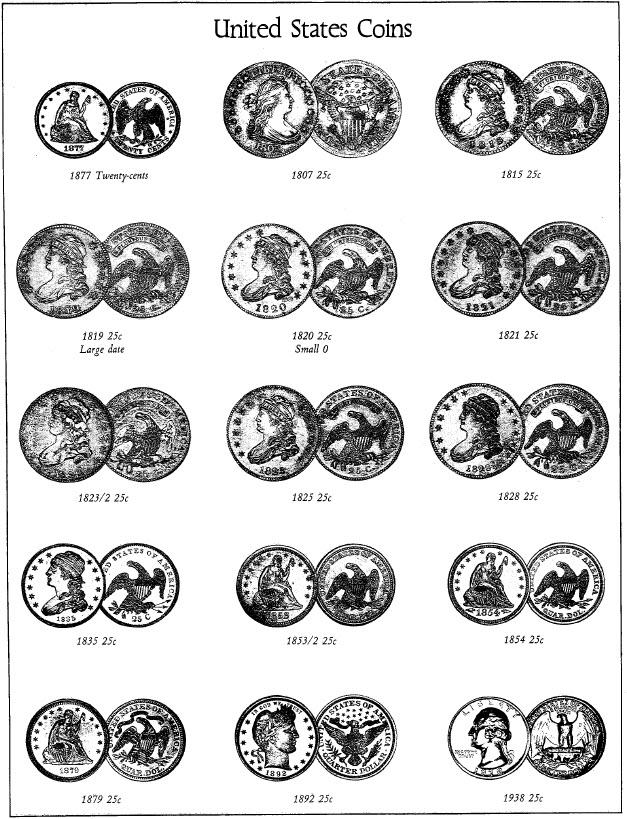
Following the modest coinage of 1796, no quarters were produced until 1804, in which year the reverse style was changed to the heraldic eagle design. Pieces of this format were made through 1807. Then followed a hiatus, broken by the issuance of quarters in 1815. Following other silver coinage, the format was John Reich's capped bust style. This design was continued through 1838. Engraver Kneass reduced the diameter of the quarter in 1831, eliminated E PLURIBUS UNUM from the reverse, and made other modifications of the basic design.
Coinage of the capped bust type, 1815-1838, was not continuous in the early years. No examples were coined with the dates 1816, 1817, 1826, 1829, or 1830.
On one variety of 1822 quarter the engraver, believing he was working on a half dollar die, placed the denomination SOC on the reverse. The error was noticed, and the numerals 25 were everpunched. Six years later in 1828 the same blundered die was used again.
1823/2, an overdate (no non-overdate quarters were produced in 1823), is a rarity. Curiously, nearly all known specimens show a high degree of wear.
The most famous rarity in the entire quarter series is the 1827. Although mint records indicate 4,000 pieces were struck, apparently these coins must have been struck from earlier-dated dies or possibly the production was melted and never released. In any event, no 1827 quarter showing evidence of circulation has ever come to light. There were, however, Proof quarters made in 1827 for use in presentation sets. Joseph J. Mickley, the pioneer Philadelphia collector, visited the Mint that year and obtained for face value four examples. Others were made as well. Today numismatists believe that about 10 are known to exist.
Many decades later a crude restrike of the 1827 quarter was made from rusted dies. Whereas the 2 in 25c on the original 1827 Proof quarter has a curled base, the restrikes were made with an incorrect reverse which has a square-base 2.
The 1827 quarter die was produced by altering an unused die bearing the date 1823. Close examination of the last digit of the date reveals that the issue properly should be designated an overdate, 1827/3. Other overdates abound among early capped bust quarters. As noted, coinage was not continuous, with the result that dies prepared for a given year were not always used in or near the year indicated. Later when they were used the date was altered in the die, producing an overdate.
The Liberty seated design with stars on the obverse appeared in 1838 and was continued through 1891. To signify the weight change in 1853 arrowheads were added to each side of the date and an aura of rays was added to the eagle on the reverse. The rays were discontinued, but arrowheads were retained in 1854 and 1855. 1866 Saw the introduction of the motto IN GOD WE TRUST to the reverse design. In 1873 and 1874 arrowheads were added near the date.
The Liberty seated quarter series contains a number of rare issues, including the 1842 with small date numerals (this variety was issued only as part of the relatively few Proof sets issued this year 1842 quarters made for circulation had larger date numerals), 1849-0, 1853 without arrows and rays, and the Carson City issues from 1870 to 1873. Philadelphia Mint quarters from 1879 to 1890 were made in limited numbers, as were half dollars of the same decade, for the facilities of the Mint were severely taxed by the immense coinage of silver dollars made in response to the Bland-Allison Act.