The History of United States Coinage As Illustrated by the Garrett Collection
Q.David Bowers
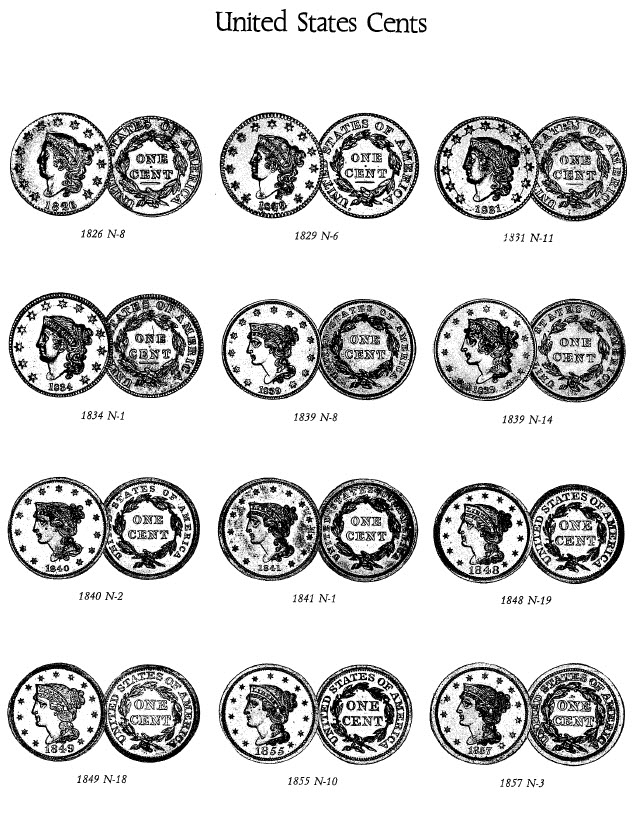
In 1795 numerous die varieties were produced. Interesting among them are the reeded edge cent, whose origin and purpose are unexplained, and the so-called Jefferson Head, presumed to have been a pattern issued by John Harper, a saw maker, who supplied material to the Mint at various intervals during the period and who actively solicited a contract for private coinage.
The uncertain supply of copper remained a problem which was not solved until regular shipments of prepared planchets (complete with raised rims) were received from Boulton & Watt, of Birmingham, England, toward the end of the decade. Previous. to that time copper was of irregular quality. Supplies from certain sources were coarse and discolored. This accounts for the wide variation of metallic surfaces observed on early copper coins of the period.
The Liberty cap design, in use since the end of 1793, was discontinued part way through 1796 in favor of Robert Scot's draped bust design, a style which was subsequently utilized through 1807. Within this period are to be found many different die variations, including such errors as the 1796 LIHER TY, several varieties lacking stems to the reverse wreath, and one famous blundered die, the so-called Three Errors Reverse, which lacks one wreath stern, has the mathematically meaningless fraction 1/000 (instead of 1/100), and has UNITED spelled as UNITED. The rarest date in the large cent series, the 1799, is also of the draped bust style. A search for a cent of his birthdate, 1799, led 17-year-old Joseph J. Mickley to learn more about coins. Later he was to become the most prominent American numismatist of the early 19th century. The 1804 cent, also of the draped bust style, is remarkable for its rarity.
In 1808 Reich's classic head style was adopted.
Coinage continued through 1814, when lack of copper planchets forced suspension. Cents from this era are often weakly struck and are on planchets which discolored easily. In an 1893 article, "Early Engineering Reminiscences," George Escol Sellers described a visit to the Philadelphia Mint in 1812:
In the rear room, facing on the ailey, with a large lowdown window opening into it, a fly press stood, that is a screw-coining press mostly used for striking ole! copper Gents. Through this window the passersby in going up and down the alley could readily see the bare-armed vigorous men swinging the heavy end weighted balance lever that drove the screw with sufficient force so that by the momentum of the weighted ends this quick-threaded screw had the power to impress the blank and thus coin each piece. They could see the rebound or recoil of these end weights as they struck a heavy wooden spring beam, driving the lever back to the man that worked it; they could hear the clanking of the chain that checked it at the right point to prevent its striking the man, all framing a picture very likely to leave a lasting impression, and there are no doubt still living many in Philadelphia who can recollect from this brief notice the first mint.
One day in the charge of my elder brother I stood on tip-toe with my nose resting on the iron bar placed across the open window of the coining room to keep out intruders, watch- ... ing the men swinging the levers of the fly press; it must have been about noon, for Mr. Eckfeldt came into the room, watch in hand, and gave the signal to the men who stopped work. Seeing me peering over the bar, he took me by the arms and lifted me over it. Setting me down by the coining press he asked me if I did not want to make a cent, at the same time stopping the men who had put on their jackets to leave the room. He put a blank planchet into my hand, showed me how to drop it in, and where to place my hand to catch it as it came out; the lever and the weights were swung, and I caught the penny as we boys called cents, but I at once dropped it. Mr. Eckfeldt laughed and asked me why I dropped it? Because it was hot and I feared it would burn me; he picked it up and handed it to me, then certainly not hot enough to burn; he asked if it was not cold when he gave it to me to drop into the press; he told me to look and see that there was no fire, and feel the press that it was cold; he then told me that I must keep the cent until I learned what made it hot; then I might, if I liked, spend it for candy.