The History of United States Coinage As Illustrated by the Garrett Collection
Q.David Bowers
In 1831 Proofs were struck for presentation purposes. No pieces were made for circulation. 1832-1835 saw a modest coinage for use in commerce. After this date the inventory was sufficiently large that no additional pieces were made for circulation until 1849. Proofs were struck in 1836 and from 1840 through 1848. In later years, probably 1858-1860, and again in the late 1860s, restrikes were made for collectors. Originals of the 1840-1848 years are distinguished by having large berries in the reverse wreath. Restrikes occur in two varieties: the so-called first restrike, with NT of CENT and portions of the wreath ribbon recut, and the second restrike with diagonal parallel die striations over RICA in AMERICA. Restrikes of both types have smaller berries than on the originals. 1849 half cents with small date numerals were also struck in proof.
Proofs of the 18405 utilize the braided hair design by Christian Gobrecht. The same style was utilized from 1849 to 1857 for coins made for circulation, an exception being 1852 which was struck only in Proof.
Rare dates in the half cent series include the 1793, popular as the only coin of its design type, 1796 with pole and without pole, 1802, and the Proof-only issues of 1831, 1836, 1840-1848, 1849 small date numerals, and 1852. References pertaining to the half cent series include United States Coinage of 1793, Cents and Half Cents, by Sylvester S. Crosby, published in Boston in 1897; United States Cents and Half Cents 1793-1857 by Edouard Frossard, Irvington-On- Hudson, New York, 1879; United States Half Cents, by Ebenezer Gilbert, New York, 1916; United States Half Cents 1793-1857, by Q. David Bowers and James F. Ruddy, New York, 1963; and American Half Cents, the "Little Half Sisters," by Roger S. Cohen, Jr., Baltimore, 1971.
Large Cents (1793-1857)
The first American copper cents issued for circulation bore on the obverse the head of Liberty facing right and on the reverse a chain of fifteen links. The legend UNITED STATES OF AMERI surrounded. The engraver, probably Henry Voigt, fearful that AMERICA would not fit symmetrically on the coin, dropped the last two letters.
On March 25, 1793, The Argus, published in Boston, contained this notice concerning the new pieces:
The American cents (says a letter from Newark) do not answer our expectations. The chain on the reverse is but a bad omen for Liberty, and Liberty herself appears to be in a fright. May she not just cry out in the words of the Apostle, "Alexander the copper-smith has done me much harm; the Lord reward him according to his works."
The reference to Alexander pertained to Alexander Hamilton, secretary of the Treasury. Other varieties of the chain cent were made with AMERICA spelledout in full. Comments such as the preceding were undoubtedly responsible for the design being changed to a more full and supple head of Liberty on the obverse and a wreath design on the reverse. Still later in the year the design was again modified to the Liberty with cap and pole style, probably the work of Joseph Wright. Early types of 1793 cents had the edge ornamented by a vine and bars design. Later the lettering ONE HUNDRED FOR A DOLLAR was used, a style which continued through part of 1795.
Toward the end of November 1794 John Smith Gardner was hired as an assistant engraver. His work was probably mostly with half cent and cent dies. Walter Breen postulates that a scarce variety of 1795 half dollar with an unusually small head on the obverse may have been his work as well.
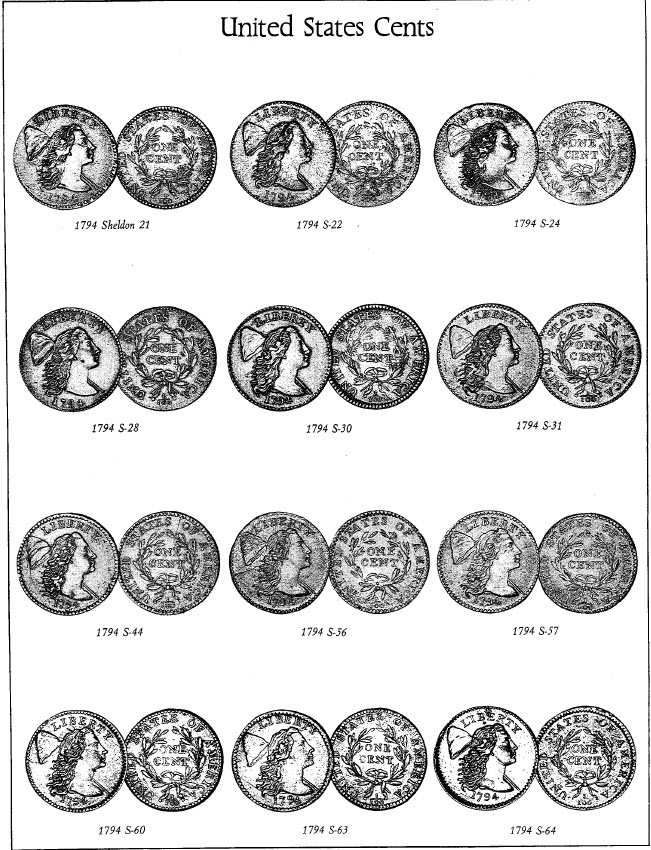
Cents of the year 1794 are favorites with numismatists. Several dozen different varieties were produced, one of which, the Starred Reverse, remains a numismatic enigma. Around the reverse border denticles are 94 tiny five-pointed stars. This curiosity, chronicled by Dr. William H. Sheldon in his landmark reference on cents of the years 1793-1814, Penny Whimsy, designated this as variety S-48. Opinion is divided concerning the origin of the piece. Don Taxay described it as a pattern, while Dr. Sheldon was inclined toward the view that it was just a curiosity, the result of a whim by an engraver during an idle hour at the Mint. Whatever its origin or intent the Starred Reverse is the most famous cent of the year.