The History of United States Coinage As Illustrated by the Garrett Collection
Q.David Bowers
In 1887 James P. Kimball, director of the United States Mint at the time, mentioned in his annual report the popular desire for improvement in coinage designs. The Liberty seated motif was considered trite, and Morgan's dollar motif had few admirers. He observed that a public competition had been considered, but it was the experience of the Mint that better results could be obtained by engaging artists who were "distinguished in their representative departments of art." In 1890 the Treasury Department proposed to hold a design competition to include 10 distinguished artists. Letters of invitation were sent to Augustus Saint Gaudens, Daniel French, and others. The artists discussed the situation among themselves and then reported that the terms of the competition were such that no good could result from it. They submitted a counterproposal, which included the provision that competition awards would be selected by presidents of art institutions or by a vote of the competitors rather than by the Mint, that payment be given for every sketch and design submitted whether or not it was a winner, that the same artist design both the obverse and reverse of a given coin, and that the present reverse designs of the half dollar, quarter, and dime were to be abandoned, among other ideas. The Treasury Department reacted by dropping the proposal.
It was then suggested that a public competition be held with Augustus Saint-Gaudens, Henry Mitchell (a gem and seal engraver from Boston), and Charles Barber (the Mint engraver) acting as judges. This did not come to pass. Charles Barber then prepared his own designs for a new silver coinage, one with a standing figure of Liberty, and the other with the familiar Liberty head as subsequently used for coinage in 1892. Barber's design encountered much criticism. In October 1894 the American Numismatic Society and others, reacting to the Barber coinage as well as the long-offending Morgan dollar, initiated a competition for a new silver dollar design. In 1895 various artists prepared sketches, designs, and models, but these never received serious consideration from the Treasury Department.
On April 22, 1896, a site in Denver was purchased for a new mint at a cost of about $60,000. Earlier, the government conducted assaying and refining using facilities acquired from Clark, Gruber & Co. in the 1860s. During the first year of operation of the new Denver Mint, 1906, silver coins from dimes to half dollars amounting to $3.2 million were produced as were $23.8 million worth of gold coins. Each coin bore the mint letter D, the same identification that had earlier been used by the Dahlonega Mint 1838-1861. The Mint was enlarged in 1937 and again in 1945.
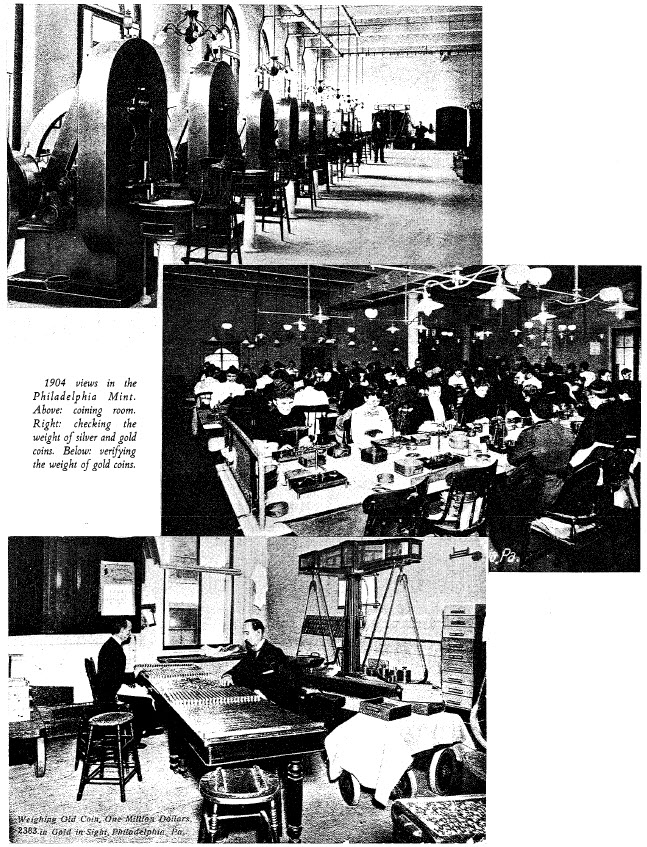
In June 1901 a new Philadelphia Mint was completed on Spring Garden Street between 16th and 17th streets. New mechanization was brought to the Mint, particularly in the area of refining in which electrolytic methods were used.
In 1909 the Indian cent design, which had been used in circulation since 1859, was discontinued in favor of the new Lincoln cent. Several years later, in 1913, a new style of nickel featuring an Indian on the obverse and a buffalo on the reverse made its appearance. In 1916 it was desired to redesign the Barber Liberty head coins which had been in use for 25 years. Contracts were given to Adolph Weinman and Hermon MacNeil to provide new designs, after the Treasury Department, in connection with the Commission of Fine Arts, had reviewed a number of submissions. Arrangements were made for the two artists to visit the Mint to acquaint themselves with coinage procedures. Apparently George T. Morgan, the assistant engraver, was very friendly and receptive, but Barber, the chief engraver, was sullen and sulky. It was Barber's unpopular design for the dime, quarter, and half dollar that was to be replaced.
Throughout the first three decades of the 20th century gold coins were struck in immense quantities. These were used in foreign exchange, particularly with countries in Europe and South America. In addition, millions of pieces were stored in Treasury vaults. On March 6, 1933, President Franklin D. Roosevelt prohibited banks from paying out gold coins. Subsequently, the public was required to return gold coins of earlier dates to the Treasury Department. Exceptions, following certain rules, were made for numismatists. Thus ended the American privilege of redeeming paper money with gold coins.
World War II and the resultant need for strategic materials forced suspension of the bronze Lincoln cent in 1943. For one year zinc-coated steel was used for cent coinage. Then for the remainder of the war a modified copper alloy was used. The composition of nickel 5-cent pieces was changed in 1942 to a new alloy containing silver. This was continued through 1945.
The Coinage Act of 1965 changed the composition of dimes, quarters, and half dollars to reduce or eliminate the silver content. Later, silver was removed from the dollar also. Exceptions were made with certain silver-content coins sold at a premium to collectors.
By the late 1970s the United States was operating four coinage facilities: the standard mints at Philadelphia, Denver, and San Francisco, plus a provisional coinage facility at West Point, New York (coins struck there bore no mintmark indicating origin). Denominations produced comprised the cent,nickel, dime, quarter, half dollar, and dollar.
Characteristics, designs, and other features of the various coin denominations issued for circulation from 1793 onward are given in the chapter to follow.