The History of United States Coinage As Illustrated by the Garrett Collection
Q.David Bowers
Visitors may be admitted by permission of an officer, to see the various operations of the Mint on all working days except Saturdays and rainy days; they are to be attended by an officer, or some person designated by him. The new coins must not be given in exchange for others or to accommodate visitors, without the consent of the Chief Coiner. Christmas Day and the Fourth of July, and no other days are established holidays at the Mint. The pressman will carefully lock the several coining presses when the work for the day is finished, and leave the keys in such places as the Chief Coiner shall designate. When light is necessary to be carried from one part of the Mint to the other, the watchman will use a dark lantern but not an open candle. He will keep in a proper arm chest securely locked, a musket and bayonet, two pistols and a sword. The arms are to be kept in perfect order and to be inspected by an officer once a month, when the arms are to be discharged and charged anew.
The watchman of the Mint must attend from 6:00 in the evenings til 5:00 in the morning, and until relieved by the permission of an officer, or until the arrival of the door-keeper. He will ring the yard bell precisely every hour by the Mint clock, from 10:00 until relieved by the door keeper, or an officer, or the workmen on working days, and will send a watchdog through the yard immediately after ringing the bell. He will particularly examine the compartments of the engine and all the rooms where fire has been on the preceding day, conformably to his secret instructions. To this purpose he will have keys of access to such rooms as he cannot examine without entering them.
If an attempt be made on the Mint he will act conformably to his secret instructions on that subject. In case of fire occurring in or near the Mint he will ring the alarm bell if one has been provided, or sound the alarm with his rattle, and thus as soon as possible bring someone to him who can be dispatched to call an officer, and in particulars will follow his secret instructions. The secret instructions given him from time to time he must be careful not to disclose. The delicate trust reposed in all persons employed in the Mint presupposes that their character is free from all suspicion, but the Director feels that it is his duty nevertheless, in order that none may plead ignorance on the subject, to warn them of the danger of violating so high a trust. Such a crime as the embezzlement of any of the coins struck at the Mint, or of any of the metals brought to the Mint for coinage, would be punished under the laws of Pennsylvania, by a fine and penitentiary employment at hard labor. The punishment annexed to this crime by the laws of the United States, enacted for the special protection of deposits made at the Mint, is death ...
Samuel Moore, Director.
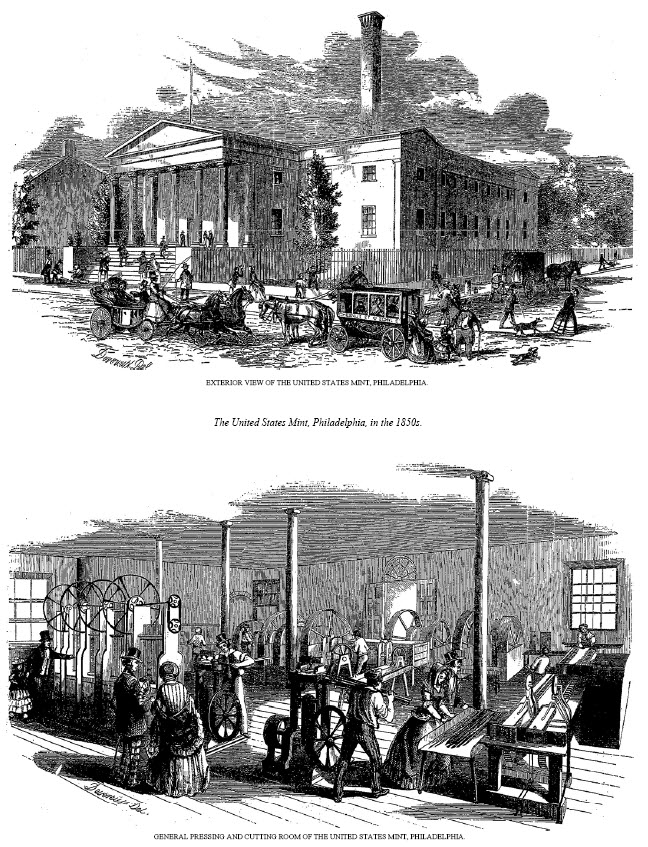
By 1828 the Mint had outgrown its facilities. Congress on March 2, 1829, granted appropriations for a new structure. A section of land on Juniper Street was purchased on April 30th. The cornerstone was laid on July 4th of the same year. Designed by architect William Strickland, the building was of marble and was copied from a Grecian temple near Athens. It was anticipated that the Mint, for which $120,000 had been appropriated, would be ready for occupancy in 1832. With this in mind an advertisement appeared on July 2nd offering the old Mint property for sale to the highest bidder. July 19, 1832 at 8:00 p.m. was set as the sale time. The new Mint was not ready on time, so sale of the old facilities was postponed. Finally on April 8, 1833, the old buildings, not including contents, were auctioned for $10,100. The new facility, finally completed at a cost of $209,230, was occupied in the same year. Equipment used in the original Mint was transferred to the new. Later, in 1856, extensive additional work was performed on the Mint to render it fireproof.
On April 20, 1832, Jacob R. Eckfeldt, son of Adam Eckfeldt, became assayer of the Mint, a position which he subsequently held for over 40 years. Together with William E. DuBois he built the Mint Cabinet, the official coin collection, beginning in 1838. Eckfeldt and DuBois, both numismatists, studied extensively and wrote about various issues.