The History of United States Coinage As Illustrated by the Garrett Collection
Q.David Bowers
Under the same 1873 legislation the half dollar weight was changed to the metric system, 12.5 grams, and the quarter and dime were adjusted proportionally. The intention was to bring the silver coins into harmony with the system used in Europe. Arrowheads were added to each side of the date of the pieces produced in 1873 under the new weight standard. This distinctive feature was continued in 1874, after which it was dropped.
In 1875 a new denomination, the twenty-cent piece, made its appearance. The coin was immediately un-popular, for the public confused it with the quarter dollar of similar size and appearance. In 1878 the denomination was discontinued. The Specie Resumption Act of 1875 provided for the redemption of fractional paper currency by coins. At the time nearly $50 million worth of fractional currency was outstanding. From 1875 to 1879 over $45 million worth of silver coins left the presses. Eventually, all but $15 million worth of fractional currency was redeemed. It is presumed that most of the missing amount was lost or destroyed.
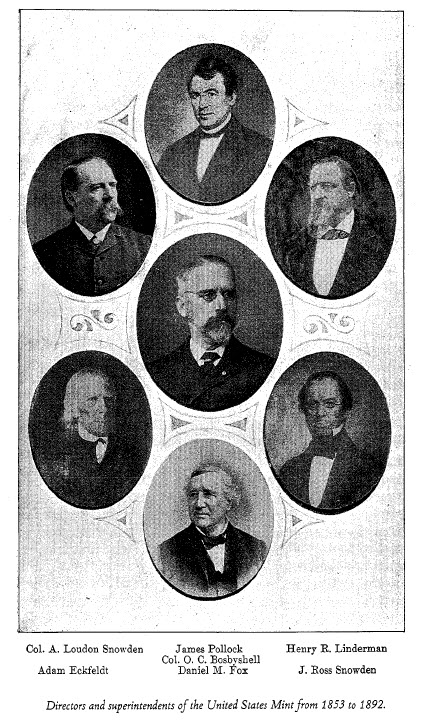
Col. O. C. Bosbyshell became coiner at the Philadelphia Mint on December 15, 1875. He continued this position until 1885 when he resigned. Later, 1889 to 1894, he was superintendent of the Philadelphia Mint. Bosbyshell had the distinction of being the first Union soldier to be wounded during the Civil War, a situation which occurred while he was marching through Baltimore on the way to Washington on April 18, 1861. He was hit on the head by a brick thrown by a Southern sympathizer. He later distinguished himself in the conflict between the states. During Bosbyshell's term as coiner many unusual and interesting patterns were produced at the Mint, a number of which were retained by Bosbyshell for private sale.
In 1876 silver coins appeared in circulation once again. The Liberty seated design, which had not been in circulation since the Civil War, was unfamiliar to many citizens. The press voiced many complaints about the design, calling it "uninteresting and lifeless," among other things. In response, the Philadelphia Mint prepared many pattern coins, some of which were of great beauty. Working on these were the Chief Engraver William Barber and his assistants, Charles Barber, Anthony Paquet, and William H. Key. George T. Morgan, who had been hired in October 1876 as a special engraver, also helped with the situation, often competing with William Barber.
In 1877 pattern half dollars were issued in an unprecedented variety of designs. Made in limited numbers, these were sold privately by Col. O. C. Bosbyshell, the chief coiner, and others. In the same year patterns in copper and gold for a $50 gold piece were issued, the only coin of that denomination to be struck at the Philadelphia Mint. It was intended that the $50 piece be styled after the contemporary double eagle and that it be relatively thin so as to discourage drilling or hollowing out the center, a practice engaged in by certain unscrupulous people. It was subsequently announced that the gold impressions had been melted. Collectors were surprised years later in 1909 when two specimens surfaced (through coin dealers with close connections to the Mint) and were sold to industrialist William H. Woodin for $10,000 each, a record price. A great controversy ensued, and the two pieces were eventually returned to the Mint. Today they repose in the Smithsonian Institution.
The Bland-Allison Act of February 28, 1878, pushed through Congress by western mining interests who were concerned by the falling market price of silver, authorized the secretary of the Treasury to purchase $2 million to $4 million worth of silver each month and to coin it into silver dollars as fast as possible. Faced with the immediate necessity to coin millions of silver dollars, the Mint rushed preparations for a new design. The Liberty seated motif had been discontinued earlier in 1873. Patterns were prepared by George T. Morgan and William Barber. On February 21, 1878, acting with urgency in view of the impending passage of the Bland-Allison Act, Director Linderman selected Morgan's design, but he specified that certain changes be made. On February 28th, the day the legislation passed, Morgan's design was officially adopted.