The History of United States Coinage As Illustrated by the Garrett Collection
Q.David Bowers
On January 11, 1816, Robert Patterson, director of the Mint, wrote to President James Madison:
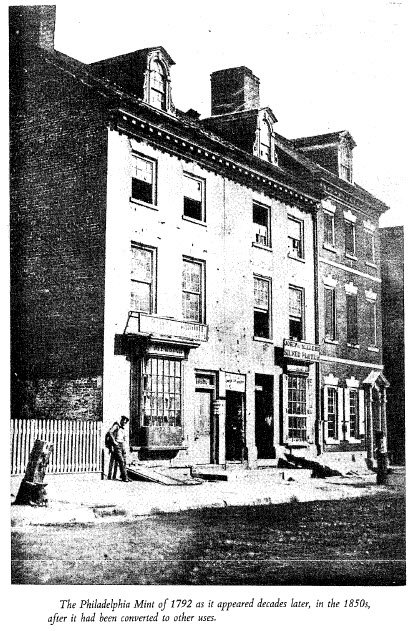
I have the mortification to inform you that this morning, about 2:00, fire broke out in the mill house, a wooden building belonging to the Mint, which was consumed together with an adjoining building containing the rolling and drawing machines, also the melting house. The front part of the building, containing the coining presses, the office, and the assayer's department is uninjured. The manner in which the fire originated is perfectly unaccountable. No fire is ever kept in the part of the building where it was first discovered; nor had any of the workmen been there for some days.
No loss of gold or silver will be sustained of any consequence, nor will a copper coinage be in the least impeded.
I shall not fail to give you necessary information on this subject as soon as an examination can be made, and the damage is ascertained.
Four days later another letter from Patterson to Madison continued on the same subject: On the morning of the eleventh I had the painful task of acquainting you with the destruction of a part of the Mint by fire. At the time its origin was entirely unknown and un-suspected by any of the officers or workmen belonging to the establishment; but on examining a barrel in a neighboring yard partly filled with wood ashes, taken from the hearths of an adjoining dwelling house, and which had been set in actual contact with the weather boarding of our mill house, a wooden building, where the fire was first discovered, no doubt remains that here the fire originated. Several distressing fires in this city and elsewhere, particularly that by which the Lutheran Church on Fourth Street was some years ago consumed, have been ascertained to have proceeded from a similar cause.
As there are not at present, nor are there likely to be for some time, any deposits of bullion in the Mint of any consequence, the public, therefore, will not probably experience any inconvenience from the above disaster until the damages can be repaired; and I am happy to be able to assure you that this can be done, and that on a much improved plan, with out any special appropriation for that purpose, merely from the balance from former appropriations not yet carried to the surplus fund. But, Sir, I would not presume to make these repairs without your approbation.
On March 16, 1816, another letter from Patterson said in part:
... but the repairs which the late fire have now rendered necessary being so considerable, I would not venture to undertake without your approbation, which is therefore, Sir, most respectfully solicited.
No estimate of the expenses or time necessary for these repairs can at present be made with any degree of accuracy; but it is believed that the balances of the last two years' ap-propriation not yet carried to the surplus fund, together with that for the present year, will be more than sufficient; and that the whole may be accomplished in eight or ten months from the time of commencement.
In truth, except the mere building, which was ill-contrived and of little value, no great loss has been sustained by the fire. The principal parts of the machinery were, in fact, nearly worn out, and must have been replaced in a short time though no such accident had occurred.
The only difficulty at present foreseen will be in procuring rollers; two or three pair of which would be wanted. These can, I believe, be best obtained through the agency of Mr. Boulton of Soho, the gentleman who has for many years supplied the Mint with copper; but in answer to a letter which I addressed to him some years ago on the subject of rollers, he informed me that they were among the articles which could not be exported without obtaining permission, from the government. This, however, might probably be effected through the application of our minister at London.
Three pairs of hard cast rollers were subsequently ordered. On July 1, 1817, Patterson wrote again:
The repairs of the Mint, which you were pleased to authorize, are now nearly completed. A substantial brick building has been erected on the site formerly occupied by an old wooden building; and in the apparatus and arrangement of machinery which has been adopted many important improvements have been introduced. Among these is the substitution of a steam engine for the horsepower heretofore employed; a change which it is believed will not only diminish the expense of the establishment, but greatly facilitate all its principal operations.