The History of United States Coinage As Illustrated by the Garrett Collection
Q.David Bowers
President U. S. Grant in 1873 appointed Linderman first director of the Mint Bureau under the new act, the office being in charge of all of the mints and assay offices of the United States. He served in that position until he became ill in the autumn of 1878. He died in January 1879.
Legislation was passed on March 3, 1863, to establish a branch mint in Nevada. It was believed that this would be a convenient place to coin the output of the silver mines nearby in the Comstock Lode. On December 27, 1867, a group of three citizens was appointed to select a site. Abe Curry, a wealthy silver producer, was one of the three and donated a city block for the purpose. A cornerstone was laid on September 18, 1866. On January 8, 1870, the Carson City Mint was opened to receive bullion. Coinage production began the same year and continued until 1885 when on November 6th the facility was closed except for bullion activities. On July 1, 1889, the coinage department was reopened after four years of idleness. Minting commenced on October 1, 1889, and continued until June 1, 1893. After that time the building served as a depository for silver and gold. In 1899 the former Mint received status as an assay office. Volume declined over the years, and operations finally ceased on June 30, 1933. The structure later passed to the state of Nevada and became the location of the Nevada State Museum. Coins struck at Carson City were given a distinctive CC mintmark.
Following the death of James B. Longacre, William Barber, who earlier served as an assistant, was appointed in January 1869 as fifth engraver of the Mint. He served until his death on August 31, 1879.
Born in London, May 2, 1807, Barber learned his trade from his father John. Emigrating to America, Barber followed the engraving trade for about 10 years in Boston. In 1865 he joined the staff of the Mint. Assisting him during his tenure were his son Charles, William H. Key, and George T. Morgan.
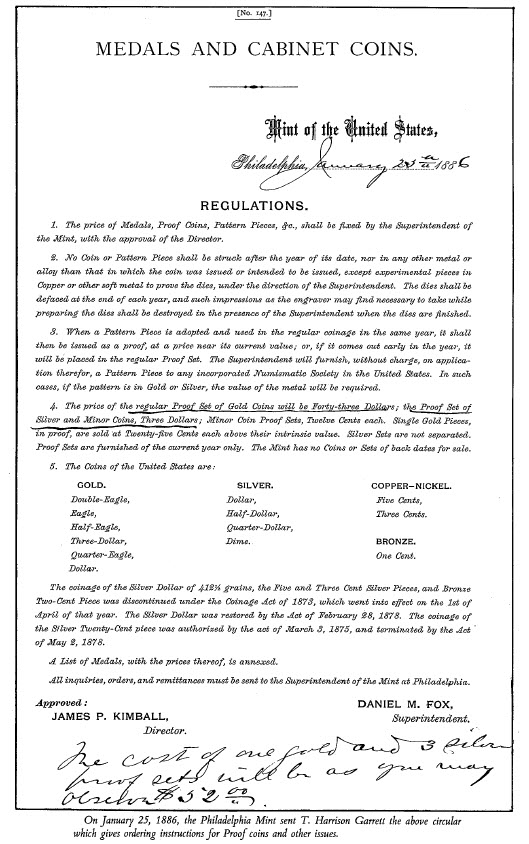
The Mint (or Coinage) Act of 1873, sometimes called the" Crime of '73, " was authored by Dr. Henry Linderman, who became the first Mint official to have his office in Washington. Prior to 1873 the Philadelphia Mint was considered the "mother mint" and the director there supervised all of the branches. The Act of 1873 provided that the Department of the Mint be established as a separate bureau of the Treasury with the director of the Mint located in Washington. The title of the chief officer at Philadelphia was changed to superintendent.
Under the same legislation the bronze two-cent, silver three-cent, and half dime pieces were discontinued. The trade dollar was added to the series. It was expected that the trade dollar, heavier than the silver dollar, would provide more effective competition for the Mexican dollar in the Orient. For the first four years after this Act there were no standard silver dollars made, but 35 million trade dollars were struck. The hoped-for results from the trade dollar, following an initial enthusiastic reception, were not realized. Many of them circulated in the United States later at a discount from face value.