The History of United States Coinage As Illustrated by the Garrett Collection
Q.David Bowers
Subsequent issues of the Philadelphia papers note that admission charges to Ricketts' Circus were $1 for a box seat and 50c for a seat in the pit. Even though Ricketts said he was not going to "particularize" the various entertainments offered by his circus, he deviated from his intention and described, for example, on May 22nd: "Besides the number of new feats, Mr. Ricketts will ride a single horse, standing erect with Two Eggs fastened o the bottom of his feet."
On May 23rd Ricketts stated that, "The first Experiment of natural Philosophy with the Parachute or Falling Screen, that was ever made on the continent of America, will be made by Mr. Planchard."
On Wednesday, June 5, 1793, the same circus featured an exhibition in which a dog, a cat, and a squirrel were put in a basket, equipped with a parachute, affixed to the bottom of a hot air balloon. When the balloon was about a mile high, a burning fuse severed the cord between the basket and the balloon, and the animals were "brought back alive, with great triumph, to the Circus, surrounded by vast crowds of admiring spectators."
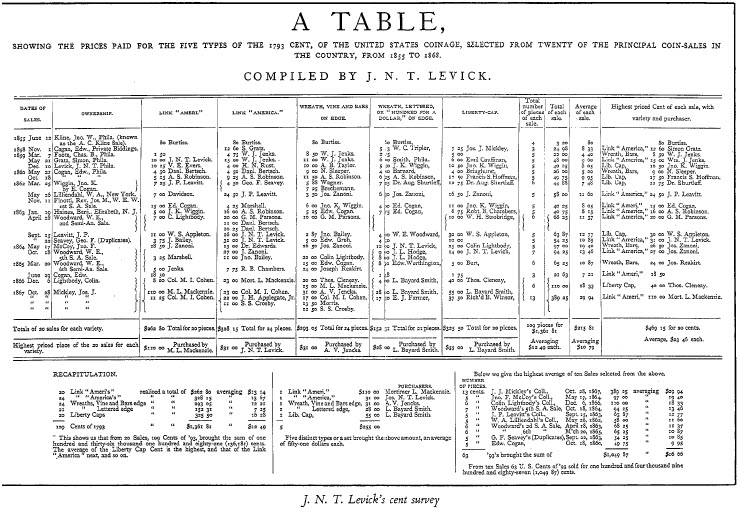
Emphasis was often placed on numismatic history and importance rather than value. There were, to be sure, exceptions. In October 1868 J. N. T. Levick published a price survey of United States large cents dated 1793, as sold in 20 different coin auction sales from 1855 to 1868. He observed that $262.80 had been paid for 20 pieces of chain AMERI coins, or slightly over $13 each, with the highest being $110 paid at the Mickley sale for a single coin by M. 1. Mackenzie. For the same variety, but with AMERICA spelled out in full, $328.15 was paid for 24 pieces ($13.67 each), with the highest being $31 paid by]. N. T. Levick for a specimen in a 1863 sale. Of the wreath cent of 1793, with vine and bars on the edge, 24 pieces were sold at auction for a total of $293.05 (an average of $12.21 per coin), with the highest being $31 for the Joseph J. Mickley Collection specimen. Additional figures were given for the 1793 wreath cent with lettered edge (21 pieces were sold at an average of $7.25 each, with the highest being $28) and the Liberty cap cent of the same date (20 sales were traced for a total of $325.50, or $16.28 average each, with the highest being $55 for the Mickley Collection coin). This study, which appeared in the beginning American Journal of Numismatics, was the first systematic survey of coin price statistics and was the forerunner of hundreds of others which were to make their appearance during succeeding decades.
The collection of J. Colvin Randall, comprising 883 lots, was sold at auction in Philadelphia in October 1868. A total of 883 lots went under the hammer. The prices realized list indicated a total of $1,294.45. Reporting on the sale, Edward Cogan voiced quite a few complaints:
The 1794 dollar brought $42, this piece was not up to the description . . . The quarters presented no feature worthy of remark beyond the fact that five or six of them being described Proofs, without stating that they were considerably injured by circulation ... The dime of 1796 brought $2.12; 1798, $3.75; 1800, $3.25, these were much over-described, as you may suppose from the above prices ... In regard to the cents, I regret to say that many of them were ridiculously over-described, in the earlier days especially. Lot 378 [a 1793 cent], described as a really beautiful coin, Uncirculated, brought the high price of $9.75. For this, you may readily imagine, I had pretty tall bidding [a reference to commissions placed with Cogan by his customers who desired him to represent them at the sale], but could not think of even offering for it, except for my lowest bid, which was $10.10; and I did not even offer anything like the price at which it was knocked down. This piece was very much rubbed, and upon my objecting to its description, I was coolly told that it was Uncirculated for a 1793 cent.
The two first coins in the colonial series, Lots 601 and 6011/2, the Non-Dependens Status and the Immunis Columbia, we were told, were put in by another party (and one well known to collectors), and that they would not be offered unless they were started at $100 each!!! I offered to make an offer on the Non-Dependens Status on condition of the party having the option of returning it if he did not approve of the manner in which the piece had been represented in the catalogue. This proposition was rejected by the parties who got up the sale, as we were told it did not belong to them; but upon the remark being made that they were beautiful pieces, and perfectly Uncirculated, I denied that this observation was correct in regard to the first one, when I was told that it was Uncirculated then for so rare a coin, by a party in whose judgment I have placed more confidence than to suppose he would think it necessary to make anything so like an apology for a piece being misrepresented. The pieces were allowed to be withdrawn ...
I had between sixteen and eighteen hundred dollars worth of orders; but from the manner in which the greatest portion of those I was instructed to bid upon were described, I have not been able to bid upon them, and purchased only to the extent of $400.
Yours faithfully, Edward Cogan.