The History of United States Coinage As Illustrated by the Garrett Collection
Q.David Bowers
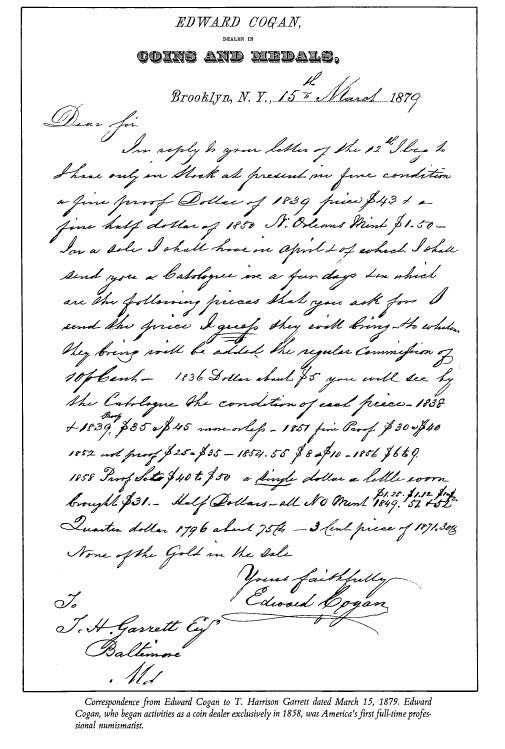
Cogan moved to Brooklyn in 1865 because he felt that the business opportunities were greater than in Philadelphia. Many auction and other catalogues, the high point being the April 1877 sale of the A. S. Jenks Collection, were issued under the Cogan imprint. Collectors and dealers of the time praised Cogan's strict grading and accurate descriptions. Unlike certain of his contemporaries, he declined the use of extravagant superlatives. Following his retirement from business on October 14, 1879, the firm was continued by his son, George, who did not always adhere to his father's strict business principles and ethics.
1858 was the year that Cogan established the first professional coin dealership in America. In the same year the American Numismatic and Archaeological Society (name later shortened to the American Numismatic Society) was formed. Less than a decade later, in May 1866, the first issue of the American Journal of Numismatics, the premier numismatic periodical of the 19th century, made its debut under the aegis of the organization.
In 1858 the Philadelphia Mint offered Proof coins to collectors for the first time. For $3 one could obtain a complete set from the cent to the silver dollar. The term Proof was used publicly for the first time; earlier specially-struck pieces with mirror-like surfaces were referred to as specimen coins or master coins. Only 80 Proof sets were struck in 1858, one ten-thousandth of the Proof set mintage of 100 years later, 1958.
The $2 price commanded by 1856 flying eagle cents, which were the most popular scarce coin of the time, prompted certain individuals at the Philadelphia Mint, possibly including Theodore Eckfeldt (a relative of Adamand Jacob Eckfeldt, a youth who had earlier been discharged for dishonesty but who later secured a position at the Mint as a night watchman) to make restrikes. During the late 1850s and early 1860s it is believed that over 1,500 additional 1856 flying eagle cents were made, all or nearly all in Proof grade. During the next several decades there was much additional tomfoolery at the Mint. Many of these shenanigans are chronicled in Don Taxay's book, United States Mint and Coinage, which described the United States Mint of the period as being a workshop for the private gain of certain employees and officials.
Dr. Montroville W. Dickeson (1812-1882) published his American Numismatic Manual in 1859. This large volume contained much information on coins, their background, and the collecting of them. The work sold well, and subsequent editions were released in the 1860s. The wide circulation of Dickeson's writings did much to stimulate numismatics.
Considerable collector emphasis was put on coins, tokens, and medallic remembrances of George Washington. On February 22, 1860, the Washington Cabinet of Medals was formally opened at the Philadelphia Mint. In 1861, James Ross Snowden, director of the Mint, published The Medallic Memorials of Washington in the Mint of the United States, a compendium of different items represented in the display. Intense interest in Washington pieces was to continue for the next several decades.
W. Elliot Woodward, a pioneer dealer from Roxbury, near Boston, Massachusetts, offered on October 23, 1860 a 36-page listing at auction of 1,222 lots. The coins subsequently realized $240.53. Included were over 100 varieties of American colonial and other early issues. Later, Woodward's auction sales achieved wide recognition in the numismatic fraternity and were regarded as being among the most authoritative published during the late 19th century.
It was the usual practice of Woodward, Cogan, and other dealers to form auction sales by using coins from their own stock, rather than from consignments. Pieces were assembled from a wide variety of sources, including general stock as well as collections purchased intact. There was no secret made of this. Often the American Journal of Numismatics, for example, would report on an auction sale and then comment upon its success by giving the amount for which the dealer had purchased the collection and the total the coins eventually realized at auction. Catalogues were prepared and distributed to interested numismatists, often free of charge. Sales with plates or upon large paper were sold at a premium. The sales themselves were conducted by independent auctioneers such as George A. Leavitt & Co. and Bangs, Merwin & Co. Such firms furnished sale rooms and facilities for viewing the coins. A given auction firm might furnish the arena for a coin sale on Monday and Tuesday of a given week, a sale of books on Wednesday and Thursday, and an auction of fossils and curios on Friday.