The History of United States Coinage As Illustrated by the Garrett Collection
Q.David Bowers
Coins first attracted my attention in 1856. The fever continued possibly for a year and then other subjects engrossed me, doubtless from lack of congenial companionship, for I knew but one collector, and it was he who inspired me. I had not yet learned of a dealer, though Henry Cook of Boston-my native place-was engaged in business at the time. The summit of my joy was reached, and my EI Dorado found at the toll house on the Boston side of the Chelsea Ferry, where I made weekly visits on Saturday afternoons and looked over a box of odd pieces. It was a custom of the tollman to accept anything having the semblance of a coin. If it proved to be something else than a piece of United States mintage it was thrown into this box. But nothing of special importance was ever secured, for my knowledge was limited, and my pocketbook small. My recollections are that Connecticut cents, Hard Times tokens, and an occasional store card composed the bulk of my treasures. It seems worthy of comment that I never found a half cent in any of the claims I prospected. It is certain at that period none were in circulation in Massachusetts. When the Civil War came on I took my collection to a State Street broker and sold it for $5. I have never forgotten my first small accumulation.
During the Civil War more important matters demanded my time, and in the years which followed, until 1878, the subject was dormant. In that year, when I was a commercial traveler, I was sojourning in the West, on the Mississippi River, just below St. Paul. Many foreign copper and silver coins were in circulation in that community, and I soon found myself making a collection of the various kinds I met with. By this means I became acquainted with three collectors in the town, and their hoards were sufficient to rekindle the flame of 20 years previous. My ardor was thoroughly aroused, and the interest I took was intense. I dreamed and talked of coins incessantly. But I soon became rational, and launched into the subject in sober earnest. Almost immediately I began to sell as well as to purchase. The captures, whether of pieces or of customers, were not large or important. In the fall of 1879, after returning to New York from one of my trips, I passed the old store of Bangs & Co. on Broadway, opposite Astor Place, and read the bulletin at the door, "Coin Sale Today." A few brisk steps took me up into the spacious rooms, where the coins of the late Theodore Riley were displayed on those long flannel-covered tables, which some of you perhaps remember. I attended the sale that afternoon, and most of those that followed, whenever I was able to do so.
In 1883 I made dealing in coins my exclusive business, beginning at 838 Broadway. When I offered my collection, numbering some 15,000 pieces, to buyers, it was chiefly composed of copper coins. My career since that time is fairly recorded in the catalogues with my public sales, the first being that of the late Alexander Balmanno of Brooklyn ...
During the Civil War, Low served with Company
B, 13th Massachusetts Volunteers. Following the conflict, he went back to Boston, then in 1870 he went to New York. As noted, he entered numismatics full time in 1883 (by an association with Westermann & Co.). He then went to Scott Stamp & Coin Co., where he served as manager at the 178 Fulton Street outlet. He remained with the firm until 1896. In that year he went into business for himself as a dealer and auctioneer. In 1911 he moved to New Rochelle, New York, where he remained for the rest of his life.
The 1890s-"Mintmarks"
The 1890-1900 decade was initiated bythe sale at auction of the Lorin G. Parmelee Collection. Catalogued by David Proskey and H. P. Smith of the New York Coin & Stamp Co., the sale featured 1,443 lots and was sold in the rooms of Bangs & Co. Proskey, who began his interest in numismatics at an early age, was well known for his deep knowledge. A contemporary described him as being the best informed of the New York dealers. His business associations were several, and included the Scott Stamp & Coin Co., New York Coin & Stamp Co., and his own business. Among the many outstanding coins he handled are numbered pieces from a large hoard of Uncirculated Fugio cents which he offered for sale for $1 each. Presumably these were from the large Bank of New York hoard which was discovered before the Civil War when the bank's old building at 48 Wall Street was demolished.
The Parmelee Collection, sold by Proskey and his partner in 1890, was considered to be the finest cabinet in America. Important among the specimens included were Nova Constellatio patterns in silver, one of two known examples of the Gloucester shilling, a 1787 Brasher doubloon, and the exceedingly rare 1776 Continental dollar in silver.
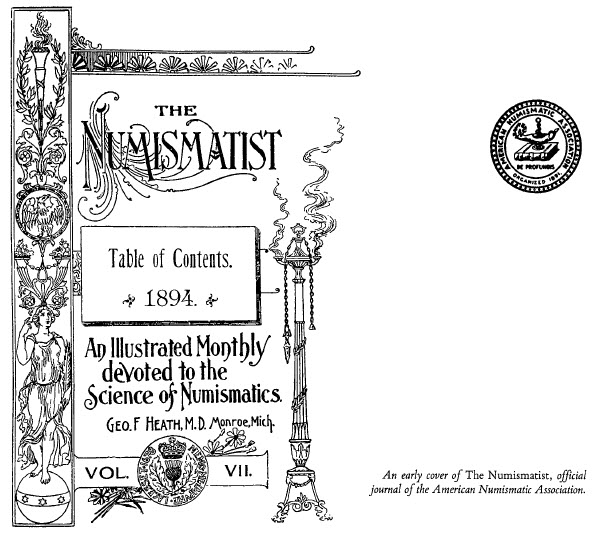
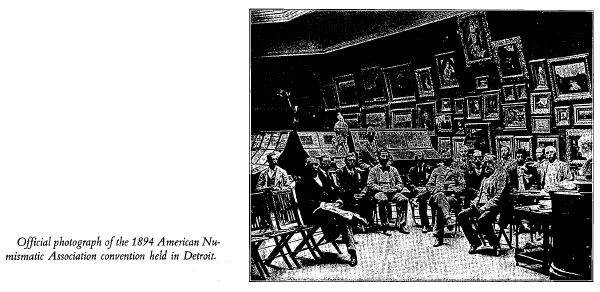
In 1891 the American Numismatic Association was founded. The Numismatist, a periodical established in 1888 by Dr. George F. Heath of Monroe, Michigan, was adopted as the organization's spokesman. Each issue contained news, answers to queries, an article or two, and a section of mail order advertisements.
A landmark in numismatic publishing occurred in 1893 when A Treatise on the Coinage of the United States Branch Mints, by Augustus G. Heaton, appeared. Prior to that time branch mints were a neglected field. Although occasional references appeared concerning them in the American Journal of Numismatics and elsewhere, by and large they were ignored. Collectors were interested only in assembling date sequences of coins. Whether a coin had a mintmark or not seemed to be of little importance. For example, during the early 1870s, when the Carson City Mint was in its formative years, many silver issues were produced in exceedingly limited quantities. Although the affairs of the Carson City Mint were reported from time to time in collectors' publications, apparently no one had the interest or inclination to seek out the early dimes, quarters, half dollars, and other issues produced there. On the other hand, coins of the Philadelphia Mint, particularly pattern issues and Proofs, were eagerly sought and were the subject of many detailed articles and discussions.