The History of United States Coinage As Illustrated by the Garrett Collection
Q.David Bowers
Coin Auction Sales Begin
Coin collecting increased sharply in the 1850s. During that decade several auction sales featuring coins were held. Earlier, coins were occasionally included as parts of estates in other sales, but no important cabinets of United States coins had been dispersed in this country. Sales, when they did occur, were apt to include foreign or ancient coins. For example, the Salem Gazette, published in Massachusetts on June 6, 1828, carried a notice of a sale described as:
Administrator's sale of books, furniture, coins, etc. On Wednesday Next will be sold at Public Auction at the House of Benjamin Watkins, Esq. in Marlborough Street, all the household Furniture of said deceased consisting of Beds, Bedding, Carpets, Table Linen, China, and Glassware ... Sale to commence at 9:00 o'clock a.m. George Nicholls, Auct.
And on Tuesday Next, George Nicholls office, Court Street, will be sold all the books of said deceased comprising about 2,500 volumes; 500 copperplate engravings, 350 Ancient Coins, Pamphlets, newspapers, etc ....
In 1876 the numismatic bibliophile, E. J. Attinelli , wrote of this pioneer 1828 sale, which he believed to be the first coin sale to be held in the United States:
Mr. John H. Nicholls, then a youth of 17, made the catalogue, and as a clerk assisted his father at the sale of the collection, which, he informs me, that he is positive to the best of his recollection did not bring a sum to exceed $1,000. Mr. Nicholls, now a resident of this city, purchased some of the coins for himself and became a numismatist, having a collection of his own at the present time.
Among the United States coins in the Watkins Collection were two Massachusetts NE shillings, two Massachusetts two pence pieces, and a Massachusetts three pence.
On October 28th of the same year Lyman & Co., also of New York, offered a sale of books and related items which contained two lots of coins. One offering, Lot 100, consisted of a "Jefferson medal," and the other offering, Lot 101, comprised "ten old American dollars and two half dollars."
During the same decade several dealers issued price lists. Daniel E. Groux of Boston issued a 16-page catalogue of coins for sale on December 1, 1855. Numerous other price lists, often consisting of but a single sheet, were offered by various individuals and firms. There were no full-time professional numismatists as such. Rather, coins formed a sideline for dealers in books, art objects, antiques, and curios.
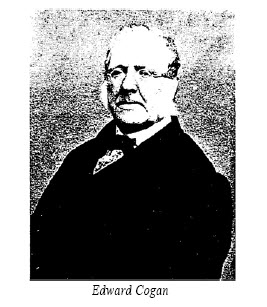
The first professional numismatist in America was Edward Cogan, who began his business in 1858. In Cogan's own words:
Quite late in the year 1856, (I will observe here how curiously the most trifling circumstances will occasionally alter a man's occupation) a friend of mine brought into my store in Philadelphia an electrotype [forgery made by electro-depositation of metal] Washington cent of 1792 and persuaded me to purchase it for twenty-five cents; upon showing it, as a curiosity, to a gentleman he offered me fifty cents for it-and the curiosity was gone-but my friend had told me that a cent of 1815 would be worth at least $5, and that there was a desire springing up for United States cents.
I immediately set about collecting an entire set from 1793 but had not the most distant idea, at that time, of ever making it a matter of business. 1 continued collecting from that time until the latter end of 1858, when finding the demand increasing, and the supply quite equal to it, 1 commenced selling my duplicates and from that period have followed the coin trade almost exclusively as a matter of business.
Cogan believed that the change from the cumbersome old large copper cent to the new flying eagle cent in 1856 and 1857 was the prime factor increasing coin collecting interest in America. When he began business in 1858 he estimated that there were approximately 100 serious collectors in the United States. At the time he came into possession of 135 1856 flying eagle cents which he suspected originated with a person employed at the Mint. 1856 flying eagle cents became an item of commercial traffic, and by the end of the decade pieces were bringing $2 each.
On November 1, 1858, Cogan had a mail bid sale.
This was described in a two-page leaflet as well as in several newspapers. Offered were 77 lots which 19 successful mail bidders acquired for a total of $128.63. Cogan observed that a notice of it:
. . . was published gratuitously by three of the principal journals in Philadelphia and was copied by several newspapers in most of the Northern and some few of the Southern states. At this time I had not more than one or two correspondents outside of the city of Philadelphia, where I was residing at the time. Within a few weeks, however, from the publication of the sale, I was receiving from 10 to 15 letters daily, some asking what I would give-and others-by far the greater number, what I would charge for certain coins; and for some year or two I had as much business as I could possibly attend to; and from that time up to the present moment I have followed the coin trade almost exclusively as a business. I have, therefore, always considered the publication of the prices these cents obtained, as a more immediate cause of the great demand there has been for coins, more or less, for the past seven or eight years.