The History of United States Coinage As Illustrated by the Garrett Collection
Q.David Bowers
Betts then provided a list of a dozen fabrications, including the aforementioned Novum Belgium piece and a fantasy shilling with Five United Colonies of New England, a pine tree, and the date 1643. "There may have been others, but these are all that come to mind which were made without the usual tools," Betts continued, and then he noted further:
Unfortunately someone about 1862 presented me with a set of letters and several engraving tools, and in learning the use of them I made a great number of store cards and medallets, most of which are unique, and all, I think, in the Yale College Collection.
The earlier ones I look upon with some interest because they used to afford me a great deal of amusement, not only in the making, but in the astonishment of collectors when looking over my cabinet.
The collection of the late Dr. Henry Linderman was scheduled to be sold at auction on Tuesday, June 28, 1887, by Lyman H. Low. Before its scheduled sale, the government intervened and it was withdrawn. Linderman, who had supervised operations at the Philadelphia Mint, used his position to enrich his personal holdings, not to mention his pocketbook. Following the withdrawal of numerous pieces which were seized by the government, the Linderman Collection Was offered for sale again, this time by Scott Stamp & Coin Co. on February 28, 1888. The preface to the Scott catalogue read:
After mature consideration of all the questions of law and equity involved in the sale of trial and experimental pieces formerly classed as "pattern" pieces made at the United States Mint, the government has allowed us to sell the celebrated Linderman Collection. The decision of the govern-ment can be summed up as follows:
"The sale of experimental pieces made in 1888 or thereafter, and unless in the metal in which the coins were issued for circulation, is prohibited." The latter portion of the decision is retroactive and covers the period prior to 1888, as well as that subsequent to it.
Under this decision we have been constrained to withdraw the following lots from the Linderman Collection: 55, 76, 90, 96, 116, 117, 126, 127, 128, 162, 163, 171, and to reduce the number of pieces in the following lots: 80, 135, 136. With the above-named exceptions the catalogue is an exact reprint of the catalogue prepared by the late firm of Lyman H. Low & Co. in June 1887 ...
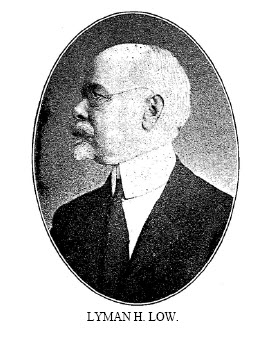
Lyman H. Low, one of the most prominent dealers beginning in the 1880s, held 211 auction sales during his numismatic career, the final one being on December 1, 1923. He served as an editor of the American Journal of Numismatics for 15 years. In addition he produced a number of monographs and articles, the best known of which is his work on Hard Times tokens. Low died at his home at 28 Clinton Place, New Rochelle, New York, on February 10, 1924, at the age of 79. His wife, the former Miss Ella Mordaunt Peshine, had died five years previously. Earlier, Low gave an account of his life in coins:
*******************************************************
An 1895 Tour Among the Coin Dealers
In January 1895 the readers of The Numismatist were treated to an interesting article, "A Tour Among the Coin Dealers," by Augustus G. Heaton, a frequent contributor to The Numismatist and the person who had several years earlier advanced the interest in collecting mintmarks of United States coins by publishing a monograph on the subject. Heaton noted that the average member of the American Numismatic Association did not have the opportunity to visit dealers in person but was only able to deal by mail. His article, he stated, "will not only give greater confidence to distrustful or hesitating buyers and their efforts to improve their collection, but will equally benefit all sellers whose integrity and responsibility is evinced in insuing transactions."
The "tour" began in New York City:
"The Scott Stamp and Coin Company has become a conspicuous location on Madison Square, one of the handsomest centers of the metropolis. The stamp department occupies the large and deep first floor of the building and many clerks are employed. The coin department is in a basement floor nearly level with the pavement. Near the show window two or three young ladies are behind a counter, busy at desks, or showing any desired part of the coin stock of several large fireproofs [safes] to the customers. Many coin publications are on the counter. Far in the rear, in a skylit office and numismatic library, is found Mr. Lyman H. Low, the manager. He is a scrupulously attired gentleman in middle life, with white hair, mustache and goatee, a military aspect, but with a brisk genial manner. He is a member of the American Numismatic and Archaeological Society of New York, one of the editors of the American Journal of Numismatics, and a man of great experience in the science and of sagacity in business.
"The New York Stamp and Coin Company is located in a spacious room on the second floor of a large building on Union Square. Its manager is D. [David] Proskey, still a young man but one of the best numismatic judges of coins in the trade and very just in valuation. He employs a clerk or two. The room contains a large stock of coins and stamps as well as minerals, curiosities, etc. Mr. H. P. Smith, wealthy collector and a shrewd numismatist, is the capitalist of the business and has brought several of the largest American collections into the market. He is often at the room and at sales and his friendly advice is of great value.
"Not far away along 14th Street is found a well known expert, Mr. Ed. Frossard, who, though of French origin, has an Anglo-Saxon stability of temperament. He is a rather large middle aged man of smooth shaven, pleasant face. He has merely a desk and small fireproof in the office of an insurance company and carries little stock, but generally has some choice pieces to show and often more or less of some collection entrusted to him to be catalogued and sold. He issues at intervals a sheet entitled Numisma and has a wide correspondence regarding coins, curios, and objects of historic interest.