The History of United States Coinage As Illustrated by the Garrett Collection
Q.David Bowers
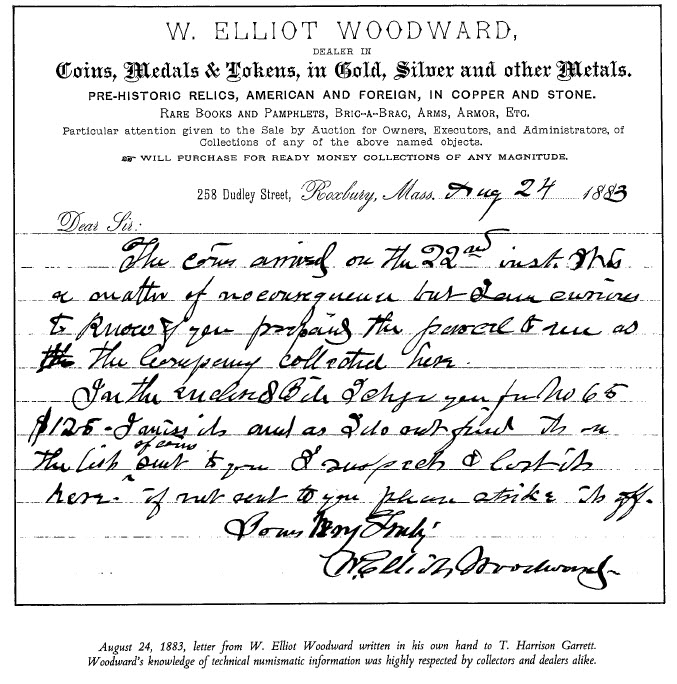
1867 was a busy year for W. Elliot Woodward, the Roxbury, Massachusetts dealer. For an undisclosed price variously estimated from $12,000 to $16,000 he purchased the remainder of Joseph J. Mickley's collection. Mickley's holdings were described as being "virtually complete in United States copper, silver, and gold series, lacking only a few pieces." During the same year Woodward, a man of many interests, reported the purchase for $410 of the Gov. Eustis estate, which included a large building with a grand hall and many rooms, one of which had been designated as the "Lafayette Chamber," in honor of Lafayette's stay there. Woodward announced that he would personally attend to the restoration of the historic structure.
Woodward described the Mickley Collection in a 196-page catalogue comprising 3,349 lots, including additions from his own stock. There was wide interest in the offerings, due to the high quality of the pieces as well as Mickley's numismatic prominence, and numerous record prices were established. Included was the realization of $750 for an 1804 silver dollar which was purchased by William A. Lilliendahl, who earlier had sold his collection at auction and who was now assembling another. Throughout numismatic history, 19th as well as 20th centuries, many collectors would build an illustrious holding in a particular series, sell it by auction or other means, and then set about forming still another collection, perhaps in a different series or with a different emphasis. So it was with Mickley, who, following the sale of his coins, acquired a strong iron safe made by Herringand began collecting anew.
The Mickley sale had its entertaining aspects as evidenced by the contradictory descriptions of Lots 2175 and 2176. The first, 2175, was described as:
Pattern three-cent piece, a circular piece of metal stamped III; believed to be the ugliest of all known coins, and certainly one of the rarest. In designing this, and the following, the artists of the Mint almost outdid themselves.
Then followed Woodward's description of Lot 2176:
Pattern cent of the same design as last, and equally beautiful. William E. DuBois, curator of the Mint Cabinet, was always ready to clarify numismatic items pertaining to activities at the Mint, particularly those which happened since his tenure there. Concerning the Woodward description he wrote:
I have great respect for Mr. Woodward's intelligence, but in this case he has not been equal to himself. Those two pieces are neither coins nor patterns, in any proper sense; mere planchets. As to the designing of them, the writer [DuBois] must take that credit to himself; the "artists of the Mint" did nothing but make the III and the 3, as requested. It was at a juncture when a three-cent piece was talked of; two mixtures of base silver were made, and these pieces were hastily struck, simply to show what the size would be. I should think that anybody might see that at a glance; and that the numismatic value of these ... is not over three cents.
Among coins produced at the United States Mint, the 1804 silver dollar was one of the main topics of discussion whenever numismatists gathered. Its rarity, origin, and value were debated intensely, spurred, no doubt, by the record realization of $750 of the Mickley piece at auction, the highest price attributed to a United States coin up to that time. Many letters to the American Journal of Numismatics were in relation to this piece.
While coins of the regular United States series were collectedby date sequence (but with no attention paid to mintmarks), greater interest was directed toward medals, tokens, and other pieces with interesting histories. For example, in June 1868 the American Journal of Numismatics devoted nearly a page to the discussion of a rare early token issued by Ricketts' Circus in Philadelphia:
Weare acquainted with only four of these curious and interesting pieces. Mr. Bushnell, in whose immense collection are generally found duplicates, triplicates, and quadruplicates of anything that is choice and difficult to obtain, possesses but one, in copper; while Mr. Levick, our coeditor, has not only one in copper, purchased for $6 at Mr. Mickley's sale, also two in silver, one of which was bought for $7.50 on the same occasion. These prices are in accordance with the excessive rarity of this token ...
An interesting advertisement describing Ricketts' Circus appeared in the Philadelphia Mail, April 22, 1793, and stated:
CIRCUS. Mr. Ricketts respectively informs Ladies and Gentlemen of Philadelphia, that at 5:00, this afternoon today, his equestrian exercises will commence as usual. The President of the United States and Family will honor the Circus with their company. For the future, Mr. Ricketts will not particularize the exercises which he means to perform, being resolved always to exert his best abilities in rendering satisfaction to the generous and enlightened citizens of Philadelphia, whose liberal encouragement ... he acknowledges with gratitude-and the continuance of whose patronage he will constantly endeavor to deserve. Mr. Ricketts attends at the Circus every morning from 6 to 8, for the purpose of instructing Gentlemen, and from 8 to 11 he will attend such Ladies as mean to perfect themselves in the plight and elegant accomplishment of riding and managing their horses . . .