The History of United States Coinage As Illustrated by the Garrett Collection
Q.David Bowers
There was no standard listing of coins available to the collector in 1875. Only by scanning a numismatic publication or reading general interest books (such as those published by Dickeson and Snowden) could the numismatist learn in what years different denominations were struck. In 1875 William S. Appleton, a well-known collector, began a serial listing in the' American Journal of Numismatics describing different coinage from 1793 onward. Virtually no attention was paid to branch mint issues, so they were not deemed important enough to be included by Appleton. Most collectors were interested only in different dates of coins.
Sylvest or S. Crosby's publication in 1875 of his monumental work, The Early Coins of America, elicited' praise throughout the numismatic field. The American Journal of Numismatics said in part:
There is much that may be said in commendation of this elegant volume. The typographic execution ... is very handsome. The paper, which is slightly tinted, is of excellent quality. The wood cuts are accurate, and the heliotype [a method of photographically illustrating coins] familiarizes numerous pieces, known only to many by descriptions. But the merit that overtops all others to which it may rightly lay claim is its reliability, this, for a historical work, is indeed all-important ... The author is to be congratulated that it is now completed and that he has succeeded so well ... It is not likely to receive or to require any corrections other than those which the light that subsequent discoveries may throw upon the subject, show to be needed. The numismatist especially must hereafter regard it as an authority not to be questioned when brought into conflict with previous essays, excepting upon evidence of the most satisfactory character.
The Crosby reference stood the test of time well, and a century later it was still the standard reference book on the subject of colonial and early American coinage.
The same year, 1875, the outstanding collection formed by Col. M. I. Cohen, of Baltimore, Maryland, was catalogued by Edward Cogan and sold at auction by Bangs, Merwin & Co. The event featured ancient issues, coins of the world, and many United States pieces, including great rarities. The total realization was $9,744 for 2,400 lots.
The Centennial Exhibition was the main event in America in 1876. Spread over 236 acres in a Philadelphia park, the buildings and related construction cost $10 million. Dr. Henry R. Linderman, director of the Mint, declined to set up a display at the Exhibition but, instead, invited visitors' to Philadelphia to call at the Mint:
... between the hours of 9:00 and 12:00 a.m. The United States Mint Cabinet numbers at present 6,443 pieces, of which the total number of United States mintages is 813; the number of colonials is 712; the number of Washington medals 244; and of other medals 635; the balance of the collection consisting of fine Greek, Roman, and foreign gold, silver, and copper coins.
Linderman went on to say that:
The rarest American coins at the Mint are a Brasher Doubloon in gold, the 1785 Immune Columbia cent in gold [acquired from Matthew A. Stickney in 1843 in exchange for an 1804 silver dollar], and the 1804 silver dollar.
While no special coins were produced for the Centennial Exhibition, several varieties of Mint medals were made as were dozens of private tokens and other pieces. At the fair itself J. W. Scott & Co., the well known stamp and coin dealer, had a sales exhibit which attracted wide interest.
Eager to record the Centennial numismatic medals and tokens for posterity, the American Journal of Numismatics began a serial listing of different emissions in its January 1876 issue. The author was H. W. Holland. One popular set of medals was "struck" by squeezing black walnut wood which had been steamed until it was in a: semi-pulpy condition. George H. Lovett, a diesinker of New York City, announced the issuance of a series of eight Centennial medals commemorating the battles of 1776. The obverse of each portrayed the head of Washington, while the reverse listed the name and date of each conflict. The set was available in white metal for $2, bronze $4, or silver $14.
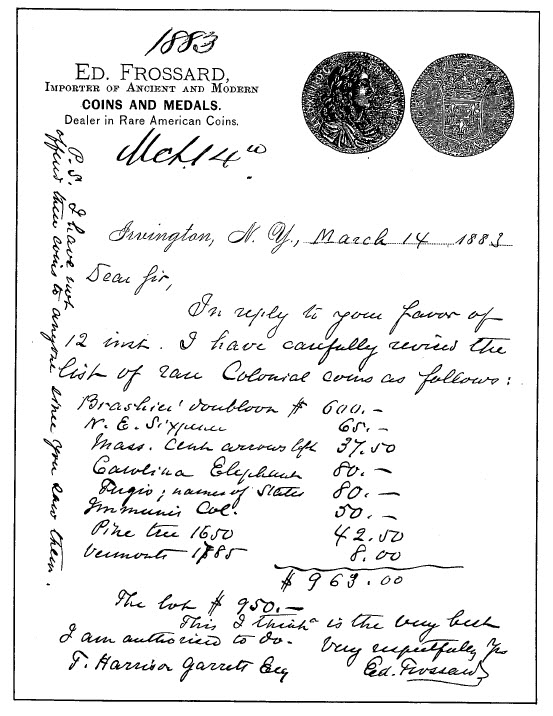
Invoice and letter from Ed. Frossard to T. Harrison Garrett, March 14, 1883. Offered are a number of important rarities including a 1787 gold doubloon by Ephraim Brasher of New York City, a 1652 NE sixpence struck by the Massachusetts Bay Colony, a 1787 Massachusetts copper cent with transposed arrows, a 1694 Carolina Elephant token, a 1787 pattern Fugio copper cent, an Immunis Columbia copper, what is probably a 1652 pine tree shilling of Massachusetts (some imitation pieces dated 1650, as per the invoice, did cause confusion among numismatists of the period, but it is unlikely that Ed. Frossard would have been thus deceived; undoubtedly the date is a typographical error), and a 1785 Vermont copper piece.