The History of United States Coinage As Illustrated by the Garrett Collection
Q.David Bowers
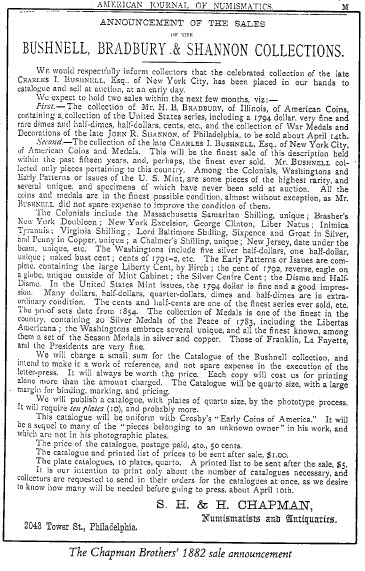
With much ambition and a flair for showmanship, they soon incurred the jealousy of Frossard, Woodward, and other dealers, most of whom were quick to point out the slightest deficiency in a Chapman publication. The Bushnell Collection afforded the opportunity for a large white-covered hardbound catalogue with gold lettering on the cover. A special limited edition with twelve pictorial plates was sold for $5, whereas the regular catalogues were offered for $1 apiece. Filled with lengthy descriptions, flowery adjectives, and details designed to entice the buyer, the Chapman catalogue was criticized by the Coin Collector's Journal, the American Journal of Numismatics, Numisma, and others. Comments appearing in the American Journal of Numismatics in the July and October 1882 issues are humorous when read today, but must have been very embarrassing to the Chapmans at the time. Excerpts:
The sale of the late Charles 1. Bushnell's collection is going on in New York, as we are printing the last pages of the Journal ... In the next number we shall have a full notice of it. The catalogue, prepared by the Messrs. Chapman, is a quarto, 136 pages, 3,000 lots. We have had little time for studying it, but must confess to a certain disappointment at its contents ... This feeling is quite general. Some exception may be properly taken to the expression of "opinion" so freely volunteered by the compilers, both as to the value of the pieces offered and on numismatic points of interest which must be taken with a grain of salt, and to their neglect to give credit to what others have done, but we must regard this as an oversight or an error of judgment ... A few funny typographical errors have crept in, but the wonder is, in all these catalogues, that no more appear. We notice (in the description of Lot 368) that Harvard has moved down to New Haven ... A tare Washington piece (Lot 1301) is mentioned as "unknown to Marvin," whereas on page 296 of Marvin's work he expressly refers to the identical piece as probably being in the Bushnell Collection. Of Lot 247 it is said that but three are known. This is doubtless an error; three times that number could readily be traced. The remark under Lot 920 seems to us to be in very questionable taste, to say no more. If they had read ALL that Crosby says, they would not have said what they have. Lot 2117 locates Salem, the home of witchcraft, in New Jersey!
Ed. Frossard, writing in his house organ, Numisma, was very acidic.
Except where it could not be avoided, the names of every American authority on coins and medals have carefully been excluded. Statements founded on the expressed and published opinions of others are uttered as if no one had ever before given the subject a thought. See, for instance, the remarks under Lot 247 about the Virginia halfpence. Who discovered these varieties of halfpence? And, who has repeatedly offered them for sale, singly and in sets, was it J. W. Haseltine? Would not the mention of his name have been a slight tribute of respect to him who first led the Chapmans into numismatic byways? This feature may be thought politic, but would it not have been more generous or less selfish to have granted something to others? The Revolutionary Peace Medals, for instance, are generally catalogued according to Mr. Appleton's list, who wrote something worth knowing about Washington medals; the names of Woodward and others are likewise studiously omitted when references to their catalogues are made; this of course is more than selfish, it is simply uncourteous. Messrs. Chapman apparently prefer to leave the collectors in the dark rather than to commit themselves so far as to mention a single name ... While 50c is only a fair price for this large and handsomely printed catalogue, $5 is too much by half for the illustrated one. There is but one opinion among collectors on this point. Phototype plates are obtained at very low prices; they are not as costly, handsome, or perfect as the best specimens of the heliotype, and were there 20 instead of 12, $5 would still be a preposterous price for a coin sale catalogue. The former ridiculous pretensions of the compilers to the effect that the catalogue would form a sequel to Crosby's masterly work, The Early Coins of America, also fall to the ground ...
Once the sale took place, Frossard attacked it again:
A plain and correct catalogue would have reflected honor on its compilers, but the Chapman brothers apparently exhausted themselves on the plates and the mechanical part of the work, unconscious of the fact that a proper use of English terms, and intelligible construction, also general accuracy in statements made, are of greater importance in a work of this kind than thick paper, new type, and gilt letters. Careless proofreading, tautology, and exhibition of boastful egotism can be overlooked; hazardous, overdrawn, incorrect statements of history, rarity, and condition, cannot; the latter, rather than the former, are the chief defects of the catalogue, but all combining, help make the Bushnell sale catalogue, as published, unworthy of the collection it is supposed to describe ...
Frossard then devoted a full page of Numisma to criticism of lot descriptions on a coin-by-coin basis. To be sure, Frossard had some good things to say about the sale as well, but overall the review was quite scathing.