The History of United States Coinage As Illustrated by the Garrett Collection
Q.David Bowers
The same year, 1881, Frank D. Andrews released a 54-page monograph, A Description of 268 Varieties of United States Cents, 1816-1857, in the Collection of Frank D. Andrews. Issues were described in minute detail. The edition of Andrews' book was limited to 40 copies, many of which were distributed among his friends. Remaining copies could be obtained for 25c each. The American Journal of Numismatics declared that the work was "of absolute necessity to collectors of American copper coins." The same publication noted that the Andrews book was much more scholarly than one published on the same subject by Ed. Frossard, A Monograph of United States Cents and Half Cents. Frossard's work was characterized as sloppy and incomplete, whereas Andrews' was noted as being quite precise and definite.
Auction activity continued its strength in 1881. The January 1882 issue of the American Journal of Numismatics reported on sales of the last quarter of 1881, including Scott's sale on October 10; Woodward's 41st sale on October 25; Woodward's 42nd sale, featuring the John E. Burton Collection, on October 26-28; Woodward's 43rd sale on October 31-November 2; Frossard's 17th sale on December 8; Frossard's 18th sale on December 27; Scott's sale on December 19; Haseltine's sale on November 28-30, which featured a detailed "Type Table" of silver coins; Haseltine's sale of December 12-13 featuring the Louis Grauer Collection; a sale held on December 17 in Boston by a deputy sheriff, coins sold to satisfy creditor's claims; Charles Steigerwalt's 3rd sale, held on December 22; and a sale in London. W. Elliot Woodward reported that he was suffering from a "sad misfortune;" he was called for jury service and expected that some of his future sales previously announced would be delayed.
At the time it was a common practice for a commission of 5% to 10% to be charged to the buyer in auction sales. Occasionally reductions were given, as in the March 13, 1882 sale of John W. Scott's personal collection, catalogued by Scott & Co., and sold at the sale rooms of George A. Leavitt and Co. The catalogue said:
In consideration of there being scarcely any lots in the catalogue worth less than $2 our commissions will be reduced to 5% for purchasing of this sale. On amounts over $500, 2 1/2% and on $1,000 or over 1%.
The proliferation of studying coins by new die varieties was the subject of criticism by William S. Appleton in the January 1882 issue of the American Journal of Numismatics. His article, entitled "Numismatics Run Mad," stated:
We can think of no better words [Numismatics Run Mad] to apply to such a pamphlet as the "Haseltine Type Table Catalogue," the contents of which were sold at auction on November 28-30, 1881. The only parts which concern us here are the United States regular coinage; 163 lots of silver dollars, 408 half dollars, 149 quarter dollars. In connection with these, the words "variety" and "varieties" are so used as to make it evident that Mr. Haseltine considers every die, however slightly made different from another, of which it was intended to be an exact reproduction, as constituting a variety. He finds, for instance, thirty dollars of 1798, twenty-three of 1799, thirty-two halves of 1795, etc. In two cases, lots 769 and 776, each as a separate number to a half dollar already described, because part of the profile is double, probably by slipping of the die or planchet; 147 and 149 are so numbered as two varieties, because the die cracked in use; but this is probably an oversight, as in other cases he does not give two numbers to such ... we are far from saying it is not worthwhile to describe all differing dies, but we must protest against the use of' 'variety" as applied to such.
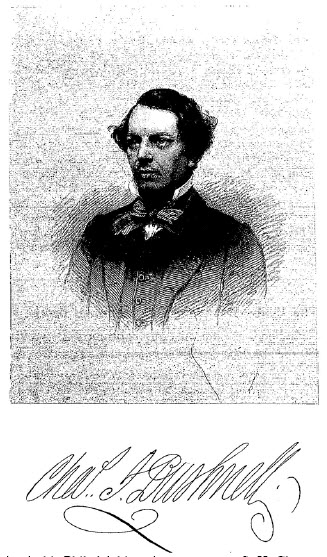
On June 20-24, 1882, the collection of Charles I.
Bushnell was sold at auction. Bushnell, prominent New York attorney, had died at the age of 70 on September 17, 1880. Earlier, particularly in the 1850s, he was an avid collector and researcher in the field of coins, particularly tokens, medals, and other issues apart from the regular mint series.
Following Bushnell's death, the collection was offered intact by his son at $10,000. The highest offer received was from Lorin G. Parmelee, a well-known Boston collector, who purchased it for about $8,000. Parmelee selected the Chapman Brothers, S. H. and Henry, who earlier staged their first auction sale in 1879, to conduct the event, possibly because of their relationship as nephews of Bushnell.
Samuel Hudson Chapman was born on July 15, 1857, in Philadelphia, the son of two Irish immigrants. His younger brother Henry was born in the same city on October 18, 1859. In 1875, Henry Chapman, just 16 years old, was employed by Capt. John W. Haseltine in his Philadelphia coin stamp store. S. H. Chapman worked in the same dealership. In 1878 they started a business on their own under the name of S. H. & H. Chapman, familiarly known as the Chapman brothers.