The History of United States Coinage As Illustrated by the Garrett Collection
Q.David Bowers
William S. Appleton, who earlier prepared a listing of dates of various United States denominations, presented a survey of New Orleans Mint issues in July 1876, assisted by William E. DuBois. "It may not be absolutely perfect, but it is thought to be very nearly so," Appleton stated. "If omissions are to be found, I hope to be informed of them. I believe the same facts cannot be read elsewhere." The listing did include some errors (such as the 1861-O silver dollar which does not exist) and omissions (such as the 1838-0 half dollar), but it did form a beginning. Still, the average collector did not care about mintmark varieties.
Auction activity continued strong. On June 12-17, 1876, a collection which was formerly the property of J. Carson Brevoort, of Brooklyn, and more recently the property of Lorin G. Parmelee, of Boston, was sold at auction by Leavitt & Co. Prepared by William H. Strobridge, the catalogue comprised nearly 3,000 lots. It was Parmelee's practice to purchase a collection intact, remove the pieces wanted, and sell the remainder at auction. Or, sometimes Parmelee would auction a collection which contained pieces he wanted, and then bid on the pieces he desired, sometimes through an agent, until he acquired them, no matter what the cost would be. The price really made no difference as he owned the coins.
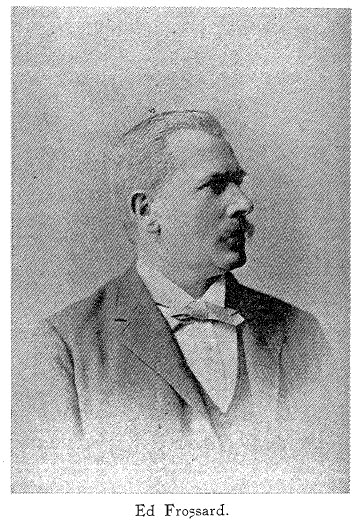
More publications began to appear. In December 1875 The Coin Collector's Journal, published by J. W. Scott & Co. and edited by Ed. (for Edouard) Frossard, made its debut. Two years later Frossard was to initiate his own publication, Numisma, a fiery and irreverent journal, spiced with many opinions, which continued in print until 1885. Frossard's ever-watchful eye was often focused on the machinations of the Philadelphia Mint and dealers privileged to do business with it, on his competitors'auction catalogues and other offerings, and on the numismatic scene in general. He found room in his schedule to prepare many auction catalogues during the same period. By the time of his death in 1899 he had conducted 160 sales.
In the December 1877 Numisma Ed. Frossard eagerly reported a startling new discovery in the field of American colonial issues. The obverse of the piece depicted the Earl's Crown and the legend PETER MINVIT. The reverse showed a triangular shield with a slightly curving border, and a beaver in a field of rippling waters, with the legend NOVUM BELGIUM 1623. Frossard described the piece as relating to New Netherland and stated that:
Frossard printed a letter from Wilson Defendorf, a collector who had owned the piece for some time, and who stated to Frossard that "You deserve all the credit there may be attached in making this coin known to the people of the United States."
By March 1878 Frossard had learned,much to his chagrin, that the "Novum Belgium" piece was not a rare early colonial coin but, rather, had been fabricated as an idle curiosity by C. Wyllys Betts, a young New Haven, Connecticut collector. Frossard's colleagues, remembering well the many barbs he had directed against their catalogues and other efforts, never let him forget this glaring blunder. When Frossard would make an authoritative comment which offended a competitor, they would remind him of his "expertise" concerning the colonial forgery.
Around the same time numismatists were delighted with another bit of news concerning colonial pieces, this one real. In October 1876 a group of 16 pinetree shillings, coined in Massachusetts and bearing the date 1652, were found when sand was being unloaded. These were apparently in a box which had decayed. The sand was sifted, and 14 additional specimens, each as bright as the day of mintage, according to contemporary reports, came to light.
Auctions continued to make numismatic headlines.
In the absence of regularly-issued priced catalogues, auction sales together with lists of prices realized formed the early-day equivalent of today's Guide Book of United States Coins. To keep abreast of the market, the collector of the late 1870s was encouraged to subscribe to as many auction catalogues as possible and take note of the realizations. The Coin Collector's Journal, published by Scott, gave a view in 1877 of a typical coin auction sale:
Let us look in on one of these sales and see how it is conducted. The auction room, we shall suppose, is that of the well-known New York firm of Bangs & Co. on Broadway. The room is long and narrow, with the clerks' desks at the Broadway end, and a partition about five or six feet high running nearly the whole length of the room. Beyond this partition, on a raised platform, sits the persuasive auctioneer. During the forenoon of the day of sale, the coins are on view, and each piece enclosed in an envelope numbered so as to correspond with the catalogue, is lying orderly on a long table. Intending purchasers are busy inspecting the coins, carefully examining the pieces, one by one, and having compared them with the descriptions in the catalogue, mark down in their book the prices they are willing to pay. A couple of hours is consumed in this examination, so that it is now, perhaps, near the usual hour of the sale. An attendant replaces every coin in its envelope, and carries the whole collection inside the partition, no more to be seen or handled except by the purchaser after the sale. Chairs are next placed in front of the partition, and these are gradually taken possession of by the parties interested.