The History of United States Coinage As Illustrated by the Garrett Collection
Q.David Bowers
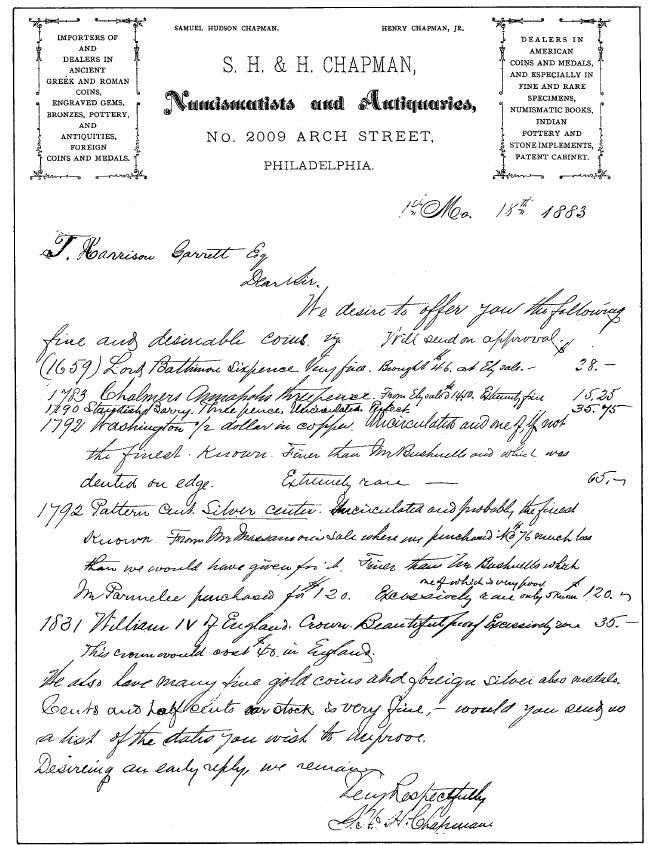
This January 18, 1883 letter, from S. H. & H. Chapman offers T. Harrison Garrett several important rarities. Quotations and offerings from the Chapman Brothers, which were very frequent during this period, usually were quite detailed and often gave comparative price and rarity information.
The problem of private sales from the Mint continued. Early in 1879 the American Journal of Numismatics reported that the patterns of the preceding year, 1878:
... were all distributed amongst members of Congress and friends of Mint officials, and were refused to societies [of collectors]. The whole business of Mint patterns has been very singularly managed and, to some extent, is so still. It has been estimated that in 1859 and 1860 $50,000 worth of patterns were struck and disposed of at the Mint, without any benefits of the government at whose expense they were coined. Copies were not even put in the government collection of its own coins, which is inferior, except in Washington medals and pieces, to the most ordinary collections, while the officials, in whose charge it is, take no pains to fill its numerous gaps. During Mr. Lincoln's administration these abuses stopped, but of late years they have begun again. For example, numerous pattern dollars. struck between 1869 and 1874 have since then turned up and passed into the hands of collectors, none of which appear in the government collection or were distributed in a lawful manner to the numismatic societies, while favored individuals collected at a trifling expense sets which were sold at large sums. Over $100 apiece has been paid for some of these mysterious pieces. We did notice in a late catalogue a medal described as a rarity which will no doubt bring a good price. The dies for it were made within two years at the government Mint, by the Mint workmen, with the Mint machinery, but none of the medals are in the government collection (or were as of a short time ago), and none have appeared in the Mint sale-list or for distribution in numismatic societies. All this seems to show that laws for the distribution of government favors are one thing, and their enforcement quite another.
The 1880s-Decade of the Chapman Brothers
The flood of coin auctions continued. In January 1880 the American Journal of Numismatics reported that:
The number of coin sales is unabated; indeed it is rather on the increase, and we might fill several pages of the Journal with notices of the various collections which have been recently offered, but must confine our remarks to a simple reference to the different sales and most interesting pieces ...
Our readers will doubtless have noticed the large number of coin sales which have been chronicled in the Journal for the year just closed. It far exceeds that of any other year in our history and must be encouraging to the dealers. We hear of several others in preparation. Mr. Woodward, Mr. Harzfeld, and Mr. Frossard are all hard at work preparing catalogues.
So crowded was the auction calendar that the same publication noted after describing ten sales that:
We should be glad to allude to other recent sales, that of the Messrs. Chapman, which contains some very choice pieces, Mr. Woodward's sale of the Gertz, Peeker, and other collections, Mr. Harzfeld's Philadelphia sale, and others announced, but the crowded state of our pages forbids us to do so in the present number.
A few months later numismatists were delighted when an aged resident of Sag Harbor, New York, began spending 1,500 Uncirculated half dollars he had set aside years earlier in 1836 when they were first minted. These were saved at the advent of the Panic of 1837 and had been hoarded since that time. The appearance of such a large number of bright new coins in circulation caused much attention and was the subject of a newspaper article.
In April 1881 another half dollar story made the rounds when it was reported that: A gentleman in Meriden, Connecticut, known as a persistent coin collector, has recently come in possession of a lot of half dollars, from the first year of their mintage down to 1838. A large proportion of these half dollars are uncirculated-that is, just as they came from the Mint press. There is a curious story connected with these coins. During the war, a man living in Georgia had saved from year to year a great number of half dollars. He seemed to have obtained them directly from the Mint. Alarmed by rebel incursions, and equally afraid of a visit from Union soldiers, he made them up into several parcels, placed them in iron boxes, and buried the boxes in the ground. Some four years ago he died. Just previous to his death he revealed to his heirs where the money was buried, and they readily found part of the treasure, but it was only after a long search that the whole was discovered. There were originally several thousand of these half dollars.