Walter Breen's Encyclopedia of Early United States Cents
Walter Breen
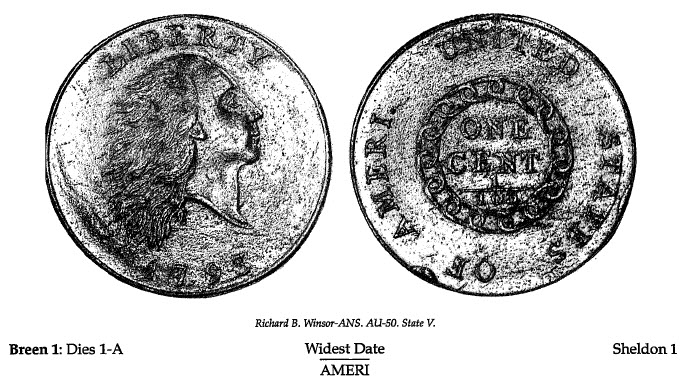
Obverse 1. Widest date of the type. Spacing between 7 and 9 is noticeably greater than the width of the 9. Below the bust point and parallel to it is a field mark (probably a die scratch) which may represent a false start. This obverse is always weaker than on variety 2, most of all at the date. See Die states.
Reverse A. AMERI. Left end of the fraction bar points to M. ONE is closely spaced and E of CENT is slightly high.
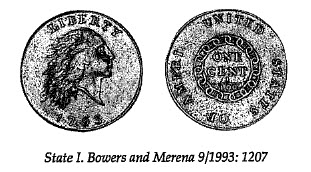
Die states: I. Perfect. Obverse is always weak, especially at the date; this may mean that the dies were set minutely too far apart (as though to strike thicker blanks) and in vertical (axial) misalignment so that their faces were not quite in parallel planes. All seen to date have a shallow wedge-shaped bulge extending through the 1 of the date upward to the left into the curls. This does not advance noticeably.
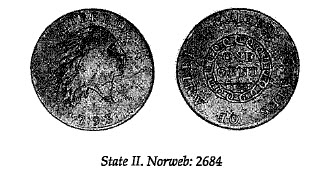
II. Crescent-shaped bulge develops, concave downward, through the 1 in date. Nearly midway between 7 and 9 is a minute chip with a tiny cluster of fainter chips right of the base of 7. No evidence of clashed dies. Reverse is bulged between u and the rim.
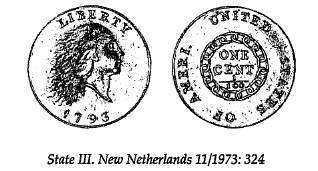
III. Faint clash marks from the chain show below the bust truncation. The date becomes weaker.
IV. Heavier double clash marks appear on the obverse, from the chain.
V. Cracked through the tops of TATE.
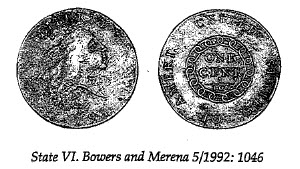
VI. Heavy rim break covers the tops of TAT. McGirk 1G. Very rare. The discovery coin for this die state is in the ANS, from the W. H. Schmidt collection, donated prior to 1913.
Equivalents: Crosby-Levick 1A. Frossard 1.1 (1, first reverse). Proskey 1. Doughty 1. Crosby I-A. McGirk 1A, 1G. Sheldon 1. EAC 1. Encyclopedia 1632.
Low Rarity 4.
Remarks: Some have speculated that the abbreviated legend was deliberate symbolism, after the style of the Masonic Unfinished Pyramid on the reverse of the Great Seal (copied on the current one dollar bills). Others insist that it represented a layout problem: adding the final CA would have made this word end too close to UNITED.
Quantitative analysis of current rarity ratings suggests that approximately 6,350 were struck. The actual number may have been higher and the survival proportion lower; these wore down rapidly and many survivors are identifiable only from part of the reverse. On the other hand, that at least 16 survive in grades of Extremely Fine and above suggests that the general public retrieved examples from circulation to save as the first of their kind, even as with the 1793 Wreaths, 1794 half dimes, 1796 dimes and quarters, 1794 dollars, and 1795 half eagles.
Discoverer is uncertain: possibly Mickley. Perhaps Cogan in 1858 or Dickeson before 1859.
C. Douglas Smith reported an obverse brockage many years ago. This is now unlocated. See "Oops!" chapter.