Walter Breen's Encyclopedia of Early United States Cents
Walter Breen
Predictably, scrap copper varied greatly in homogeneity, density, malleability, and hardness. This is partly from different trace elements and partly from the way the individual lumps had been treated in manufacture. This was a most unsatisfactory expedient; the coiner's department (Voigt) learned quickly that different ingots cast from it varied greatly, with far too many gas bubbles. Strip rolled from these ingots (and therefore also, in turn, the planchets cut from it) came out with too many cavities (pit marks) and laminations (flakes, cracks, and splits). Many surviving Chain cents accordingly show such flaws, collectively termed "planchet defects." These do not automatically detract from a coin's grade or desirability, but some are unsightly, and they could have attracted criticism, becoming one of many excuses for attacks by those politicians who wanted to abolish the Mint and negotiate with British token makers for contract coinage. For more on this issue see the introductory historical material on 1794, below. (R. W. Julian, in a letter to the editor dated July 26, 1994, notes that "it is quite possible, and even likely, that some of the copper imported from England was of the correct thickness for simply punching out the blanks. It may also have been necessary to roll it down slightly. Once used, of course, it had to be melted and rolled over again.")
Chain cents may have been ceremonially struck on Washington's birthday, Friday, February 22. (Julian, "Cent Coinage of 1793," p. 64.) Eight deliveries for circulation followed. (Julian, "The Beginning of Coinage-1793," Numismatic Scrapbook Magazine, May 1963, p. 1359.)
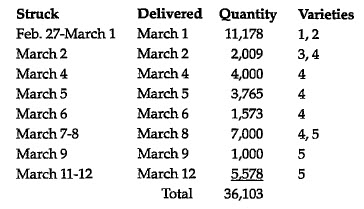
Coinage halted for lack of blanks, though more copper was on hand to be melted, rolled, and cut. Over 40,000 additional blanks were ready by March 31, though by this time the Wreath type dies were in production. (Julian, "Cent Coinage of 1793," p. 66.)
Quantitative rarity ratings indicate that slightlymore than 1,000 Chain cents survive of all kinds, or about 2.8% of the original mintage. (Survival proportions vary with later designs and dates).
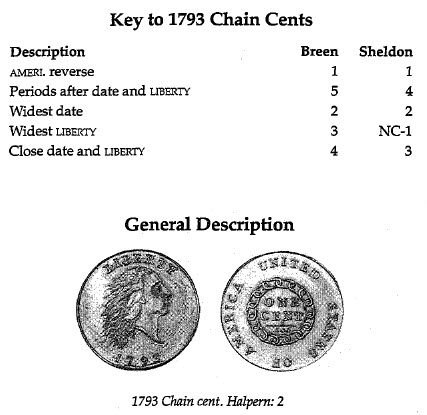
Obverse: Liberty's head is facing right with a low, receding forehead, windblown hair, and a short, pointed neckline. This device was drawn by hand directly on the die blanks, not sunk from a punch. LIBERTY above and 1793 below are each from individual punches. The border is a plain raised lip, without ornamentation.
Reverse: An endless chain of 15 links was entered by repeated use of a single link punch. Within, ONE / CENT / 1/100. Around, beginning at about 11:00, UNITED STATES OF AMERICA (the first die abbreviates it as AMERI). All letters and numerals were individually punched. The border is the same as on the obverse.
Edge: Vine and bars. Genuine specimens with plain edge are mint errors with all reported to date listed. (Beware of casts and electrotype copies).
Diameter: Variable; the blank cutter used was normally one that produced a 17/16 inch diameter (27.0 millimeters) planchet, but different specimens range from 25 to 28+ millimeters. These may possibly represent use of blankcutters for one inch and 35/32 inch (25.4 and 27.8 millimeters, respectively). Part of the variance comes from different forces of the press: without a close collar, stronger blows (or additional ones) spread a planchet wider. The blank used for the presentation specimen of variety 5, "The Coin," was apparently deliberately broader than normal although the exact diameter is unrecorded.
Weight standard: 208 grains (13.48 grams). Observed range, 200-221 grains (12.96-14.32 grams).
Planchet stock: Rolled from local scrap copper or punched from ingots, as discussed above.