Walter Breen's Encyclopedia of Early United States Cents
Walter Breen
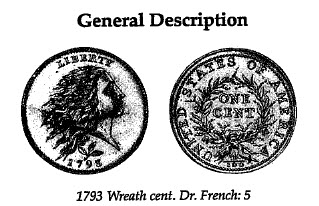
Obverse: Liberty head faces right, in higher relief than on the obverses of the Chain type. Her hair is in detached pointed locks with the lowest three especially long and divergent. A tiny double curl fills the angle between the lowest lock and neckline. All seven heads used on different dies of this design were apparently drawn by hand following a Single sketch. LIBERTY and date are from individual punches: on the first obverse, they are large as on the Chain cents, thereafter small. A taller 7 later replaced the short punch. Between the date and bust there is a sprig of leaves, so different on each obverse die as to enable instant recognition. Within a raised rim, narrower than the blunt lip rim on previous obverses, there is a border of round beads, probably imparted by a twin punch. (Craig Sholley, August 1, 1996 letter to the editor, notes: "There is no evidence that the Mint used 'twin' or 'double dentil' punches in sinking the border details .... There is no example of a coin, in any series, showing double punching of the dentils [except for a single example of our 1793 number 8 with an extra bead on the obverse] which would indicate a twin punch. The Mint had another method of sinking the border details; this being a punching machine. The purchase of such is documented in the Mint records-see Stewart, page 174, warrant for July 20, 1793.")
Reverse: Wreath of two composite branches bearing lanceolate leaves (for olive or laurel?) and trefoils (for cotton?), with linear, or forked, rows of berries (Crosby calls them "axillary racemes"). At their crossing, a thick ribbon is tied, forming asingle bow. One trefoil within each branch, below or opposite C T; other trefoils outside, that on the right branch opposite the inner trefoil, that on the left varying in position (in one die omitted and in another, duplicated). ONE CENT IS within the wreath with the statutory legend around, and the fraction 1/100 below the knot. Raised rim and beaded border, as on the obverse.
Edge: Vine and bars, as before. The last variety comes also, occasionally; with edge lettered ONE HUNDRED FOR A DOLLAR and two leaf clusters; more often only one leaf cluster follows DOLLAR, this latter edge device continuing into early 1794.
Diameter: 17/16 (27.0 millimeters); range 26 to 28.5 millimeters, as in the Chain design, and with the same explanation.
Weight standard: As before. Observed range, about 200 to 216 grains (12.96 to 14.00 grams).
Planchet stock: Rolled from scrap copper.
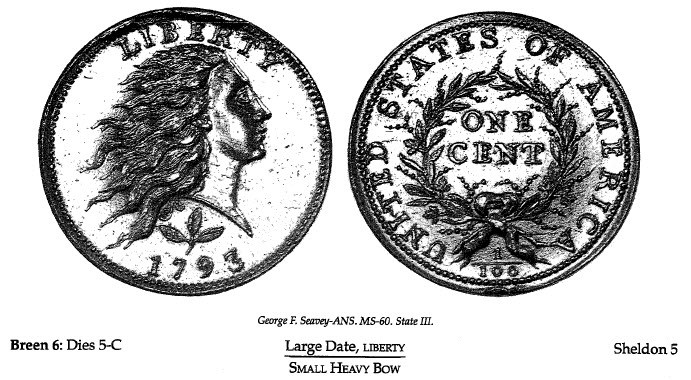
Obverse 5. Large LIBERTY and large date. Leaves above the date are well formed and well spaced. The date wears down faster than other details.
Reverse C. Smallest, heaviest bow with thick ribbons, ending close to the border. Three trefoils on each branch with two opposite N, one at D, and a cluster of three nearest RIC. Legend and denominator are very close to the border beads. Die chips between the tops of TED and at OF A.
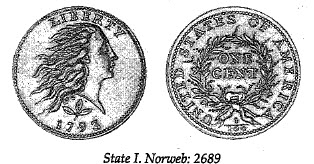
Die states: I. Imperfection at beading right of Y. Tiny bulge at IT. Faint bulge between FA. Minute splinter out of the die below space between EN, often hardly visible.
II. Rim crumbling over u and over BER.
III. The rim crumbling has developed into a rim break joining ER which is extremely rare. John Wright first described this. (Wright, "The Design Cud," p. 215.)
Equivalents: Crosby-Levick 4C. Frossard 4. Proskey 7. Doughty 7. Crosby 6-F. McGirk 2C. Sheldon 5. EAC 6. Encyclopedia 1637.
Low Rarity 4.
Remarks: Discoverer uncertain: possibly Mickley, Dickeson, Crosby, or Levick.
Variety 6 formed about one-third of the 12,000 struck Apri1 4-9 and delivered April 9, 1793, possibly 4,000 to 4,500.