Walter Breen's Encyclopedia of Early United States Cents
Walter Breen
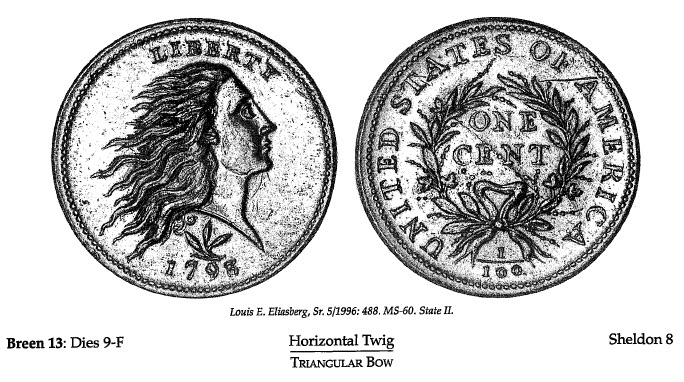
Obverse 9.
Reverse F. Triangular bow, which is concave at the top. Stem ends lie along the ribbons. Two outer trefoils on the left branch are opposite the first two TS. The fraction bar is long and curved. Tops of A-ES are above adjacent TS.
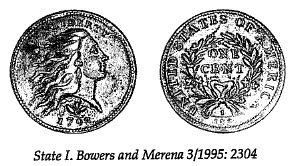
Die states: I. Obverse as on the preceding, state VIII.
Reverse without any cracks. Bulge slants down to the right through the wreath, just missing O(N), through the center dot, crossing EN, and to the right bow. Very rare.
II. Obverse with a faint ridge from the brow slanting down through the field before nose. In the date, 93 are increasingly defective due to die crumbling or possibly foreign matter in the die. Reverse with a bisecting crack along the bulge within the wreath from (S)T through the center dot, gradually extending (at first faintly) to (s)T and final A.
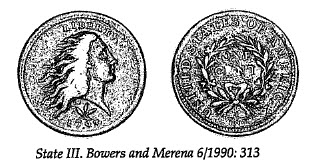
III. Light cracks from the hair through JBE. The ridge and earlier cracks are heavier. Light cracks from the rim to the top serifs of B and R. Additional clash marks from the wreath. The reverse bisecting crack is heavier. Faint central bulge, which becomes increasingly pronounced.
Equivalents: Crosby-Levick 7E; Frossard 6 and 7.1; Proskey 11. Doughty 10. Crosby 9-G. McGirk 2F. Sheldon 8. EAC 13. Encyclopedia 1641.
Low Rarity 3.
Remarks: At least one has been seen with a plain edge.
A uniface example (reverse) was offered as lot 4465 in the 1977 ANA sale. See "Oops!" chapter.
Some were probably struck April 19 although most were likely the 8,000 of June 27-28. This reverse has affinities with reverse B of the 1793 half cents, and may have been made about the same time.
I vaguely recall seeing one with a lettered edge advertised by Celina Coin Co. about 1945 or 1946. (Editor's note: The Celina Coin Company advertisement was somewhat confusing. I believe that this lettered edge specimen did not exist. Poor advertising layout may have been the culprit.) The discoverer is most likely Edouard Frossard, if this is the coin he was alluding to in his notation "Beside No.9 (our numbers 16b,16c), other varieties of this type have been found with the edge inscribed ONE HUNDRED, etc., and others, but very rarely, with the edge plain." (Ed. Frossard, Monograph of United States Cents and Half Cents, Irvington, NY: the author, 1879, p. 10.)
Condition Census:
MS-63 Robert Leslie • Peter Mougey • William H Woodin • Thomas L. Elder #43, 9/1910: 5 $90 • Dr. George P. French, privately • Howard R. Newcomb • J. C. Morgenthau & Co. #458, 2/1945: 8 $310 • Floyd T. Starr • Stack's 6/1984: 13 $38,500 • R. E. Naftzger, Jr., 2/ 23/1992. Eric Streiner • Jay Parrino (The Mint). State!I. Obverse and reverse illustrated in Noyes.
MS-60 With a line-like planchet defect on the reverse. Henry Chapman • Henry Chapman 6/1909: 730 $57.50 • S. H. Chapman • George H Earle, Jr. • Henry Chapman 6/1912:3360$52 • John H. Clapp, 2/6/1942. Louis E. Eliasberg, Sr. • Bowers and Merena 5/1996: 488 $27,500 • Spectrum Numismatics. State II.
AU-55 Charles I. Bushnell • Lorin G. Parmelee • S. H.& H. Chapman 6/1882: 2609 $55 • S. H. & H. Chapman • S. H. & H. Chapman 3/1883: 289 $76 • George W. Cogan • T. Harrison Garrett • Robert Garrett, 1919 • John Work Garrett • Johns Hopkins University • Bowers and Ruddy Galleries 11/1979: 54 $24,000 • Stanley Kesselman • R. E. Naftzger, Jr., 12/11/1986 • Herman Halpern • Stack's 3/1988: 9 $29,700 • Ed Milas (Rare Coin Company of America) • Silvana DiGenova (Tangible Investments of America) • Superior Galleries 1/1989: 3087 $31,900 • Martin Paul (The Rarities Group) • Bowers and Merena 3/1991: 131 $28,600 • Martin Paul (The Rarities Group). State II.