Walter Breen's Encyclopedia of Early United States Cents
Walter Breen
MS-61 Richard B. Winsor • S. H. & H. Chapman 121 1895: 825 $110 • S. H. & H. Chapman • George H. Earle, Jr. • Henry Chapman 6/1912: 3359 $160 • Henry Chapman • Col. James W. Ellsworth, 3/1923 • Wayte Raymond, 4/1923 • George H. Clapp • ANS. State II.
MS-60 A. Kosoff (Numismatic Gallery), privately 10/23/1947. R. E. Naftzger, Jr. • New Netherlands Coin Co. 11/1973: 327 $6,500 • First Coinvestors • Pine Tree Auction Co. 2/1975: 591 $6,600 • First Coinvestors • Dr. Robert J. Shalowitz • Ed Hipps (Ed's Coin & Stamp Shop) • Joel D. Rettew Rare Coin Galleries. State IV.
AU-55 Herman Halpem. Stack's 3/1988: 7 $19,800 • R.E. Naftzger, Jr. • Early American Coppers 4/1989: 14 $29,000 • Dr. Robert J. Shalowitz • Brigandi Coin Co.
AU-55 With a plain edge. Owned by Carl Wurtzbach prior to 1928.
AU-50 C. David Pierce • Hollinbeck Stamp and Coin Co. #16, 11/1944: 1835 $410 • Hollinbeck Stamp and Coin Co. FPL, 1945: 7 $450.
EF-45 Dr. William H. Sheldon • Del Bland • Julian Leidman.
EF-45 Hollinbeck Kagin Coin Co. • 1964 ANA (Federal Brand Enterprises): 33 $1,200.
EF-40 H. O. Granberg • William H. Woodin • The United States Coin Co. 5/1915: 68 $75 • Henry C. Hines • Dr. William H. Sheldon, 1955 • Dorothy Paschal • unknown • American Auction Association 5/1973: 128 $4,000.
EF-40 Sharpness of AU-55 but burnished. C. A. Watters • Glendining & Co., Ltd. (London) 6/1917: 271 • unknown • Dr. William H. Sheldon • T. James Clarke, 10/1954 • R. E. Naftzger, Jr. • A. Kosoff 4/1956: 7 $1,200 • Dorothy Nelson • Stack's 2/1976: 5 $3,600 • Joseph Kuehnert • Auction '79 (Superior Stamp & Coin Co.): 1513 $14,500 • unknown • Superior Galleries 6/1981: 29 $17,500 • Dennis Irving Long • Bowers and Merena 1/1990: 15 $7,920 • Silvano DiGenova (Tangible Investments of America).
EF-40 Howard R. Newcomb • J. C. Morgenthau & Co. #458, 2/1945: 6 $110.
EF-40 Sharpness of AU-50 but edge dents. Stack's 1/1987: 836 $5,500.
EF-40 Charles J. Dupont • Stack's 9/1954: 8 $175. EF-40 Peter Mougey • William H. Woodin • Thomas L.Elder #43, 9/1910: 4 $50 • Lyman H. Low • Allison W. Jackman • Henry Chapman 6/1918: 688 $95 • Elmer S. Sears. George H. Hall • Stack's 5/1945: 171 $175.
EF-40 Auction '86 (Rare Coin Company of America): 503 $5,280 • Walter Dudgeon • Early Copper Auction #11, 1/1994: 131 $14,000 • Alan Weinberg.
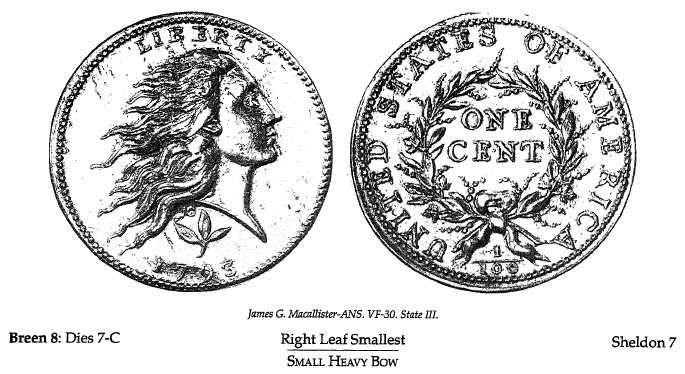
Obverse 7. Widest small date with short 7. Wide LIBERTY with u close. Small R with straight tail. Two leaves of the sprig lean left while the third is smaller and much narrower.
Reverse C.
Die states. I. Obverse with an extra dot above I from the same punch as the border beads, touching I and the border. Discovered by Dr. Charles L. Ruby. See Remarks.
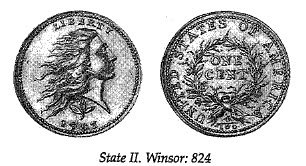
II. The extra dot no longer shows. No die failure at the date.
III. Die failure in an arc through 179, although faint at first.
IV. Break from the rim, vertically to loop of 9, then through the upper part of shaft and crossbar of 7, just below the arc failure, which eventually becomes so heavy that 9_3 can hardly be made out.
V. Crack from the rim above R through the base of T to the forelock. Extremely rare. 1)
Robinson S. Brown, Jr. (1986), lot 9. 2) Reported.
Equivalents: Crosby 8-F. McGirk 2E. Sheldon 7. EAC 8. Encyclopedia 1638.
Low Rarity 6.
Remarks: Discovered by Sylvester S. Crosby in 1878. The discovery coin was very worn, and is not now identified; nor is the second one Crosby found (also very worn). Both came from a lot of low-grade 1793s found in Philadelphia. The cataloguer of Starr/lot 12 quoted Henry Chapman's conjecture that this specimen was one of the two. Henry Phelps found the third one; the fourth was the Winsor, Hall coin plated in Crosby.
Variety 8 probably formed a small minority of the 6,112 struck April 10-13 and delivered April 13, most likely under 700 in all, the die failure at lower obverse apparently accounting for its rarity.
The extra dot of state I is the first hard evidence that the engraver used a twin punch to make the border beads. Apparently, he inadvertently rotated the twin punch before giving it a Single hammer blow. The tiny hollow in the die probably became filled with foreign matter so that later states no longer showed the dot. This is more probable than the alternate explanation, which would have required extensive reworking; head, border, and letters do not differ enough on the Dr. Charles L. Ruby coin from later die states to admit the latter. (Craig Sholley notes "I disagree that this is evidence of a twin dentil punch. This extra dot can just as easily be accounted for by the punching machine slipping or being initially mis-adjusted." Communication to the editor, September 9, 1996.)