Walter Breen's Encyclopedia of Early United States Cents
Walter Breen
1793
Wreath Design
(63,353)
The new wreath design was Director David Rittenhouse's answer to the newspaper criticisms mentioned at variety 5.
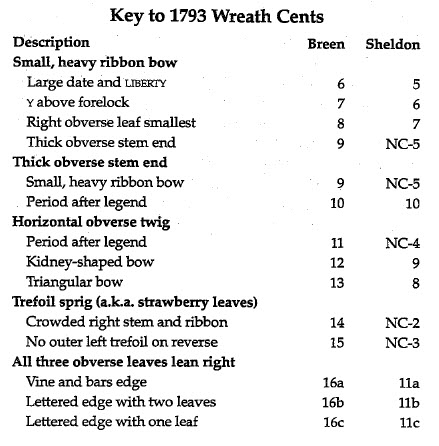
Unlike any other United States coins, these show a leafy sprig between the head and date; unlike any other coins except the Voigt and Birch cents of 1792 and the half cents of 1793, they have linear, or forked, spikes of berries.
Which plant(s) the wreaths depicted has been controversial for over a century. Most likely, Rittenhouse furnished a sketch representing a composite wreath: the trefoils represented cotton leaves while the berries or florets remain unidentified (possibly corn tassels); the lanceolate leaves are less like olive than laurel. (See also, Half Cent Encyclopedia, p. 30.) If Rittenhouse did intend to depict laurel, the most likely species is bay laurel or laurel of Apollo, laurus nobilis, native to the Greek islands and Italy, but brought to the Atlantic Coast colonies in the 1600s. In folklore, this plant was linked with victory and peace; in superstition, it was a charm against lightning striking any place where it grew or was hung or strewn. Ancient Greeks used it to make wreaths for crowning victors in town games. Rittenhouse doubtless knew this and would have favored the symbolism as relevant at once to the American victory in the Revolutionary War, and to the triumph of the Mint over its detractors.
The actual diesinker is uncertain. It was not Voigt as the style is too different from the Chains. Neither Joseph Wright nor Robert Scot had yet been hired. This leaves only two likely candidates: Birch (Editor's note: The specific identity of Birch has not been located. We are referring here to the same Birch whose name appears on the 1792 coins known as the "Birch Cents" To date, contemporary records have not been located confirming the identity of Birch.) and Adam Eckfeldt.
In favor of Eckfeldt is the close kinship between these reverses and those of the half cents of 1793, which Eckfeldt claimed as his own work," In favor of Birch is the kinship between the seven cent reverses and that of the Birch and Voigt cents of 1792. Most likely, both men worked on these dies, with Eckfeldt afterwards basining, polishing, and hardening them. (R. W. Julian notes that Voigt "almost certainly did the Wreath dies but may have been given a small amount of help by Eckfeldt. The quality is not up to the Wright level and Birch was not a competent engraver. Eckfeldt was definitely not the engraver because if he had been this skilled, the half cent planchets would not have waited for some weeks to be coined and, most importantly, Eckfeldtwould have been given the engraver's post. Instead, he did contract work for the mint until January 1796 when he was appointed assistant coiner at a salary of only $600 as compared to $1500 for the engraver. The difference of $900 was a large sum of money in those days and young Eckfeldt was hardly wealthy.")
Coinage began April 4, using blanks produced during the last few days of March from the remainder of the scrap copper bought March 1 through 6; these ran out April 19, halting coinage. Other copper purchases followed: (Table after Julian, "The Beginning of Coinage-1793," Numismatic Scrapbook Magazine, May 1963, p. 1363.)
| Date | Pounds | Source |
|---|---|---|
| April 4 | 59lb 8oz. | Mary Jones |
| May 16 | 11,294 | Watson & Greenleaf |
| June 25 | 346 | John Murphy |
| June 29 | 45lb 8oz. | Henry Voigt |
| August 1 | 2,434 | Ferdinand Gourdon |
The May 16 shipment consisted of 58 pigs (crude ingot castings) reshipped from New York to Philadelphia on the sloop Hope (under Captain Webb). Its arrival time shows that it must have served for the Lettered Edges. The Gourdon purchase was called "wrought copper," more costly than scrap. The August 1 acquisition date indicates that it may have been used in part for making half cent blanks, but mostly it served for Liberty Caps and the earliest 1794s. The other purchases were scrap copper.
On inception of the design, April 4, the coiner struck a few prooflike specimens (presentation pieces) on brilliantly polished blanks. (Walter Breen's Encyclopedia of United States and Colonial Proof Coins, 1722-1989, New Revised and Corrected Edition, Wolfeboro, NH: Bowers and Merena Galleries, Inc., 1989, p. 30.)
The first obverse die began, almost at once, to chip and crumble at the rims. Later dies buckled quickly, a problem originating in incomplete hardening, for which Eckfeldt found no solution until 1795.
Only the first obverse die continued the large LIBERTY and date as on the Chain type, however, the larger head produced a crowded effect. (Many collectors feel this is the most aesthetically pleasing obverse.) This doubtless explains why Jacob Bay had to make new smaller letter and numeral punches.
Between April 9 and July 17, 1793, Voigt delivered 63,353 cents in nine batches, as follows: (Table partly after Julian, "Beginning of Coinage-1793," p. 1359.)
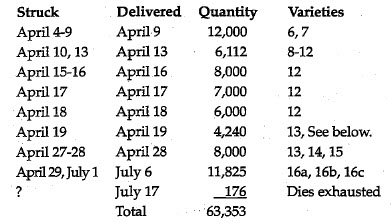
The interruption on April 19, according to Julian, came about because the Mint's primitive rolling mills had broken down, as often occurred from 1793-1815. (Reliable rolling mills had to await the major overhaul following a fire which destroyed the Mint's back building in January 1816.) The supply of blanks was exhausted on that same day and the rolling mills were not again serviceable until the middle of June, after which the Mint resumed its search for acceptable copper.
Probably about 4% of the original 63,353 coin mintage survive: 2,400 to 2,800 in all grades, of which almost 30 qualify as Mint State, and many more show only trifling signs of circulation. This proportion is higher than for later years perhaps due to British collectors, who saved them as colonial issues, and to local citizens who squirreled them away as novelties.
During the summer of 1793, Rittenhouse finally located the ideal man for the engravership, Joseph Wright. Most likely, Wright's cameos convinced the Mint officials that he could create suitable device punches: an essential task for multiplying dies for the anticipated larger mintage. Among Wright's first tasks was to make a device punch for the cents, effectively signaling the end of the Wreath design.