Silver Dollars & Trade Dollars of the United States - A Complete Encyclopedia
Q. David Bowers
1935 Peace Dollar
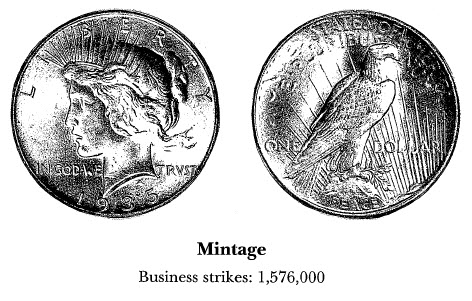
Numismatic Information
Commentary: The 1935, like the 1934, came out on the market slowly and over a long period of time. Little attention was paid to the issue in numismatic circles.
Circulated grades: Worn coins are slightly scarce now and are mostly in higher grades such as EF and AU. In the 1950s, mixed bags of dollars abounded with these and other issues of 1934 and 1935.
Mint State grades: The 1935 is readily available in Uncirculated grade. Most are in MS-60 through 63 or even 64 grades. MS-65 pieces are scarcer but can be found with ease. Lustre is often satiny, rather than deeply frosty. The strike is usually decent, including on the center of the reverse. Cherrypickers would go out of business if all Peace dollar issues were like the 1935!
Some pieces show abrasions, often prominent on the face of Miss Liberty. It is not unusual for a 1934, 1935, or 1935-S to have frosty fields with few bagmarks, but to have the face nicked up, the latter possibly being from marks on the original planchet.
Varieties
Business strikes:
1. Breen-5739. Hub combination III-B2. VAM-I. Just the one variety.
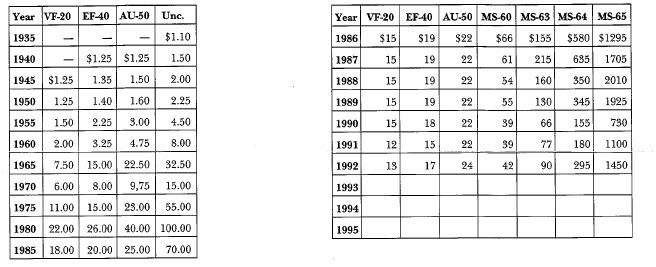
1935 Peace: Market Values
1935 Peace: Summary of Characteristics
Business Strikes:
Enabling legislation: As earlier; plus others, including the Silver Purchase Act of June 18, 1934
Designer: Anthony de Francisci
Weight and composition: 412.5 grains; .900 silver, .100 copper
Melt-down (silver value) in year minted: $0.49950
Dies prepared: Obverse: Unknown; Reverse: Unknown.
Business strike mintage: 1,576,000
Estimated quantity melted: Unknown.
Approximate population MS-65 or better: 1,200 to 1,900 (URS-12)
Approximate population MS-64: 5,000 to 10,000 (URS-14)
Approximate population MS-63: 10,000 to 18,000 (URS-15)
Approximate population MS-60 to 62: 20,000 to 35,000 (URS-16)
Approximate population VF-20 to AU-58: 75,000 to 125,000 (URS-18)
Characteristics of striking: Usually well struck and frosty with a satiny surface.
Known hoards of Mint State coins: I am not aware of any extant mint-sealed bags. Rolls sometimes come on the market.
Proofs:
None
Commentary
The 1935 in Mint State is usually seen with satiny lustre and nicely struck.
Additional Information
Silver Price Amended
The Annual Report of the Director of the Mint, 1935, told of a silver price amendment:
"Under Executive proclamation of December 21, 1933, the price to be paid by the mints for newly mined domestic silver was fixed at 6.4.64 cents. This proclamation was amended by a proclamation of April 10, 1935, fixing the price at 71.11 cents. A further proclamation of April 24, 1935 raised the price to its present level of 77.57 cents."
The Year 1935 in History
On January 29, 1935, the Senate rejected United States membership in the World Court. On May 11, President Roosevelt established the Rural Electrification Administration. At that time only about 10% of America's 30 million people living on farms had electrical service, but thanks to the REA and other efforts the figure would climb to 90% within 15 years. Congress passed the Social Security Act on August 14, 1935. On September 8, Governor Huey Long of Louisiana was assassinated by Carl Austin Weiss, M.D., who sought to save America from an aspiring dictator. Historians (William Manchester among them) would later write that American history probably would have been much different if Huey Long had lived.
Farms operating in the United States dropped from 7.2 million in" 1931 to about 6.81 million in 1935, and a third of farmers received government subsidies for not growing certain crops. Canned beer was introduced by Krueger of Newton, New Jersey, and would grow in popularity far exceeding that of the brown-bottled variety. Alcoholics Anonymous was founded in New York on June 10, 1935. Beginning an era of trans-Atlantic "palace" liners, the S.S. Normandie went into service for the French line. On September 2, a hurricane caused massive damage to the Florida Keys. Will Rogers and Wiley Post died in a plane crash in Alaska on August 15 on their way to the Orient. William Randolph Hearst reportedly earned the highest salary in the U.S. in 1935, with Mae West ("Come and see me sometime") earning the second highest.
Popular songs of 1935 included Red Sails in the Sunset, I'm In the Mood for Love, Stairway to the Stars, The Music Goes Round and Round, and I Can't Get Started. The first football bowl game was held in Miami on January 1, 1935, when Bucknell defeated Miami 26-0. The first major league night baseball game was played on May 14 at Crossley Field in Cincinnati. The real estate trading game Monopoly was introduced by Parker Brothers of Salem, Massachusetts, bringing a fortune toCharles B. Darrow of Pennsylvania, who laid out the game board by using street names from Atlantic City, New Jersey. Thomas Wolfs Of Time and the River and John Steinbeck's Tortilla Flat were published.
The B-17 bomber was demonstrated by the Boeing Aircraft Company. Experiments continued with radar, which would play an important role in World War II several years later in 1939-40. Adolph Hitler denounced the Treaty of Versailles that provided for the disarmament of Germany, and organized the Luftwaffe to give Germany a military air force. Nazi leader Heinrich Himmler proposed a breeding program to create a pure Aryan "super race" of blonde, blue eyed children, and encouraged young women "of pure blood" to mate with S.S. officers. The Nuremberg Laws enacted by the Nazi "party on September 15 deprived Jews of German citizenship and set up other restrictions, beginning widespread prosecution that would accelerate to become the Holocaust. Josef Stalin decreed that Russian children Over 12 years old were subject to the same laws as adults, incurring sentences such as five years forced labor for stealing a cucumber or eight years for stealing corn or potatoes.
The numismatic market was active at the beginning of 1935, and would become hyperactive by the end of the year, spurred by "a geometric price progression for the newly-issued Hudson and Old Spanish Trail half dollars. The Numismatic Scrapbook; first published in 1935, joined TheNumismatist as a monthly forum for tile exchange of ideas and publication of dealers' advertisements. Coming years would see a boom in numismatics, with 1934-35 serving as the foundation. Tort Knox was established in Kentucky as a repository for United States gold bullion.