Silver Dollars & Trade Dollars of the United States - A Complete Encyclopedia
Q. David Bowers
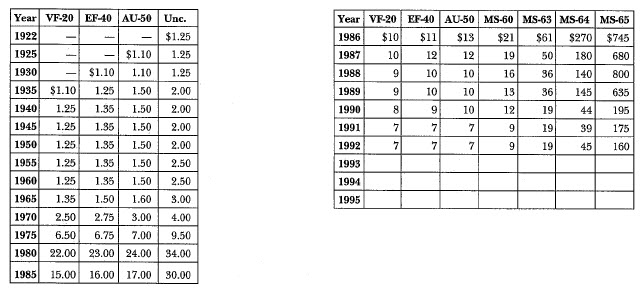
1922 Peace: Market Values
Regular Relief
1922 Peace: Summary of Characteristics
Business Strikes (Low Relief):
Enabling legislation: As earlier; plus bullion authorized by the Pittman Act, April 23, 1918
Designer: Anthony de Francisci
Weight and composition: 412.5 grains; .900 silver, .100 copper
Melt-down (silver value) in year minted: $0.52543
Dies prepared: Obverse: Unknown; Reverse: Unknown.
Business strike mintage: 51,737,000
Estimated quantity melted: Unknown.
Approximate population MS-65 or better: 10,000 to 20,000 (URS-15)
Approximate population MS-64: 30,000 to 60,000 (URS-16)
Approximate population MS-63: 300,000 to 600,000 (URS-20)
Approximate population MS-60 to 62: 2,000,000 to 4,000,000 (URS-23)
Approximate population VF-20 to AU-58: 10,000,000 to 154,000,000 (URS-25)
Characteristics of striking: Usually fairly well struck, but not especially well detailed due to the low relief of the dies (characteristic of later Peace dollars as well).
Known hoards of Mint State coins: Many bags of Uncirculated coins exist. These have been common for years.
Proofs (Low Relief):
Dies prepared: Obverse: At least one; Reverse: At least one.
Proof mintage: Two Sandblast Proofs, made and/or sold privately by George T. Morgan; possibly as many as eight Satin Proofs.
Population Proof-64 or better; Sandblast Proofs: Two (URS-2)
Approximate population Proof-64 or better; Satin Proofs: Reliable data not available; Walter H. Breen says he has seen three (thus URS-3).
Commentary
This and the 1923, 1924, and 1925 Philadelphia Mint issues constitute the four most common Peace silver dollars; 1922 is slightly scarcer in higher grades than the other three.
Additional Information
Silver Dollars Popular in Telluride
The Numismatist, January 1922, carried the following filler:
"With gold coin of any denomination difficult to obtain by the public, refreshing news is contained in a press dispatch from Telluride, Col, to the effect that the Bank of Telluride will hereafter handle no paper money, only gold and silver beingpaid out. All checks are cashed and all large change is given in silver dollars and $5, $10 and $20 gold coins."
Interest Wanes in Peace Dollar (March 1922)
The Numismatist, March 1922, printed this item:
"The New Peace Dollar: Public interest in the Peace dollar has waned almost to the vanishing point, and the few weeks that have passed since it was rather hastily served to the public has enabled collectors to more leisurely pass judgment on the designs and the conditions under which it was issued.
"There is at least one angle from which to view the issue that may have been overlooked by ANA members. In the joint resolution authorizing the coinage of a commemorative peace coin for general circulation, which failed of passage through Congress, and which was urged by a committee of the ANA, it asked for an unprecedented thing. A coin of this character has never been issued by the United States. Collectors have become accustomed to the numerous commemorative coins issued by European countries, which, apparently, are struck in fairly large quantities and placed in circulation at face value, if we are correctly informed. It was such an issue that the ANA sought. But the currency regulations of European countries are on a different basis than those in the United States.
"All commemorative coins of the United States have here-tofore been issued as a medium through which funds might be realized from their sale at a premium. Such issues have invariably been placed in the hands of commissions or promoters of expositions or memorial projects at face value, and the selling prices have been left entirely with those in whose hands they were placed. The enhanced price at which they are sold is considered a sufficient safeguard against them passing into circulation. It is very rarely that such a coin is found in circulation. It is improbable that a bill authorizing their issue could be put through Congress without such an understanding regarding the premium to be placed on them. They are issued for souvenir purposes, and not for circulation.
"The joint resolution urged by the ANA provided for an issue of silver dollars of special design commemorative of the establishment of peace between the United States and Ger-many, to be placed in circulation, and not to be delivered to a commission for any particular object. It would have been possible, of course, for the ANA to have secured just what it asked for by the passage of the joint resolution. The coinage could have been continued for a time, and then Congress could have passed a bill authorizing a change of design that was not commemorative in character. But such a procedure would have violated a custom to which the United States seems wedded.