Silver Dollars & Trade Dollars of the United States - A Complete Encyclopedia
Q. David Bowers
1925 Peace Dollar
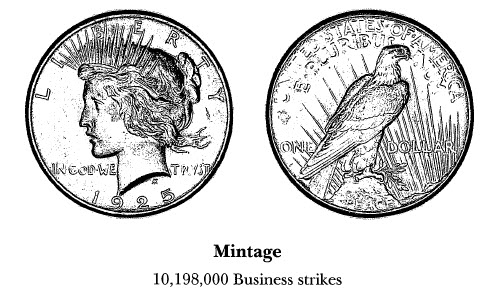
Coinage Context
Large mintage: This was the last large-mintage issue in the Peace dollar series, the last issue to cross the 10 million mark.
Numismatic Information
Once rare: In 1940, the 1925 Peace dollar was considered to be the rarest Philadelphia Mint issue in Mint State; but by 1945 it was considered second rarest (after the 1923). In numerous offerings early in that decade it was priced higher than the 1934-S. In 1945 at the sale of the Frederick C.C. Boyd Collection (billed as "The World's Greatest Collection" by the auctioneer, the Numismatic Gallery) an Un-circulated 1925 crossed the block at $6, outranking in price all other Peace dollars except the then-rare 1923, which fetched $9. By comparison, a 1934-S in Mint State was knocked down to a bidder for only $4.50.
However, by late 1940s, enough had been released from Treasury vaults that the 1925 Peace dollar was demoted to the status of a plentiful issue. Walter H. Breen in his Encyclopedia stated that many of the 1925 dollars paid out in the 1940s were heavily bagmarked. Apparently, most of these newly issued coins disappeared into collections and into the "woodwork," so that by the early 1950s, the 1925 was back on the scarce; list again. Catalogue values remained high until hundreds of bags were released in 1954-55, after which the date became very common. I remember selling a large quantity to Charles E. Green, of Chicago, who traded under the name of R. Green. I had obtained the coins for face value at a local bank.
By the mid to late 1950s, the 1925 Peace dollar was so common that specimens were a nuisance for dealers searching for rare dates. I recall that at the time they were a drug on the market, along with 1922, 1923, and, to an extent, 1924 (the 1924, common elsewhere, seemed to be somewhat more elusive in Pennsylvania, where I searched through dollars). However, by the early 1960s, most must have been distributed, for Wayne Miller in 1982 wrote that in his experience, bags of 1925 dollars were elusive. Perhaps he was referring to the West, where, apparently, few bags of Philadelphia Mint Peace dollars were paid out.
This date has a place in the heart of John Highfill, who wrote in his 1992 Comprehensive Encyclopedia that a bag of 1925 coins was the first original bag of Peace dollars he ever bought, in a career which eventually included handling many bags of many different dates.
Circulated grades: In VF-20 to AU-58 grades 1925 Peace dollars are extremely common and are not in demand, as Uncirculated pieces are so plentiful.
Mint State grades: Today, Mint State 1925 Peace dollars are very common in all Uncirculated grades M-60, 61, 62, etc., you name it. The typical coin is everything a Peace dollar should be, but usually isn't. The usual Uncirculated 1925 Peace dollar is very bright and lustrous with above average striking, including at the center of the reverse. MS-63 and MS-64 coins are readily available, and MS-65 coins are frequently encountered as well. As such, the 1925 makes a nice coin for a type set.
There are exceptions to quality, however. Many have light milky-colored spots or stains, possibly from dilute sulfuric acid used during the coining process at the Mint. Whatever their cause, the spots are lightly etched into the metal surface and cannot be effectively removed.
It has been my experience that bagmarks, when found on 1925 Peace dollars, are apt to be light and not at all disfiguring, although Walter H. Breen, cited earlier, stated that many of the pieces released in the 1940s were heavily marked.
Differences in striking:John Kamin, publisher of The forecaster newsletter, recalled the following:(Letter to the author, September 8, 1992.)
After I had bumped into that 100-bag hoard of 1924 Philadelphia Mint Peace dollars, I aggressively sought out large quantities of "sister" 1925 Peace dollars, but soon began to discriminate. There were two different kinds of strikes and conditions on the 1925 that I noticed. The 1925 cartwheels that interested me were the highly struck-up 1925 Peace dollars that reminded me of the 1921 Peace dollars, so well were those 1925s struck. These particular 1925 Peace dollars that I sought were often golden toned, indicating long storage in tubes in a particularly beneficial atmosphere. Although they were not as high relief as the hard-to-stack 1921 Peace dollars, they were indeed beautiful.
A few bags of 1925 dollars were offered that were flatly struck, resembling the 1922 and 1923 strikes, often heavily bagmarked, and without the beautiful golden toning reminiscent of certain untouched rolls of Buffalo nickels. My personal opinion is that those beautiful struck-up 1925 Peace dollars (which I never found by the bag, by the way, only individual rolls) in over 30 years of searching, are quite scarce. But the regular 1925 Peace dollars are still perhaps six to eight times as scarce as the 1924 Peace dollars.
Varieties
Business strikes:
1. Breen-5722. Hub combination II-B2. VAM-I.
This is the usual variety. V AM-2 has slight doubling on olive branches.