Silver Dollars & Trade Dollars of the United States - A Complete Encyclopedia
Q. David Bowers
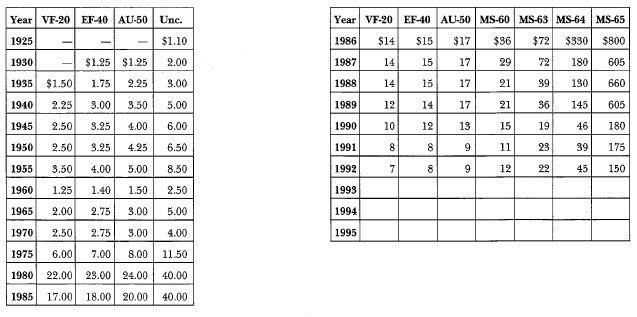
1925 Peace: Market Values
1925 Peace: Summary of Characteristics
Business Strikes:
Enabling legislation: As earlier; plus bullion authorized by the Pittman Act, April 23, 1918
Designer: Anthony de Francisci
Weight and composition: 412.5 grains; .900 silver, .100 copper
Melt-down (silver value) in year minted: $0.53681
Dies prepared: Obverse: Unknown; Reverse: Unknown.
Business strike mintage: 10,198,000
Estimated quantity melted: Unknown.
Approximate population MS-65 or better: 20,000 to 35,000 (URS-16)
Approximate population MS-64: 40,000 to 65,000 (URS-17)
Approximate population MS-63: 200,000 to 350,000 (URS-19)
Approximate population MS-60 to 62: 650,000 to 1,000,000 (URS-21)
Approximate population VF-20 to AU-58: 1,750,000 to 3,500,000 (URS-23)
Characteristics of striking: Usually very well struck and very lustrous .
Known hoards, of Mint State coins: Many bags were released by the Treasury in 1945; prior to that time they were considered to be scarce.
Proofs:
None
Commentary
This and the 1922, 1923, and 1924 Philadelphia Mint issues constitute the four most common Philadelphia Mint Peace silver dollars. In high Mint State grades the 1925 is the most plentiful Peace dollar.
Additional Information
Pittman Act Report
The Annual Report of the Director of the Mint, 1925, advised of the status of silver under the Pittman Act:
"Deliveries of silver purchased under the Act of April 23, 1918, were completed on or before October 1, 1924. Approximately 18 million silver dollars remain to be coined from the silver purchased under this act.
"The New York market price of silver during the fiscal year ended June 30, 1925, averaged $0.68813; the lowest price was $0.66125, on July 1, 1924; and the highest price $0.72375, on October 9,1924."
Efforts to Popularize the Dollar
The Numismatist, February 1925, carried this item:
"Forsome time efforts have been made to popularize the silver dollar and secure for it greater circulation than it has enjoyed for years. The cost of printing enough $1 silver certificates to supply the demand is the motive behind the effort to induce the greater circulation of the silver dollar."
The September 1925 issue of the same publication had more: "The Treasury has admitted defeat in its efforts to increase the circulation of silver dollars, according to a press report from Washington. The American public, it has decided, apparently is determined never again to carry any amount of the old 'cartwheels' in its money pockets.
"Some months ago Assistant Secretary A.S. Dewey launched a campaign to increase the circulation of silver dollars as a means of saving the dollar bills, which since the war have been used so extensively that the Bureau of Engraving and Printing has had no time to' print a surplus for seasoning.' The campaign promised success from the start and about 10 million dollars was set out from the Treasury, but it was not long before it came back. The circulation of silver dollars saves only about 50 million dollars."
The Year 1925 in History
Mrs. William B. Ross was inaugurated as the governor of Wyoming on January 5, 1925, thus becoming the first woman governor in the U.S .. James ('Jimmy") Walker was elected New York City mayor on November 3, 1925, and went on to become one of the most popular individuals to fill that office.
In January, while exploring, a cave in Kentucky, Floyd Collins became trapped. Although the day-by-day drama of the rescue attempt made national headlines, Collins was found dead on February 16. In July, John T. Scopes, a teacher arrested for teaching the theory of evolution, was defended by Clarence Darrow during the famous Scopes trial in Dayton, Tennessee. Scopes was found guilty and was fined $100. Prosecutor William Jennings Bryan died of apoplexy on July 26, 1925, several days after the end of the trial, possibly from the strain caused by the case. On March 18 the worst tornado in America's history leveled sections of Eastern Missouri, Southern Illinois, and Southern Indiana, killing 689 people. On August 8, 1925, 40,000 hooded Ku Klux Klan members staged a march in Washington, D.C.
The Florida land bubble continued to inflate, only to break later in the year, ruining many investors. Laid-out housing tracts, often with fancy gates and signage but no houses yet, were abandoned-to become overgrown and derelict for decades to come. In the largest cash transaction in American business history, the Dodge Brothers automotive manufacturing company was purchased for $146 million by investment house Dillon, Reed & Co. of New York. Minnesota Mining and Manufacturing Company introduced Scotch Tape brand adhesive tape. Old Gold, Lucky Strike and Chesterfield, among many others, were popular cigarette brands. Two firms merged to form the Caterpillar Tractor Company, which would later build a huge factory in Peoria, Illinois. Modern designs featured in the Exposition Internationale in Paris gave a glimpse at the beginning of the Art Deco period. William Randolph Hearst moved into San Simeon castle overlooking the Pacific Ocean in California.
Radio program WSM Barndance in Nashville, later to become The Grand Ole Opry, aired in November 1925. Popular songs of the year were Collegiate, Don't Bring Lulu; I'm Sitting on Top of the World, Moonlight and Roses, Jalousie, Show Me the Way to Go Home, and Five Feet Two, Eyes of Blue. The season's best-known musical was No, No, Nannette. Movie theatres in 1925 showed The Big Parade, The Phantom of the Opera (with Lon Chaney), Ben Hur, The Freshman (Harold Lloyd), and The Gold Rush (Charlie Chaplin). Books published included Theodore Dreiser's An American Tragedy, Sinclair Lewis' Arrowsmith, Anita Loos' Gentlemen Prefer Blondes, and The Great Gatsby by F. Scott Fitzgerald. Persistence pays, and after his first 20 submissions received rejection slips, James T. Thurber finally became a regular contributor to The New Yorker magazine, which had premiered on August 21, 1925.
General William ("Billy") Mitchell charged Navy officials with "criminal negligence and almost treasonable administra-tion of national defense" in September 1925 when they resisted the use of air power (also see 1921). He was courtmartialed and found guilty in December. Later military events, however, would prove Mitchell's theories to be correct, but he died in 1936 before the impressive force of naval air power was used to its fullest. Adolph Hitler's book Mein Kampjwas published in Germany; at the time Hitler was serving a prison sentence.
The Lexington-Concord, California Diamond Jubilee, and Fort Vancouver half dollars were produced in 1925. The Norse-American Centennial Committee wished to have a commemorative half dollar produced, but settled instead for octagonal silver medals struck at the Mint.