Silver Dollars & Trade Dollars of the United States - A Complete Encyclopedia
Q. David Bowers
1925-S Peace Dollar
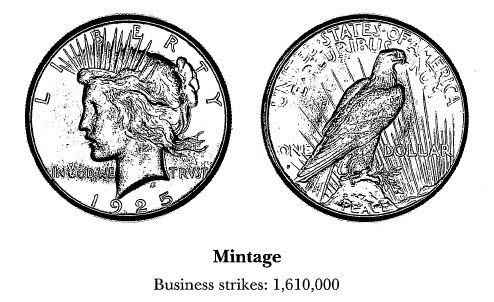
Coinage Context
Small mintage: Like the 1924-S, the 1925-S dollar was made in relatively small quantities. Many of them were stored at the San Francisco Mint until the 1940s and 1950s.
Numismatic Information
Hoard coins: In 1938 and again in the spring and summer of 1942, many bags of 1925-S Peace dollars were paid out by the San Francisco Mint. The issue became common in dealers' stocks. However, the numismatic market for Peace dollars was limited, and I imagine that following the 1942 release, no more than two or three thousand Uncirculated pieces were sold to collectors during the ensuing 12-month period. Most of these coins disappeared into family holdings, and as few rolls or large quantities went to anyone buyer, any 1925-S dollars reappearing on the market years later did so without notice.
In 1949 and 1950, many more bags of 1925-S dollars came out through San Francisco, Oakland, and other California banks. There was little interest in them at the time, however. Some additional bags were paid out in the late 1950s. This last quantity was not large, but at least 10 to 20 went into the hands of dealers. These may have included the five bags that were later owned by LaVere Redfield, of Reno. John Highfill reported that Redfield sold a full or partial bag to Dean Jones in 1974, and four other bags, all with weakly struck coins, were auctioned by the Probate Court as part of the Redfield estate in January 1976.
Circulated grades: Probably, the majority of the 1925-S dollar coinage went into circulation in the 1920s. Worn pieces in VF-20 to AU-58 grades are easily available today but are far from the commonest in the series. Probably, a couple of hundred thousand or so exist.
Mint State grades: Uncirculated 1925-S dollars are much more plentiful than 1924-S, despite the lower mintage of 1925-S. However, in MS-65 grade, the 1925-S is surprisingly rare. Indeed, it and the 1928-S are the two toughest varieties to find in this grade in the entire Peace dollar series,
The striking of the typical 1925-S dollar is apt to be unsatisfactory, with weakness on the reverse, particularly on the high points of the eagle. Lustre is average. Bagmarks can be a problem.
Cherrypicking is advised and will be difficult, although not as hard as for 1924-S. Be very careful when buying coins in higher grades, for a tiny difference in grade can make big difference in price.
Varieties
Business strikes:
1. Breen-5723. Hub combination II-B2. VAM-1.
Micro S mintmark. This the major variety. Minor positional varieties of mintmarks are not collected. V AM-2 has slight doubling on reverse.
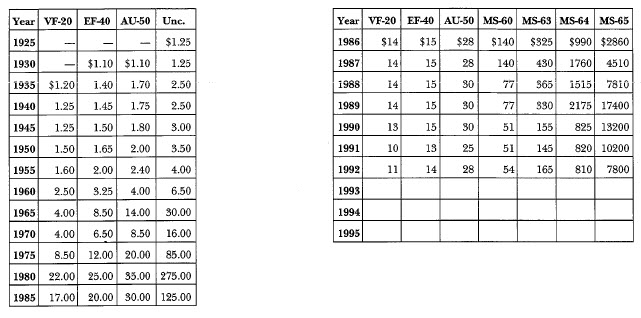
1925-S Peace: Market Values
1925-S Peace: Summary of Characteristics
Business Strikes:
Enabling legislation: As earlier; plus bullion authorized by the Pittman Act, April 23, 1918
Designer: Anthony de Francisci
Weight and composition: 412.5 grains; .900 silver, .100 copper
Melt-down (silver value) in year minted: $0.53681
Dies prepared: Obverse: Unknown; Reverse: Unknown.
Business strike mintage: 1,610,000
Estimated quantity melted: Unknown
Approximate population MS-65 or better: 125 to 225 (URS-8)
Approximate population MS-64: 2,000 to 4,000 (URS-13)
Approximate population MS-63: 5,000 to 10,000 (URS-14)
Approximate population MS-60 to 62: 15,000 to 25,000 (URS-15)
Approximate population VF-20 to AU-58: 160,000 to 275,000 (URS-19)
Characteristics of striking: Most 1925-S dollars are lightly struck at the center of the reverse.
Known hoards of Mint State coins: Bags were paid out of the San Francisco Mint in 1938 and the 1940s and 1950s. LaVere Redfield is said to have had nearly five bags in the mid-1970s.
Proofs:
None
Commentary
Mint State coins are often lightly struck and/or extensively bagmarked.