Silver Dollars & Trade Dollars of the United States - A Complete Encyclopedia
Q. David Bowers
1924-S Peace Dollar

Coinage Context
Low mintage: By 1924, Peace dollars were redundant, and no specimens were struck at Denver. At the San Francisco Mint the production was 1,728,000, which was a tiny fraction of the quantity of 1922-S and 1923-S dollars made earlier at the same facility.
Numismatic Information
Commentary: Unlike 1922-S, 1923-S, and 1926-S, of which many bags came on the market from the San Francisco Mint in the 1940s and 1950s, quantities of 1924-S seem to have been paid out only occasionally. A few 1,000-coin bags were released in the late 1950s and were quickly absorbed at prices of about double face value, a high premium at the time. The Redfield estate is said to have had a few hundred Uncirculated coins; no bags.
The low mintage and the relative unavailability of mint-sealed bags combine to make this one of the scarcest issues of the early part of the Peace dollar series, and the rarest S-Mint coin up to this point in time.
Circulated grades: Circulated 1924-S dollars can be found but are relatively scarce. Most are in higher grades such as EF and AU, perhaps indicating that quantities slipped into circulation as late as the 1940s and 1950s, under the noses of numismatists. Most experts agree that the 1924-S in worn grades is among the top eight scarcest of the 24 Peace dollar varieties.
Mint State grades: Mint State 1924-S dollars are scarce, especially in higher grades. The issue is near the top of the rarity list in grades such as MS-63, MS-64, and MS-65.
Most specimens are lightly struck, especially on the reverse, but there are numerous exceptions. Well-struck coins are apt to be expensive, and deservedly so. Lustre is usually average to frosty. Some pieces have a matte-like surface, possibly due to acidetching the surface of the dies to remove polish marks. Bagmarks can be a problem, and some coins have many.
High prices posted in catalogues and auction listings are mostly for better strikes with good lustre. Just as there is not a "standard" Mint State quality for the 1924-S, there is not a standard price.
Varieties
Business strikes:
1. Breen-5721. Hub combination II-B2. VAM-1.
Micro S mintmark. One standard variety. Positional mintmark varieties are not collected.
1924-S Peace: Summary of Characteristics
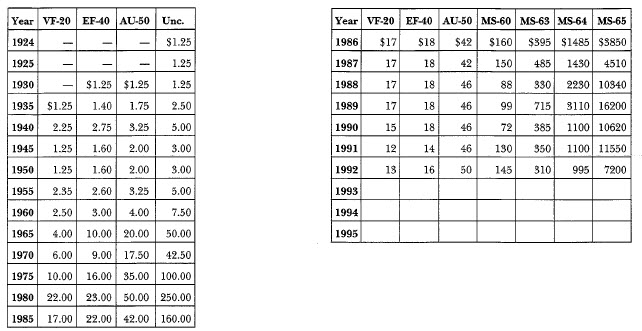
1924-S Peace: Summary of Characteristics
Business Strikes:
Enabling legislation: As earlier; plus bullion authorized by the Pittman Act, April 23, 1918
Designer: Anthony de Francisci
Weight and composition: 412.5 grains; .900 silver, .100 copper
Melt-down (silver value) in year minted: $0.51906
Dies prepared: Obverse: Unknown; Reverse: Unknown.
Business strike mintage: 1,728,000
Estimated quantity melted: Unknown.
Approximate population MS-65 or better: 150 to 300 (URS-9)
Approximate population MS-64: 1,500 to 2,500 (URS-12)
Approximate population MS-63: 3,000 to 5,000 (URS-13)
Approximate population MS-60 to 62: 10,000 to 20,000 (URS-15)
Approximate population VF-20 to AU-58: 40,000 to 70,000 (URS-17)
Characteristics of striking: The average specimen is poorly struck on the reverse.
Known hoards of Mint State coins: Many bags were released in the 1940s and 1950s, but few of these survive today.
Proofs
None
Commentary
Mint State pieces are usually seen bagmarked.