Silver Dollars & Trade Dollars of the United States - A Complete Encyclopedia
Q. David Bowers
1934 Peace Dollar
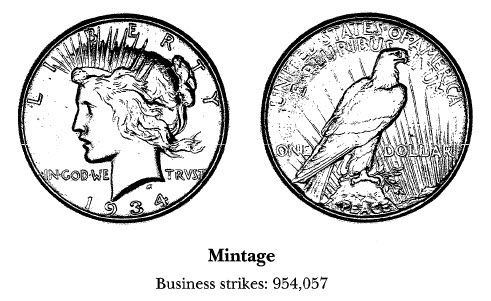
Coinage Context
Source of silver: The Act of May 12, 1933 authorized the government to accept silver bullion at the value of 50 cents per ounce in payment of war debts and to convert this bullion into silver dollars and subsidiary coins. This was followed by President Roosevelt's edict of December 21, 1933, which man-dated that the mints buy silver to coin into dollars.
Then came the Silver Purchase Act of June 18, 1934, which required that the Department of the Treasury acquire silver from all sources presenting same until the market price of silver was raised to $1.2929 (a figure which was considered to be the standard value of silver for many years), or until the Treasury holdings of silver equaled one third of the value of the Treasury holdings of gold. The silver thus acquired was used to coin Peace silver dollars in 1934 and 1935.
Numismatic Information
Commentary: Bags of 1934 dollars were paid out through Eastern banks from the 1930s onward. Little documentation of 1,000-coin bags exists, and I do not know if any original mint-sealed bags survive today.
Circulated grades: Circulated coins in VF-20 to AU-58 grades are somewhat scarce, possibly the second scarcest (after the 1928) in the series, and are mostly in higher grades.
Mint State grades: Uncirculated coins are plentiful in numismatic channels. You will have no trouble finding a 1934 to suit your requirements, whether it be MS-60 or MS-65, although the latter can be pricey. Even so, the 1934 seems to be somewhat un-appreciated on the market.
Most are well struck and have nice lustre, although Wayne Miller filed this dissenting opinion in his 1982 book: "Like most other Philadelphia Mint Peace dollars from 1926 to 1935 the strike is often weak. In addition many pieces lack mint lustre."
Sometimes it can be difficult to distinguish a high-grade AU from a low-grade Mint State coin. The best place to look is on Miss Liberty's cheek, rotating the coin under a pinpoint light source to detect friction.
Some pieces, if not dipped, have a brownish or yellowish cast to the surface, perhaps from sulfur in the cloth bags in which these were once stored.
Varieties
Business strikes:
1. Breen-5733. Hub combination III-B2. VAM-1.
Just the one issue. All 1934-5 dollars from all three mints are from new master dies and hubs (III-B2): motto letters thinner, straight tail to R in TRVST.
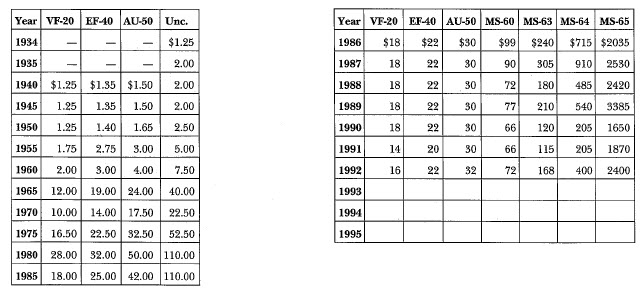
1934 Peace: Market Values