Silver Dollars & Trade Dollars of the United States - A Complete Encyclopedia
Q. David Bowers
In 1982, Wayne Miller commented as follows:
"Fully struck 1921 Peace dollars are very rare and always command a premium. Well-struck gems are very desirable." This information is just as valid today.
Most Uncirculated 1921 Peace dollars are in the MS-60 to 62 range. These are plentiful. MS-63 coins, while scarcer, are also easy to find. At the MS-64 level the issue becomes elusive, and MS-65 coins are rare.,As the certification services often use an un-specified combination of "market grading" -a mix of technical numbers, striking quality, and eye appeal it will really pay you to cherrypick for quality when buying an example of this date. Ideally, a high-grade 1921 dollar should have a high degree of all these factors, but in practice this is often not true.
Something to look for: Some specimens exist with reverse die rotated 20° counterclockwise from the normal orientation. These are rare.
Proofs: Walter H. Breen suggests that at least the first 20 were satin finish Proofs, of which perhaps 10 are known today. These are sharply struck and central hair and wing and leg feathers are better than business strikes. The first three were delivered by messenger to President Harding, Secretary of the Treasury Andrew W. Mellon, and Director of the Mint Raymond T. Baker on January 3, 1922. A specimen in Auction '87, Lot 1885, described as a "Satin Proof," came with' a card reading "20th dollar coined in Philadelphia Mint 1921 new Peace dollar." The same dies were used to make the earliest business strikes. Later Proof's are matte or sandblast. These are also very sharply struck. Possibly as many as 10 are known.
Caveat emptor: Beware of "Satin Finish Proofs," "Matte Proofs," and other special Proof strikings, even if accompanied by authentication papers or letters from experts. Phony coins abound, most of which have papers from before the late 1980s. Any such coin should be submitted to PCGS, NGC or ANAC,S for certification; I consider their word to be reliable.
Varieties
Business strikes:
1. High Relief: Breen-5712. Hub combination I-A. VAM-1. Obverse and reverse in higher relief than in later years (except January 1922 High Relief issues). Fields (particularly the obverse) more concave than on later years. Obverse: Rays from top of Miss Liberty's head thicker, and without the three very short rays seen between the first four longer rays on later issues. Reverse: Leaves and branch slightly differently configured than on later issues. Distant mountains at lower right differently arranged. Ar-rangement and count of rays slightly different than later issues. A comparison of a 1921 dollar with any specimen of the low-relief style 1922 and later will show these and other minor differences.
VAM-2 has the letters in PEACE on the reverse slightly doubled on the left side. Slightly scarcer than the preceding.
Proofs:
1. Proof issue: High Relief dies as preceding. 20 are believed to have been struck. However, most "Proofs" offered on the market are business strikes that have been tampered with.
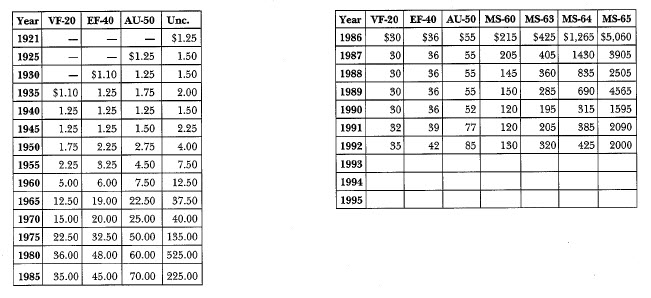
1921 Peace: Market Values
Business Strikes:
Enabling legislation: As earlier; plus bullion authorized by the Pittman Act, April 23, 1918
Designer: Anthony de Francisci
Weight and composition: 412.5 grains; .900 silver, .100 copper
Melt-down (silver value) in year minted: $0.48801
Dies prepared: Obverse: 41; Reverse: Unknown. Business strike mintage: 1,006,473, all struck during the last few days of December 1921.
Estimated quantity melted: Probably none under the Silver PurchaseAct of 1942 except as part of mixed date groups.
Approximate population MS-65 or better: 1,000 to 2,000 (URS-12)
Approximate population MS-64: 3,000 to 6,000 (URS-l3)
Approximate population MS-63: 10,000 to 20,000 (URS-15)
Approximate population MS-60 to 62: 30,000 to 60,000 (URS-16)
Approximate population VF-20 to AU-58: 50,000 to 90,000 (URS-17)
Characteristics of striking: 99% or more are lightly struck on the hair strands at the center of the obverse.
Known hoards of Mint State coins: None
Proofs:
Dies prepared: Obverse: At least one; Reverse: At least one.
Proof mintage: 10 or fewer Matte Proofs
Approximate population Proof-60 to 65 or better: 8 to 12 (URS-4)
Commentary
1921 Peace dollars were very widely distributed beginning in 1922. Coins of this date have high-relief features.