Walter Breen's Encyclopedia of United States and Colonial Proof Coins 1722-1989
Walter Breen
Cent. Type la: small date, closed 6 (knob of 6 nearly touches loop). *Unlisted, obv. N-l, rev. 1844 B-8 (unlike business strikes from this obv. die). Plain outlines (repunching) below 18 and within lower loop of 8; date low, roughness at border between second and fourth stars. (1) Dr. French, exhibited at ANS 1914; French: 648; T. James Clarke; Calif. Specialist. (2) Morgenthau 10/5/39, Phila. Estate. (3) Newcomb, Starr, 1949 ANA:1792.
- N-4. Double date, first punched obliquely (bases only showing strongly) well to left, then corrected, so that outlines show left of each figure. Rev. not described. Hines, N.J. Specialist. Oddly, unknown to Newcomb in proof state; possibly Hines obtained the piece after Newcomb's book was published (1944).
- N-19, perfect die. Small curved line on cheek, convex upward, pointing down to r. Curl point over inner r. curve of 8, peak of 1 even with extreme left edge of truncation; die file marks through E in AMERICA. (1) Philadelphia Estate, ex Newcomb II: 743, impaired. (2), (3) Two examples offered by Walter F. Webb to Homer Downing in July 1941.
- Obv. N-15 and 21, like last but without cheek line; "round hole" in ear. Rev. different: around E's in ONE CENT, S OF heavily doubled ("recut"), faint die file marks through UNIT, roughness over MERICA. Elder, June 1911: 1361, to Hillyer Ryder, Wayte Raymond, NN 41:924, to Kagin, now Philadelphia Estate.
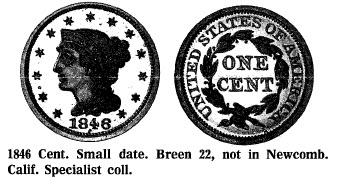
*B-22, not in Newcomb. Obv. similar to N-17, curl point midway between r. curves of 8; small curved line like a reversed C on neck; irregularities in 184, file marks at Y. Rev.: Same as 1844 B-8. Usually, border narrow below date. (1) Smithsonian, from Mint's proof set. (2), (3) "Dupont": 872, 873, both to a N.Y. state private collection. (4) N. J. Specialist. (5) Philadelphia Estate ex Mehl 1/22/38, possiblyex Mougey, Sleicher. (6) The Balboa (Calif.) bank proof set. Small cheek spot. (7) Apparently the variety in the cased set below. Others exist.
- Type 1b: Small date, open 6, knob distant from loop, this 6 in other ways a little differently shaped from the closed (N-9, 10, and a couple of unlisted varieties). N-10. Curl point in line with extreme r. side of 8, plain vertical die file marks within ON and EN (rev. 1845 N-11). (1) The coin Newcomb saw: Calif. Specialist, ex Parsons: 1906, H. Chapman, Hines, Wiirzbach, Sheldon, Ernest Henderson, T. James Clarke. (2) Dr. French -T. James Clarke: 335, not seen as it was out to a mail bidder when I was examining the Clarke cents. (3) The former J. P. Young example.
- Type II: Tall narrow numerals, same as on the tall date half dollars. *B-27: Similar to N-13 but without line crossing 1: curl point over inner r. curve of 8, 1 not touching border; die file scratches at ERT and ear. Rev. 1844 B-8. (1) Dr. French:661 as "A-12" (understandably), "Dupont" :874, Phila. Estate. (2) "Dr. French duplicate," T. James Clarke:336. (3) F. C. C. Boyd, NN 51:1258, D.N., TAD:154. (4) Cleneay:839 (proof set), Mougey:245, Beckwith:106, Morgan: 352, B.Max Mehl. Possibly same as either of last two; illustrations unavailable.
Half Dime. *B-2. Not in Valentine. Shield point above left upright of 1, whereas on the V-I variety constituting the scarce business strikes of this date shield point is about over r. upright of 1 and date slants down. First publicized by B. Max Mehl in the Neilsale (1947) as a new and exceedingly rare variety - presumably after Neil's own notes. Mehl there claimed it had been unknown (i.e, unrecognized) until about 1945. However, specimens had been pictured earlier. (1) SI ex Mint. (2) Eliasberg. (3) Brock, Univ. of Penna., P.H. Ward: 1015. (4) Bullowa, May 1952. (5) Atwater: 1154, Allenburger: 1052. (6) Boyd, WGC: 239, Neil: 1613, Phila. Estate. (7) Ex Dr. Judd set, Bowers. (8) Cased set below. (9) Merkin 4/66:79 at $750, H.W., 1971 ANA: 624, Reed Hawn: 606 at $1,600. (10) Bolender 3/2/56: 1230, Phila. Estate. (11) S 6/73: 992, $1,700, later in Balboa bank proof set. Spotted over I(M), on neck and below 18. (12) "A.R.," S 12/71:182, impaired. Cf. also Parmelee: 1176, H. P. Smith: 1027, either or both probably represented above.
Dime. *B-2. Shield point between tip and left upright of 1. Rev. Perfect die, without the defects on MER commonly seen on business strikes (which are rarer than 1844, q.v.). (1) SI ex Mint. (2) Dr. Judd set, Bowers. (3) Cased set below. (4) Atwater: 939, Phila. Estate. (5) NN 36:116, from either Wayte Raymond or Brand estate, not since traced. (6) Balboa bank set; lint mark between 6th and 7th stars. (7) LM 2/72:96. Two others reported.
Quarter. *Normal date, die file marks slant down sharply to right of it; "extra hair" below chin; small outline above first star. Rev. All red stripes extend upwards into azure; die file mark, rim to E(R). (1) SI ex Mint. (2) Ex Dr. Judd set, A-Mark. (3) Cased set below. (4) Kern: 1417, Phila. Estate. (5) Col. Green, 1946 ANA:447. (6) Dr. Green: 1399. (7) Brock, U. of Pa., Rovensky:602. Possible reappearances of the above: Rothert:796; W. 1. Carson; Parmelee:1174 (nicked); S. W. Freeman:1159. There are also those in the proof sets mentioned below.
Half Dollar. Type I. Medium date, as on the N-II cents; commonly called "small date," but this is not the same logotype as was used on the small date cents. Apparently two pairs of dies; I have description for only one: Die file marks, rim to field below 4th star; 10th star towards 11th; rev. vertical die file marks below wing left of shield. (1) Newcomb II:857. (2) Boyd, WGC:285. (3) Col. Green, 1949 ANA: 1502. (4) I owned one with cracked rev. die, ca. 1956, cleaned. (5) I owned an impaired perfect-die coin about 1953. (6) N.Y. state specialist. (7) James A. Stack estate: 444, field nicks, $900. The following records are believed to represent reappearances of the above:
Col. Green, Geiss:532; Earle:2989; Paramount Fixed Price List, ca. 1966, Krouner, LM 2/71:744; Reed Hawn: 153, $1700; W.L. Carson, ex Merkin. There are also the coins from the proof sets, one broken up, the half dollar offered as "Terrell": 858, Rothert: 865.
_ Type II. Tall date, as on the cents. Low date slants down to r., short line from left base of 1. Rev. Die failed to take full polish between arrowheads, between olive leaves, and within MER-A and A F of HALF. I saw this coin about 1953, attributed it as Beistle 5-C, but have no record of its present location.
Silver Dollar. *B-l. So-called overdate. Date first logotyped obliquely and much too low, about half its own height below final position, then correctly repunched. Parts of upper halves of 846 show at lower halves of those digits. Called "1846 over 45" in Parmelee: 1171, "1846 over 1844" in WGC. Not correctly identified as a blundered die until I examined the Eliasberg coin in 1953. Rev. of earlier dates in the forties, with the two minute defects on r. side of final A. (1) Clapp, Eliasberg. (2) Garrett:262, $3300, F. G. (3) Boyd, WGC:135, Guggenheimer:972, "Penna. Coll.," S 5/57:524. (4) Mickley, Reichardt, Reakirt, 1962 Columbus sale. (5) Amon Carter Sr. & Jr. (6) Parmelee: 1171, H. P. Smith: 442, badly cleaned, not now traced. (7) Golding: 237. (8) Balboa bank set, ex Dr. Judd set (?), lint mark from rim near first S. (9) Menjou:2091. (10) Golden II:3057. (11) Cass, "Empire": 1729. (12) Bowers, 2/27/1964, Phila. Estate. At least three others reported, one of them ex W. 1. Carson. The variety is a naked-eye blunder, making it the more surprising that this die would have been approved for use on proofs.