Walter Breen's Encyclopedia of United States and Colonial Proof Coins 1722-1989
Walter Breen
Silver-minor proof sets. Those originally issued naturally contained neither the copper-nickel half cents nor the Flying Eagle cents. Stickney: 1797, ex the mint in the year of issue, was complete from half cent to half dollar, the dollar apparently removed for inclusion in a denomination set.
Gold Dollar. Third design, "Wide Indian Princess" head 1856-89 - reduction of the three-dollar head. Upright 5, B. AI. Philadelphia Estate, ex 1941 ANA:586, thought to be the first of the new design, Feb. 17, 1856. No duplicate reported. Dies drastically lapped.
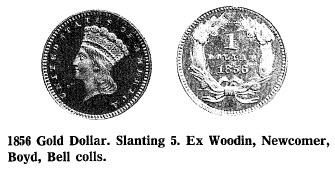
-Slanting 5. *B.B3. Heavy 6, date begins low and slants up to right. (1) ANS ex Brock, Morgan, showingclash marks in rev. field. (2) Woodin: 856, Newcomer, Boyd, WGC:ll, "Memorable":ll. (3) Brock, Univ. of Penna., P. H. Ward. (4) Eliasberg. (5) Lohr:967 to "Dr.L." (6) Melish:1750, N.Y. state specialist. Jay:217 ($1750) is probably areappearance of no. 2 or 3 above; illustrations forbid certainty.
Quarter Eagle. Small date as on half dime. *Date slants up, 6 farther from border than 1; letters more delicate than usual. (1) MiIls:575, Clapp, Eliasberg. (2) A. Reimers (H. Chapman, 7/22):840, Newcomer, Boyd, WGC:124, "Memorable":116, "R", Wolfson: 168, Ullmer: 363, $30,000. Wayte Raymond knew no third specimen, nor is any other now rumored.
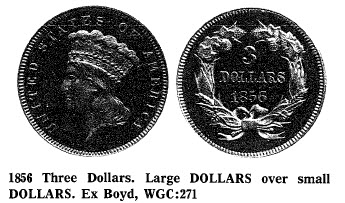
Three Dollars. *B-3. Obv. Polish below ear and on throat. Rev. Large DOLLARS over small DOLLARS -evidently a die left undated in 1854 and not used until 1856. (1) Eliasberg. (2) Garrett:394, $21,000. (3) Harry Bass. (4) Mike Brownlee. (5) Boyd, WGC:271, doubtless one of preceding.
Half Eagle. Large date, upright 5 as on the quarter dollar. No die variety data. Reported by Wayte Raymond, not now traced.
Eagle. Same comment.
Double Eagle. None reported, though formerly believed to exist as the smaller gold denominations certainly existed.
Complete proof sets. It is doubtful if any were made.
1857
Early sets of this year contained the half cent and copper cent; they must have been made up in January, as that was the time of manufacture of the copper coins. Early dealers repeatedly concurred with Snowden's eyewitness claim (Mint Manual, 1860) that many of the undistributed copper coins (presumably proofs and business strikes alike) were remelted at the mint. Later sets, those made after May 1857, contained the small cent instead of the copper coins; but very few were made. See Silver-Minor Proof Sets, below.
Half Cent. One obverse only, with date larger than on former half cents save for 1847-49, 52-53. Two reverse dies.
- B. 1-A, dot or chip on r. side of first A in AMERICA; the die used on all business strikes of this date. (1) N. J. Specialist. (2) Martin F. Kart John. (3) The former Stack specimen. One other reported, unverified. These are evidently the very earliest proof half cents made in January 1857.
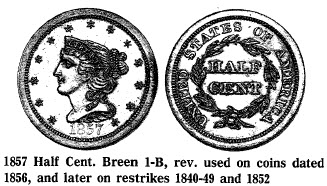
- *B. 1-B. Rev. is the B die of 1856, found also on coins dated 1840 through 1849 and 1852: double impressions on CENT and ribbon. About two dozen, possibly nearer thirty known. However, quite a number of these appear to be restrikes, the obverse die repolished and the date strengthened, knife-rims unusually plain, weights far off the 84-grain norm. I would guess that less than fourteen unquestioned originals now survive; the restrikes fall into two of the known series ("81.8", one of the earlier groups, and the unnatural thick ones). See Restrikes and Fantasy Pieces. As a rule, since originals and restrikes come from the same dies, few dealers or collectors bother to weigh half cents, and manyare unfamiliar with the appearance of the various series, even aside from the fact that labeling a coin a restrike is now likely to be a way of lowering the price realized (despite many restrikes being rarer than originals), most 1857's are sold without mention of status aside from the grade or label of "Proof". This date, though not much rarer than earlier years in proof state, uniformly has brought a higher price because the business strikes (a low mintage, high meltage final year coin) have long done likewise. Possibly the odd delivery of Jan. 24, 1857, $1.33, may mean 266 proof half cents.