Walter Breen's Encyclopedia of United States and Colonial Proof Coins 1722-1989
Walter Breen
VI. PRESENTATION AND OTHER "MASTER" COINS AND SETS, 1840-57
1840
*Half Cent. Gobrecht coronet head design. Rev. large berries on wreath (altered by Gobrecht's hand as the hub had small berries). About 17 known, at least five of them in museums (Smithsonian, ANS, Johns Hopkins, Omaha City Library, Mass. Historical Society), at least one of the others worn (Gardner: 650). Some of the proofs of this year have an extraordinary flaming color found on 1841's and a single 1842 and no other half cents. Some of these were struck on blanks which had earlier been reeded, probably experimentally in a Castaing machine. (Smithsonian; NN 54:1633; Eliasberg, ex Lyman Low, Sept. 1901, and at least two others.) Two restrikes known from the Large Berry reverse die (see Restrikes and Fantasy Pieces).
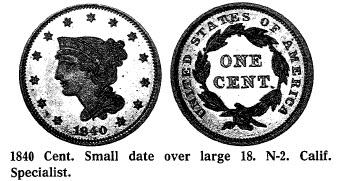
Cent. Small date. N-2. Blundered die, small straight date over larger 18 leaning to r. The die was originally dated 18 - in expectation of use either in 1839 or 1840, but by the time the Engraving Department got around to using it, the individual large date punches had been abandoned in favor of the small date logotype or gangpunch. About 14 or 15 proofs are known, and it is incredible carelessness that among all the dozen or so obverses made for this year, the one with a naked-eye blunder would have been chosen for making proofs. Some specimens have a fiery brilliance like the 1841's and the half cents of this year. (1) Mint, SI. (2) Beckwith:95, W. F. Morgan:319, T. James Clarke:310. (3) C. David Pierce, T. J. Clarke: 309, Sloss, Lahrman:411. (4) "Dupont": 808, TAD:137. (5) Gardner: 1166. And so forth. The variety is scarce in business strike form.
Half Dime. No drapery, type of 1838-39, coined between April and September. *Not in Valentine: first star far from rock, date low, perfect dies; more like V-4 than any other but not identical. (1) Mint, SI. (2) Eliasberg. (3) Newcomb, exhibited in ANS 1914, was probably this variety. (4) N.Y. state specialist. McCoy: 638 to Leslie is possibly one of the above. Others probably exist. The "V-2" in E. M. Wharton: 1070 (1945) is unverified.
- Drapery, type of 1841-58. By Robert Ball Hughes, after Gobrecht, coined Nov. - Dec. only. Heavy extra fold of drapery from forearm to below knee, in the interest of respectability. V-7, high date. (1) Bullowa, May 1952. (2) Newcomb, exhibited ANS 1914. The type is very scarce, being struck only at year's end; the proofs may have been intended for the Secretary of Treasury or some other official, to memorialize the new type, but I have seen no transmittal letter to confirm this guess.
Dime. No drapery. B-2. At least five known, one impaired. Cf. Gardner: 1483, $450 (1965); Lichtenfels II: 2989. Probably others exist, perhaps even with drapery.
Quarter. No drapery. I have seen two and am reasonably sure that others survive. My records are incomplete, but I seem to recall a badly cleaned one from the Mint's proof set in the Smithsonian, which would make a third.
- With drapery. Winsor: 614. Compare the drastically cleaned piece in Holmes: 2937. "Dupont": 1817, laconically described as "Brilliant proof. Still very attractive and very rare," suggesting that a remark about cleaning or impairment was suppressed, has been questioned. I suspect that these pieces, if proofs, were made for much the same purpose as the half dimes with drapery. Wayte Raymond knew two.
Half Dollar. Small letters as in 1839. Beistle lists his I-A and 2-Aa (rev. clash marks) as two different varieties the only differences, aside from clash marks, appear to be in the placement of the date, obv. 2 supposedly having it minutely lower than obv. 1, but it would be impossible to tell them apart without both at hand. Rev. Almost all vertical stripes completely through azure. I suspect that only one pair of dies actually was used. These must have been Col. Green coins, but they are not now traced. Cf. also H. P. Smith: 673, impaired; Allenburger: 982, Phila. Estate; Brand-Lichtenfels 1:2801; Reed Hawn: 128, "gem," $1800. I have seen at least one other.
Silver Dollar. B-1. Only the one obv. on proofs; date about centered. Shield point about over left upright, left base of lover space. Defect on r. side on final A in AMERICA, much smaller than that on the 1842-52 series, on originals. Winsor: 419, documented there as being the first specimen struck, passing from some mint employee eventually to Richard Winsor at a then (1895) extraordinary $100, later M. A. Brown: 298 (4/97). Not now traced. Compare also WGC: 127, Lyman-Bement: 238 (cleaned), Geiss: 334, Dr. Judd: 132, 1949 ANA: 216. Another in the Winsor proof set.
- *B-2. Rev. of 1842-52: two plain tiny defects on r. side of final A, claws not joined (lapped die), small defects in border above E in UNITED, space between arrows clear, arrowheads not touching, third line of first stripe (gules, counting from observer's left) and first (left) line of 6th stripe extend far into azure, other lines of those stripes and all three of 2nd extend slightly into azure. T. J. Clarke, NN 48:657 to Kagin; Philadelphia Estate ex Brand, Bowers May 5, 1967; Cass - "Empire":1722; David Golding: 231; Amon Carter Sr. & Jr., possibly ex Geiss:334; others. It is not certain whether all pieces bearing this reverse were struck in the year of issue, this remark holding for the series 1840-52, though some certainly were.
Silver proof sets. "Given to collectors from the Mint for $2.02". - George F. Jones, 1860, earlier cited. Winsor: 1065, complete, one other heard of. Presumably early issue, without drapery on silver, as with the assembled (?) NY specialist set.
Quarter Eagle. Only one variety in proofs. Small date as on the small silver, half cents, & c. (1) Smithsonian, from Mint (impaired). (2) T. L. Gaskill, NN 48:217, also impaired. (3) N.Y. Specialist.
Half Eagle, Broad mill (diameter of 1834-39 coins, 15/16", very wide rim outside beaded circle, usually not well centered). Fine edge reeding. (1) Smithsonian, from Mint. (2) Woodin, Newcomer, Green, Farouk, Struck January 1840, quantity unknown. Business strikes are very rare.
Eagle. Smithsonian, from Mint. (?)
Complete proof sets. Early ones would have contained the half dime, dime and quarter without drapery; the half eagle would have been of the broad mill type. It is extremely unlikely that any were made up late enough in the year to include the with-drapery silver. Smithsonian, from Mint: badly cleaned, the coins separately enumerated above.