Walter Breen's Encyclopedia of United States and Colonial Proof Coins 1722-1989
Walter Breen
Silver Dollar. [12] All specimens known in silver or copper are restrikes made in late 1862 or 1863, using the regular proof rev. of that year and a new obverse. See Restrikes and Fantasy Pieces.
Silver-minor proof sets. None made for release to collectors according to George F. Jones (1860) cited above. As Mougey: 1277 was such a set, though lacking copper coins and half dime, it is possible that all the coins in it were restrikes except for the silver with arrows. I very much hope that the set has remained intact and may become available for examination. Die identities on these coins may enable determination if any of them are in fact originals rather than restrikes - with obvious effect on the status of the above described smaller silver denominations.
Gold Coinage. No proofs known, though at least one quarter eagle obv. was polished for use in making proof pattern cents with a special rev. concocted for the purpose (ONE CENT in wreath.. lacking any mention of our nation's identity). For the proof coins made experimentally by or for the San Francisco Provisional Mint (the U.S. Assay Office of Gold under Augustus Humbert), see Mintmaster's Provisionals below.
1854
Half Cent. Only the one obverse. Rev. Second die, with small rustpit on upper right part of upright and top serif of I of UNITED. Copper. About 25 to 30 survive.
- Copper-nickel. Judd 155, Adams-Woodin 192. Two known. (1) Woodin, Judson Brenner, F. C. C. Boyd, various dealer intermediaries, King Farouk, a Florida dealer named Randall (about 1955), unknown private coIl. Weight unrecorded. (2) "Dupont": 1115, D. N., Dr. Spence sale, March 1975. Weight 84 grains (standard for copper), small edge nick. The original Woodin coin, described as "unique" in AW, was later theorized to be a restrike on a planchet intended for Flying Eagle cents. This would be proved if and only if the Woodin-Farouk coin weighs 72 grains, which is standard for 1856-64 'small cents in this metal.
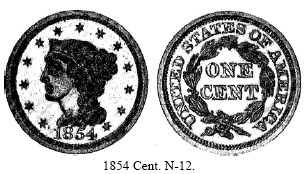
Cent. N-12. Small line (part of base of a 1 first punched too low) just below center of base of 1 in date; 54 about touch; date very high, slanting minutely down to right, with 1 touching bust, 85 all but touching device; faint die file marks at border below 854. Often slightly off center, border narrower at left obv., wider at r. with knife-rim. Less rare than the half cent, possibly 30 to 50 known. (1) SI from Mint. (2) Newcomb 11:751, Phila. Estate. (3) Calif.Specialist. (4) "Dupont":991. (5) "Dupont":992, D.N., TAD:189. (6) J. B. Wilson, Ryder: 938. (7) Hines, Downing, Sloss, Lahrman:475. (8) T. James Clarke:406. (9) Mougey:266, Beckwith:114, Morgan:386, B. Max Mehl as "Andrews 14," T. James Clarke: 407. (10) The writer's example, obtained in Philadelphia, heavily coated with wax; later 1975 EAC; subsequently ruined by purchaser's cleaning. I have seen possibly a couple of dozen others.
Trime. New design, two extra outlines outside the star ("three outlines to star" in all), arrows and olive branch within the C, to distinguish the new coinage in standard silver from the 1851-53 billon issues. Occasion: beginning of new coinage, May 22. Two varieties, both much rarer than the copper coins.
- Obv. one of the usual dies with part of base of 5 between 85. (1) SI ex Mint. (2) J. C. Morgenthau 10/5/39:550, Phila. Estate. (3) Col. Green, 1952 ANA:2821, Dr. Sloss. (4) "Dupont": 1335. (5) Philip G. Straus estate, NN 53:403. (6) Bell II: 1032. (7) KS 3/65:516, possibly same as one of foregoing. Possibly six others seen in all. Wayte Raymond was sure of over a dozen survivors, possibly not all the above included among them; I would not be sure that as many as twenty exist. Some have been impaired by drastic cleaning or brief circulation. Some from these same dies show strong field striations (before dies repolished?).
- Obv. No traces of extra 5; die file marks above TED. (1) Lately consigned to FCr. (2) Mal Varner, ex "Crown" coll., ca. 1900. Others probably exist.
Half Dime. V-2. High date touching base, left base of I and r. base of 4 close over respectively left and right parts of dentils. Arrows high, almost touching base and border. Shield point above left edge of upright of 1, skirt pendant left of central above top of 5. (1) SI, ex Mint. (2) Landau: 388, Norweb. (3) Bullowa, May 1952. (4) "Dupont":1400. (5) 1974 ANA:486, nicked, $2600. (6) J. C. Morgenthau 1/43: 485, Phila. Estate. (7) Atwater: 1165. Cf. also Dr. Green: 1105, Newcomb (privately sold), KS 1/67:1571, W. L. Carson, etc. Almost as rare as the trime. These dies also used for impressions in argentan (formerly misidentified as copper-nickel), broad flans, plain edges, possibly as mint experiments to show how this metal could be mistaken for silver or copper-nickel or both. Judd 166, Adams-Woodin 185.
Dime. B-1. All digits and arrows touch base, 54 touch each other. About as rare as the smaller silver. (1) SI ex Mint? (2) J. C. Morgenthau 1/43:447, Phila. Estate. (3) Boyd, WGC:551, possibly ex Parmelee: 1249, Woodin: 595. (4) Dunham: 183. (5) J. B. Wilson: 713. (6) A. J. R., Elder 12/29:915 "from a set." (7) T. L. Smith estate: 396, possibly one of foregoing. (8) Brand-Lichtenfels II: 3012, ditto. I have seen a few others.
Quarter. Date and arrows high but free of base.
Shield point minutely r. of left edge of 8, left base of 1 r. of center of dentil and oddly shaped, r. base of 4 slightly r. of center. Rev. almost vertical striae above QU and near arrows; lowest horizontal stripe extends far to left into wing. About as rare as the dime. (1) Allenburger:1134, Phila. Estate. (2) Brand, Lichtenfels II:1434. (3) Superior Galleries, Steve Ivy, Nov. 1975. (4) Parmelee:1248, Woodin:454. Cf. also D. S. Wilson: 637; Kern: 1446, possibly earlier appearance of above.
Half Dollar. Obv. Beistle 2, very high date, 54 practically touching; extra outlines on stars (not constant - die repolished removing them?), foot supported but toe not enclosed (lapped die). About as rare as the quarter. (1) Phila. Estate. (2) NASC 2/73:692, lacquered. (3) Reed Hawn: 181, $6,750. Cf. also Parmelee: 1246; Earle: 3008; G. H. Hall: 1145; J. B. Wilson:390; A. J. R., Elder 12/29:914 "from a set;" Geiss:548, some of above probably same coins.