Walter Breen's Encyclopedia of United States and Colonial Proof Coins 1722-1989
Walter Breen
Silver Dollar. *B-1. Triangular defect at base, above and r. of 5, possibly serif of a misplaced 4? Rev. Scattered die file marks slant down to r. in shield -two plainest in first white stripe. Usually weak at left wing. Less rare than smaller silver. (1) SI ex Mint? (2) Phila. Estate. (3) Ely: 123, Garrett:272, $3500, cleaned. (4) Amon Carter Sr. & Jr., possibly ex Atwater:235 and/or Geiss:351, Neil: 50. (5) Haseltine Type Table, Davis-Graves: 1353. (6) Neumoyer:2142 to a dealer. (7) 1974 ANA:25, $3750, impaired. (8) Brand, Lichtenfels II: 1166, field nick. (9) Boyd, WGC:148. (10) Baldenhofer, Ostheimer, LM 9/68:351, LM 6/71:805, 1975 ANA: 1075. (11) Cass, "Empire": 1739. (12) Miles: 1592, possibly one of foregoing. (13) Lohr:861, ditto. Cf.J. B. Wilson: 134-5. A few of these may be duplications (after cleaning, especially Miles) but the photographs indicate most are different. We may estimate possibly a couple of dozen survivors.
Silver-minor proof sets. Much rarer than expected. (1) Stickney: 1795, complete, from mint in year of date. (2) D. S. Wilson: 1033. Others have most likely been dispersed.
Gold dollar. First design (as in 1850-53), small size. [1+] (1) Seen by Wayte Raymond before 1951. (2) From the set furnished the authorities of the City of Bremen, July 1854, in exchange for a group of coins of Bremengiven by them to the Mint collection. What appears to be this piece was recovered in Switzerland and seen at the 1975 ANA Convention; vertical die file marks at lower left, both sides; very low date, almost touching leaves; slanting die file mark above E of STATES.
- Second design (as in 1855), large size. [5+] The proof mintage figure furnished by R. W. Julian, who discovered it in the Archives. Design by J. B. Longacre, completed in mid August 1854, one proof furnished the Secretary of Treasury on Aug. 17, approval notice sent back to the Mint Director on Aug. 18, new coinage began Aug. 19. Similar to Breen II-I, but with minute recutting on DOLLAR. (1) SI ex Mint? (2) ANS, ex J. P. Morgan. (3) Cohen: 240, Parmelee:1244, Woodin:851, Philadelphia Estate. (4) Melish:1742 at a low $525, N.Y. state specialist, cleaned. (5) Johns Hopkins Univ.
Quarter Eagle. [1+] Date very heavy, top of 1 touching device, base of 1 double, 54 touch; 2 parallel die file marks slant down crossing second red stripe (from left) near base. One known, believed from the set furnished the City of Bremen, July 1854, 'liberated' May 1945, later turned up in a bag of quarter eagles by a German noncollector, via a Zurich bank, privately at $35,000 (1974) to Mocatta Metals. In an ill-advised market test, it was placed in 1976 ANA:2804, selling at $8,000 to Brownlee, probably for Harry Bass.
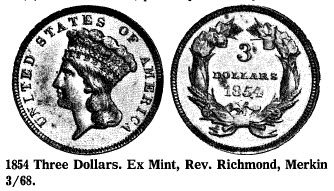
Three Dollars. First design, small DOLLARS this year only. [15+] *B-1. Heavy letters, ES on same base arc line, some other details differ from later dies. Fifteen "specimens" sent by Mint Director Snowden to the Secretary of Treasury, April 28, 1854, per #136, Letters, Mint & Branches, 1854, R. G. 104, Treasury Section, National Archives. (1) SI ex Mint .. (2) Jenks: 5782, Clapp, Eliasberg. (3) Mint, Rev. Richmond, Merkin 3/68:400 at only $1,600. (4) Geiss:1582, impaired. Two were in the J. B. Longacre estate, 1870. It is probable that a few others were made at the beginning of the new coinage of this denomination, May 1, 1854. (First delivery of regular coins, 23,140 on May 8.) Others almost certainly survive. Cf. McCoy: 1986 to French; Cleneay;688; Bell I: 265; Kern:184, impaired; Rovensky:1733, imp.
- B-2. Lighter letters as usual, final S below base line of E. (1) Possibly in the set furnished City of Bremen; July 1854, possibly the Harry Bass coin. (2) One other seen many years ago.
Half Eagle, Eagle, Double Eagle. [1+ each] Known only from the set furnished the City of Bremen in July 1854, none now located. The 1854 proof $20 in the Smithsonian turned out to be an S mint coin (see Branch Mint Proofs).
Complete proof sets. One made up for presentation to the officials of the City of Bremen, Germany, July 1854, as mentioned in the introductory historical material to this section. The set was "liberated" during World War II and occasional coins from it have turned up in recent years.
1855
Half Cent. Only the one variety. Slanting 5's. Probably well over thirty specimens survive.
Cent. Slanting 5 only. Newcomb 10: small dot or die defect on front line of coronet. Many of these are around, possibly over 100 in all. Two were in the Lahrman sale, two others in "Dupont"; Clarke: 418-420 were all called N-10 though I examined the coins and found that the Wurzbach-Hines-Sheldon-Henderson - "Sheraton" piece, Clarke: 418, was a Newcomb 11, as was lot 420; 421, called N-11, was a N-I0. There are also many early strikes, deceptive ones albeit with rounded rims, weak coronet point, weak borders, sometimes even with the 6th star failing or absent.
- *N-11. Distinctive among the three slanting 5's dies, this has curl point very slightly r. of inner r. curve of 8; no spur from front line of coronet. Extremely rare; Newcombnever OWNed one. (1) One offered to Homer Downing by Walter F. Webb, July 3, 1941. (2) Phila. Estate. (3) Geiss - Lahrman: 486. (4) "Dupont":1101. (5) Beckwith:115, Morgan:389, B. Max Mehl as "Andrews 10", T. James Clarke:420. (6) Earl Kohl, Waldorf (KS) sales 2/59:1241, 2/60:937, Calif. Specialist. (7) Clarke: 418. (8) King Umberto:917, Calif. Specialist. (9), (10) Two specimens ex Judge Sawicki. Two others seen, one impaired. No. 1 above is probably same as one of the later mentioned coins. I doubt that as many as 15 survive.
Trime. Obv. from the die used later on 99% of business strikes: repunching on 855, date first cut too low and slanting down to r., then corrected. (On business strikes the extra 8 is gone and only parts of extra 5's show above knobs.) Probably under 30 survivors, possibly under 25,which is more than most dealers would like to admit. As business strikes are highly coveted owing to their comparatively low mintage, the proofs have been accorded the usual treatment -trumpetings of "Extremely Rare! " being about the least found - and date collectors have snapped them up. As a result, one in S. J. Kabealo's Pittsburgh (Penn-Ohio) auction of 11/14/1958, lot 1018, reportedly brought $1,050, a figure which as late as 1966 remained a world record. At least a dozen traceable in auctions, seven others seen outside them which could not be immediately traced to auctions. The price climb has been spectacular: Miles:369, $1400; Jay-Scanlon:357, $3300; 1975 ANA: 95, $2500; Newlin:243 - Garrett:86, $6,500.