Walter Breen's Encyclopedia of United States and Colonial Proof Coins 1722-1989
Walter Breen
Silver-minor proof sets. (1) Phila. Mint, 1850, Alexandre Vattemare, Bibliotheque Nationale, Paris. I would like to check die varieties here, as that would establish which ones are unquestioned originals. (2) Stickney: 1794, dollar and half cent proofs, remainder unc., ex mint in 1850, probably broken up since. (3) H. P. Smith:1240, complete. (4) William Hesslein (the dealer who vanished mysteriously in the twenties) had one in 1923, according to the late Floyd Starr, who saw it; was this the H. P. Smith set? (4) McCoy: 379, 'five pieces,' apparently no copper, possibly same as one of last two.
Gold Dollar, Quarter Eagle, Half Eagle, Eagle,. [1+] Unknown, though at least one of each must have been struck in proof for the set made up for the Congressional Committee on the Library, per Patterson letter 9/26/50.
Double Eagle. [2+] Large coronet beads, Y recut, different hub from 1849; continued through 1858 on business strikes from all mints. (1) J. B. Longacre estate, 1870: 178, at a then astonishing $27, "from the first dies used for the double eagle." (2) Dr. Green: 719 (at a then extraordinary $315), which was questioned, and which I have never seen -though the price reportedly realized was fantastic for the time, well after the postwar boom in gold had faded away. Another was in the gold set mentioned above.
Date logotypes on double eagles, 1850-73, are the same as those for silver dollars; afterwards they match those used for trade dollars, through 1885, and in later years they are distinctive to the denomination.
Gold proof sets. One was made up for the Congressional Committee on the Library; untraced.
Complete proof sets. Unknown.
1851
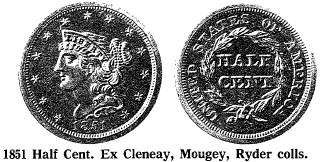
Half Cent. Only the one variety; blundered die, part of a third 1 (base and small fragment of upright) right of final 1. About eight now known, from the single pair of dies used for business strikes. One is in the Smithsonian; the Cleneay-Mougey-Ryder coin went to S. J. 0.; I found a specimen at a convention in Pittsburgh about 1958.
Cent. Unknown and unreported.
Trime (Silver 3). Occasion: Initial issue, June 30, 1851, effective date of authorizing act. (1) Eliasberg, ex Clapp. (2) W. L. Carson, doubted. (3) The Smithsonian's coin is so heavily lacquered after cleaning long ago that it is impossible to tell if it was originally a proof. (4) "Gilhousen": 108, at $4,200, found in Philadelphia in the 1950's. Cf. also Maris: 136 (1886), possibly No.1 above; McCoy: 655, bought back by consignor. The name "trime" for this denomination was coined by James Ross Snowden by analogy with dime; not in Oxford English Dictionary.
Half Dime. *V-1. High date, all numerals touching base; die rust pit at border above 10th star. Rev.:
Die file marks above AMERIC. (1) Valentine collection. (2) Eliasberg. (3) Bullowa, May 1952. (4) E. M. Wharton: 1078, unverified.
Dime. I have heard of only one, a piece formerly owned by Q. David Bowers. Other reports have led to examination of first strikes or buffed pieces.
Quarter. Wayte Raymond knew of one but it is now untraced.
Half Dollar. Unknown.
Silver Dollar. B-1. Date very high in field, close to base and slanting down to r.; base of second 1 closer to border than first; shield point about over left upright of 1. Rev.: Same as 1850 B-1. All proofs of this die combination are controversial as to their proof status, though they are definitely known to be 1851 productions. (1) Ralph J. Lathrop - 1952 ANA: 1303. Doubted on what seem to me inadequate grounds. (2) The piece pictured over G. H. Hall: 1484. Probably ex Col. E. H. R. Green. (3) Davis-Graves: 1350, several stars rounded, sharpness not equal to that on some other unquestioned proof dollars. (4) "Dupont": 2528, the one with what appears to be the best claim. (5) Golding: 243.
For the centered date pieces, see Restrikes and Fantasy Pieces. These coins have the reverse of 1858-9 in a more worn state, proving them to have been made later than 1858.
Silver-minor proof sets. None reported, none even in the Smithsonian.
Gold Dollar. Lots 175 and 176, J. B. Longacre estate, 1870. No other proofs even rumored and these two are not traced.
No higher denominations of gold are even rumored to exist in proof.
1852
Half Cent. Only the one obverse; date large, as on the half eagles. Rev.: Small berries, presumably the extra reverse left over from 1851. Probably not identical to the die of 1856-7 with doubling on CENT and ribbon, certainly not identical to the restrike die found on coins dated 1831, 1836, 1840-48 and 1852 showing heavy die file marks over RICA, as the 1852's showing that reverse are all ludicrously overweight. No example from the unquestioned original die is now traced, though at least a few must have been made owing to the evidence of manufacture of silver-minor proof sets for this year (see below). Proof that the B reverse of 1856-57, often found on half cents with the 1852 obverse, and sometimes claimed as the original die, is an 1852 product, would to have to consist of discovery of an 1852 proof set (Winsor's?) of which all the other coins are demonstrably originals (the dollar is an especially sensitive test) and in which the half cent weighs correctly without exhibiting a high knife-rim or die failure. As many 1852 half cents with this reverse are obvious restrikes with progressive die failure, high knife-rims, weights deviating greatly from the 84-grain standard, etc., any purported original would have to resemble in rims, borders, and texture or fabric, original proofs of 1850-51. Restrikes were all made after regular manufacture or import of half cent blanks had ceased, and other surreptitious fabricators had to make blanks of only approximate weight, with predictable results; light onesdid not strike up properly, heavy ones show high knife-rims as metal was forced between collars and die edges. In the absence of the Winsor proof set or any other (see below), we must assume that the original 1852 half cent with small berries is still an unknown quantity in U.S. coinage, its discovery still a thing of the future. For the Large Berries coin, see Restrikes and Fantasy Pieces, below.