Walter Breen's Encyclopedia of United States and Colonial Proof Coins 1722-1989
Walter Breen
1856
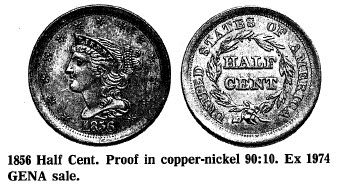
In some ways this is one of the most difficult and complicated dates of the series. There is somewhat dubious evidence of restrike activity in several denominations, and several very curious varietiesof originals. The Flying Eagle cents require a whole chapter (below, p. 243), so only the sketchiest mention is here made.
Half Cent. Only one obverse: closely spaced date, upright 5; tip of an effaced 5 (a tiny triangular mark) in field r. of 6. Three revs., two extremely rare, the other found only on proofs and known to exist on restrikes as well as on presumed originals.
- 1-A. First reverse, the only one recorded in die accounts as made for business strikes. No rust pit on upper part of I (TED); no double impressions on CENT or ribbon. Copper proof: Norweb collection.
- Same dies. Copper-nickel 90:10, pare gold color, 69.1 to 70.3 grains. Experimental alloy, not to be confused with that to follow. "Dupont":1l57; Norweb; 1974 GENA: 1234. Ignored by Judd; originally Adams-Woodin: 216. Less than ten ever recorded.
- Same dies. Copper-nickel 88: 12. Struck on planchets intended for Flying Eagle cents. [50+] Weight 72 grains. Judd: 177; Adams-Woodin: 217. Pale gray toning to dusky reddish yellow exactly as on copper-nickel cents of 1856-64. Many examples have been cleaned, some drastically so; some few have been damaged, and I have seen two or three showing evidence of wear - apparently as pocket pieces. They originated as proofs, more or less, the dies being polished as were the blanks. Apparently three lots were made, time of the second and third unknown. First group of at least 50 examples coined July 1856. This parcel of 50 was sent by Mint Director James Ross Snowden to the Secretary of the Treasury, July 11, 1856, to show what the new copper-nickel alloy would look like, and as souvenirs for distribution to interested parties in Congress, Senate and Treasury Department. The half cent dies were used because available, unneeded for coinage demands, and because they were the nearest regular dies to the size of the blanks. Longacre, always slow, had not as yet completed the dies for the Flying Eagle cents, though this particular task involved principally transfer by mechanical means (and slight hand modifications) of Gobrecht's flying eagle of 1836-39 and of Longacre's own wreath originally used on the 1854 three-dollar pieces and gold dollars of large size.
The initial group appears to be those hastily given a single blow apiece from dies that were not set quite close enoughtogether in the screw press. Many of these, though showing beautiful proof surface, lack relief detail on parts of curls, leaves of wreath, and sometimes other areas. Denticles are never up, partly because of the improper die setting (adapted to much thicker flans), partly because the blanks were not wide enough to accommodate the die-impress properly and had to be rolled down a little.
Later examples from the same dies and on the same type of blanks show relief details properly up, though border denticles are never strong. The dies must have been reset to come together a proper smaller distance apart. These are much rarer than the original group of hasty weak strikes which I take to have been the original 50. The third group are still better struck, the dies apparently again repolished; occasional examples show knife-rims. Second and third groups occur only in proof state (some cleaned) and they are extremely rare compared even to the weak ones. All are likely to be products of 1856-58. I have no auction records enabling comparative value levels to be ascertained. Brobston's, $650 asking price a dozen years ago, was one of the hasty weak strikes though in excellent preservation.
- *1-B. Reverse of 1857 B, the die found also on restrikes dated 1840-49 small date and 1852. Probably most of the 1856 coins bearing this reverse were products of the 1856-58 period, struck on blanks intended for half cents rather than on restrike blanks made up later by mint workmen not having proper equipment, as weights are within normal limits. However, at least ten appear to belong to the "81.8" series of restrikes, and four are on unnatural thick flans, matching two of the known series of restrikes dated in the 1840's, and thus testifying to restrike activity affecting half cents of even this comparatively common date. See Restrikes and Fantasy Pieces, below.
- I-C. Repolished reverse of 1854, rust pit on upper part of upright of I of UNITED. Extremely rare. Copper only, usually much toned down. Not a late product, probably made in 1856-7; weights are within normal limits and there are no unnatural wire edges or die failures. (1) Philip M. Showers. (2) Holmes: 1356 ex J. G. MacAllister (the "drunken Irishman" dealer of Philadelphia, during the 1930's and early 40's). (3) T. J. Clarke: 492. (4) A Brand example went with the Ryder collection as NN44: 338. (5) One in the writer's collection, obtained many years ago from R. McAusland.
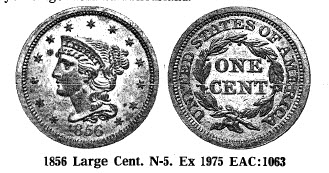
Large Cent. Only one variety. *Newcomb 5. Slanting 5, date distant from device, three minute die filemarks down from earlobe; curl point very slightly beyond8, but without the spur from end of truncation found on theother variety (N-13) having this position of curl point. Rev.Die of 1857 *N-3, with extra "berry" (die defect) on leafleft of 0 C, etc. One of the least rare large cent proofs; over100 survive. Four were in "Dupont" (: 1015-18); T. JamesClarke had at least three others; two more were in Newcomb II: 753; Downing had several, of which two went as 1952 ANA; 2220-21. Popular because ofcomparatively early date, because many collectors want alarge cent proof of no matter what date, because it is a goodshowpiece as such, because many examples come with abeautiful warm rosy or even tangerine brilliance possessingmuch eye appeal. Gardner's (1965) brought a thenastonishing $725; three times that figure would beappropriate today.
The N-7 of Lahrman: 495 is unverified; the N-4 of Clarke:423 was a business strike.