Walter Breen's Encyclopedia of United States and Colonial Proof Coins 1722-1989
Walter Breen
Silver-minor proof sets. (1) Winsor: 1069, complete; half cent original, silver varieties not specified (probably not then known). (2) Stickney: 1792, complete, ex the mint in the year of date, same comment. (3) Cleneay:840, complete, but the half cent is a restrike, probably obtained to replace the original which went into his date sequence. Broken sets are also known; ANS's, ex Brock, Morgan, lacked the half dollar and dollar, and is filed individually by denomination. McCoy: 375, to Levick, lacked the copper. Newcomb evidently owned another, lacking the half cent and dollar; the remaining coins were sold as individual pieces, the common fate of broken sets.
The question arises whether or not any of these sets dated 1840-48 inclusive were made in 1848-50 for Alexandre Vattemare or other dignitaries. Vattemare's second visit to the USA was during the years 1847-50, and he is known to have obtained proof sets from the mint; the Bibliotheque Nationale still retains his 1850 set. Should it develop that the coins in that set include any restrikes, this will enable identification of others sharing the same reverse dies in the same states but muled with earlier dated obverses as pieces probably made on the same occasion and for similar purpose. The existence of runs of dates of coins sharing a common reverse die (while other proofs of the same denomination, known to be originals, use different reverse dies in the same dates) strongly suggests the issue of various dates of proof sets at the same time. Sets of individual pieces made up each year normally had individually made dies for the year, save for half cents and silver dollars (as the Stickney sets apparently prove) and barely possibly the cents; though the cents remain moot. Any sets of various dates made up to order at the same time most probably would have been manufactured by something like the following procedure. A cent reverse die was put into the press (perhaps the 1844 B-8die earlier mentioned), a few cents from an 1844 obverse die saved from that year (or even perhaps newly made to order using old logotypes) were struck, then an 1845 obverse put into the press instead and a few struck, then a few dated 1846, and so forth,and similarly for the other denominations, since no type changes involving reverses occurred in this period. Confirmation of this process awaits sight of the Vattemare proof set of 1850. Circumstantial confirmation would consist of evidence that the same kind of copper planchets showed up on the cents (perhaps the half-cents too) in that group of proofs. The reasoning behind this conclusion is simple enough: from year to year the copper used for cents differed with differing suppliers or contractors employed by the Mint, these firms being in various parts of the USA as well as in England. Physically the cents tend to tone or tarnish or streak differently from year to year, the borders differ, as does the texture of devices; and the color on untarnished ones is also distinctive. I have already alluded to the exceptional brilliance characteristic of 1841 proof copper coins; it would almost be possible to tell the date of an original proof half cent in the eighteen forties from the reverse, so characteristically variable are the kinds of planchets used from year to year. Much the same remark could be made for the silver coins except that the tests required would be extremely sophisticated (X-ray diffractometry, spectrography and neutron activation analysis), since the mint made its own planchets and the differences from year to year would be principally those of exceedingly minute impurities or trace elements not touched by the mint's refining processes.
On the other hand, discovery of any proof silver dollars dated in the eighteen forties bearing either of the reverses of 1857-59 would immediately enable us to date them to that period, probably the same time that the 1852 silver dollars were restruck. Examination of some of the Cleneay proof sets of the 1840's including restrike half-cents would perhaps enable a decision among the following alternatives: (1) Original set from which a half-cent had been removed for inclusion in a date sequence, then replaced with a restrike. (2) Set made up in the 1847-50 period. (3) Set made up in1858"60, all the coins being manufactured to order at the time. (4) Set made up in either period, the coins being assembled from leftovers in the Coiner's vaults and any missing denominations being supplied from newly minted restrikes.
Quarter Eagle. Regular type. *B-1. Small die chip on neck. Final 8 midway between truncation and border. No die file marks at 1, its left base above r. edge of dentil. (1) Smithsonian, from Mint proof set. (2) Woodin: 973, possibly reappearing as that next to follow or as no. 5 or 6. (3) WGC: 115, possibly same as Melish: 1181, now in New York state specialist collection. (4) Ex Stack's, impaired. (5) Ex Texas private collection. (6) Ex Davis-Graves, Kesselman: is it same as last?
- CAL. over eagle. B-3 (dies of B-2). Die file marks slant up to left, touching left base of 1, which is about over center of a dentil. Final 8 nearer to truncation than to border. Three proofs were in the J. B. Longacre estate, lots 170-172 inclusive, at $5 apiece, and apparently others were made for presentation purposes in conjunction with, or commemoration of, the first shipment of California gold to the mint. Ronnie Carr swears that he has seen three different proofs, so probably more than that survive. I know that there are several prooflike first strikes, which have from time to time been sold as proofs. Incidentally, the CAL. was punched into the coins while they remained on the obv. die, as no flat spot on obv. shows on the genuine. The CAL. is a logotype or gang punch, letters always identically related to each other, rectangular period, square or oblong serifs, etc.; but the logotype is slightly differently placed from coin to coin: very low on Menjou: 1196 (pictured by Hewitt in my quarter eagles monograph), about centered on Bell II: 135 and many others, very high on Jerome Kern: 39 - Pierce: 1130 -Miles: 142 - Delp: 780 (claimed as proof, dubious).
Half Eagle. (1) Smithsonian, from Mint proof set. One other seen by Wayte Raymond years ago, but it has dropped from sight.
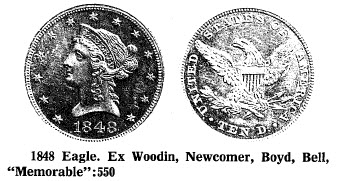
Eagle. New obv. hub. Date with open 4 logotype as on the half dollars'; *B-2: low, slanting down to r. (1) Smithsonian, from Mint's proof set. (2) Woodin: 1213, "unique", probably to Waldo Newcomer and reappearing as WGC: 653, "Memorable": 550, whereabouts now unknown. (3) One other badly cleaned piece seen about twenty-two years ago, nicked and scratched but with the sharpness and edge. (4) ANS, somewhat questionable proof, ex Morgan; sharpness is as one would wish, but dies or planchet not as brilliantly polished before striking as usual - somewhat satiny finish. I have seen a finish like this on some restrikes dated 1863 and 1865 in gold and silver, and on a few half cents. I would like to compare this piece with the Woodin proof for die identity. If the reverse proves to be the same as some later (pre-1866) proof, that will diagnose it as well; but I did not have time to make the detailed comparisons necessary to establish this while at ANS.
Complete proof sets. Smithsonian, from Mint collection, as previously and with same comment; note also that some of the proofs have been mishandled in ensuing years. Mint curators paid little attention to proofs -apparently believing them of little importance. The Woodin coins suggest that he owned a similar set which lacked the half eagle and possibly several other denominations. Occasion for earlier sets: possibly the successful conclusion of the Mexican war.