Abe Kosoff: Dean of Numismatics
Q. David Bowers
Back in 1949 a typical Uncirculated piece was not worth a great deal more than an AU coin. But, by the mid-1970s, when the ANA was studying the grading problem, this had changed, and it was sometimes the instance that a Choice Uncirculated or MS-65 coin might be worth a dozen or more times the valuation of an AU-50 piece. Obviously, the Sheldon formula had to be scrapped. Abe Kosoff argued that by default the numbers from 1 through 70 should be kept, simply because "the scale of 1 to 70 has been operating for 25 years, and many dealers now use it for all series of coins. It follows that many collectors have purchased many coins which have been recorded on many ledger pages, and many inventory cards, and on tens of thousands of coin envelopes. Changing the standard would serve no purpose, but it would create chaos for many collectors and dealers."
Others felt equally strongly in the opposite direction. Some proposed a scale from 1 to 100, while others proposed different scales. Many questioned the logic of the Sheldon Scale, which had, for example, an allotment of nearly 20 numbers for the Very Fine classification (which began at VF-20 and ended just short of EF-40) while allotting just 10 numbers MS-60 to MS-70, for the Uncirculated range, especially since the market focus was increasingly tuned in on Uncirculated and Proof coins.
In connection with the ANA involvement, Abe Kosoff envisioned a Grading Board:
"The plan is to have a small board of perhaps five members. In addition, numerous experts will oe asked to serve in limited capacities.
"For example, a collector living in Los Angeles acquires a coin from a dealer in New York, and the collector does not agree with the dealer's grading of Extremely Fine-40. If there is no dispute, fine. If there is a dispute, the collector will be advised to call Mr. X in Los Angeles, an expert who last previously agreed to serve.
"Arrangements will be made to show the coin tο Mr. X, who will have an official form in which le may indicate whether the coin is within the tolerance allowed (usually about five points), or whether it is not in the tolerance allowed, or whether it conforms to the exact grade-once the grading standards are formulated.
"If the coin is within the tolerance allowed, the collector is obliged to keep the coin. If it is not within the tolerance allowed, the dealer is obliged o accept its return and make a full refund. Decisions will be made concerning the shipping expenses and who shall pay them. An appeal from the decision will probably go to the Grading Board or one of its members.
"If a number of justified complaints are lodged against anyone dealer, action may result, but any action would not be taken by the Grading Board but by the ANA Board of Governors."
Additional debates were engendered by the elements of die wear and striking characteristics and how they affected Uncirculated coins. For example, could an MS-70 or "perfect" coin have an area of weakness, or could it be struck from weak dies, or could it be struck on an imperfect planchet? If a certain variety of half cents is always struck from worn dies, can a piece which hasn't the slightest nick or handling marks be called MS-70-if it is perfect in every other respect?
The situation became further complicated as others proposed that toning, the aesthetic appearance of a coin's surface, and other considerations be studied. Survey 10 different numismatists, and it seems that 10 different opinions would be forthcoming! Perhaps the situation never would be resolved. Decades earlier, the ANA appointed Virgil Brand and others to a committee to study grading. Nothing materialized. Then, noted dealer Henry Chapman was asked for his opinion, and his report was terse: "Impossible!"
Nothing further was done. Quite possibly in the mid-1970s the same stalemate had been reached.
The matter dragged on and on. Abe Kosoff enlisted the aid of many dealers, but many of them contributed little. Toward the end of the 1976, Abe noted:
"With great regret, I must chide a number of the dealers, some in the top-dealer class, as well as a few collectors, for stepping away from their responsibilities. I have determined that there are several reasons for their actions:
'They were afraid that their new grading standards would hurt their current overgrading policies, or they were afraid that their new grading standards would jeopardize their relationships with clients who have purchased coins from them in the past, or they were afraid that their efforts might be criticized, or that they didn't want to give up any time, or that they didn't have the time, or that they just plain didn't care, or that they would rather sit back and criticize than stand up and be counted!"
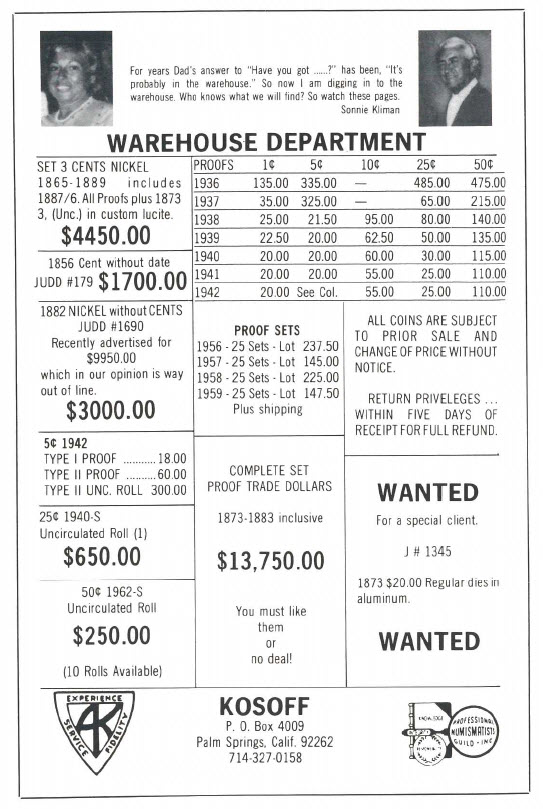
"Warehouse Department" was the title of many advertisements placed by Abe Kosoff's daughter, Sonnie, during the 1970s. Offered for sale were coins in many different categories. ("The Numismatist," December 1975)