Abe Kosoff: Dean of Numismatics
Q. David Bowers
"Here is one I cannot for the life of me understand. Lot 433 was a $5 gold piece, 1795 Small Tale reverse. It was listed as grading About Uncirculated-55, and it was truly that... A colleague had asked me to bid for it, so I examined it very closely.
I set a limit of $18,000, a high limit in my opinion. The coin opened at $15,000 and sold for $60,000. I just don't understand it, and if I, with more than 50 years of professional numismatic experience, did not understand it, how can you? "Which brings me to the point of this article; the 1980s, which we are about to enter. First, can we try to fathom all these fantastic prices? We can try.
"I saw people bidding who were unknown to any of us. Foreign money? Quite possible. OPEC money? That's a good guess. Pension fund money? No question about it. Pension funds are swallowing the finest material, and the not so finest, which is being buried in envelopes marked MS-65. Let me explain.
"For the really choice pieces the true MS-65s. pension trust money is paying through the nose, with prices unheard of. These coins have been siphoned from the market these past few years, making it more difficult for the collector to get pieces for his collection. He either has to reach for it or forget it. He often finds himself priced out of the market..."
In May 1980, Abe Kosoff reported on Part II of the Garrett Collection conducted by Bowers & Ruddy Galleries, with the second sale being held in Los Angeles:
"Garrett II is now history. I refer, of course, to Part II of the famous Garrett Collection sold by Bowers and Ruddy late in March 1980.
Some months ago, after the sale of Part I, I expressed amazement at the results of my analysis of the prices realized for pattern half dollars which had been sold at that time. You may recall that the prices realized for that group came to 3.4 times the values listed in the sixth edition of the Judd book, United States Pattern, Experimental and Trial Pieces... Imagine prices 3.4 times catalogue value!
'Well, the second sale put the first one to shame as far as records are concerned. This time there were many more patterns covering the denominations from the half cent to the $50 gold. The earlier 3.4 times book value record was smashed to smithereens. An analysis of the Garrett II patterns reveals that the prices realized averaged 9% times book value, with individual pieces ranging from twice to 33 times the list price!
"For years I have spoken and written about the probability of a price explosion in the pattern series. I never dreamed that the explosion would be atomic..." Abe Kosoff then recited a long list of patterns which sold for many multiples of their values, concluding:
"If this was a dream I was hoping I would appear-as the auctioneer! To confirm that prices were no fluke, J-1098, a $375 listing, opened at $2,000 and went to $7,000. By this time I had become a believer. The explosion which I had long predicted had come."
As cataloguer of the Garrett Collection, which ultimately realized a record-shattering $25 million in four sessions held from 1979 through 1981, the present writer (Q. David Bowers) felt compelled to add a few observations, these by hindsight. The Garrett Collection of United States coins contained many rarities in all series-colonials, regular federal issues, patterns, you name it-including many items which had not appeared on the market for years. Numerous coins had elaborate pedigrees going back to the 1870s and 1880s, coins from such well-known numismatic figures as Maris, the Chapmans, Frossard, and the United States Mint itself. Preserved with care for many years, most issues in the copper and silver series possessed attractive toning. Each piece was carefully researched, and in instances of important items, the detailed historical background was given. Accompanying the Garrett sale was the publication of a color-illustrated volume sponsored by The Johns Hopkins University and written by me, The History of United States Coinage as Illustrated by the Garrett Collection. Although the University estimated that the market for the book would be 1,000 copies at most, within a short time it had gone through several printings and over 10,000 were distributed worldwide!
There is no doubt that the Garrett auction consisted of the right collection in the right place with the right firm at the right time. Probably the coins would have done well in any market, presented as they were and being of the quality that they were, but 1979 and 1980 were heady times not only in the coin market but in world economics.
From the viewpoint of the firm that sold the collection, I am not aware of any specific OPEC money in the Garrett sale, nor do I know of any "mystery buyers." Invoices were made out to collectors and dealers, some of them requesting anonymity, but nearly all of them having serious numismatic interests. Undoubtedly, many of the dealers had commissions from other sources unknown to me.
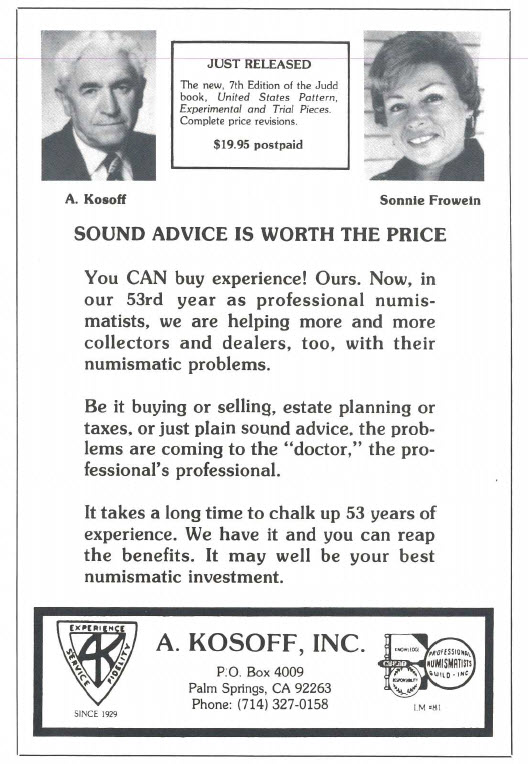
This March 1982 advertisement from "The Nusmismatist" features Abe Kosoff and his Daughter, Sonnie, who had married Dr. Dirk Frowein and was now known as Sonnie Frowein. "You can buy experience!" the text related.