Abe Kosoff: Dean of Numismatics
Q. David Bowers
"Well, suddenly I am writing about patterns, Bowers is writing about patterns, and the DiBello patterns go off exceptionally well. At the same time we find that copies or me standard work of the subjects, United States Pattern, Trial and Experimental Pieces, by Dr. J. Hewitt Judd, are out of print and are next to impossible to acquire."
Ever eager to educate, Abe Kosoff continued:
"Before we go too far, perhaps brief definitions n the subject matter are in order. I would like to avoid confusion and boil them down to this simple language.
"Patterns: Pieces representing a new design proposed for adoption but not adopted, at least not in that year.
"Trial Pieces: Pieces representing adopted designs but struck in metals other than that customarily used for the coins. An example is a regulars issue dime struck in copper.
"Experimental Pieces: Pieces struck for new denominations, new shapes, new metals, for alloys for example, coins with perforated centers, $4 denomination, and so on.
"Readers who may be interested in learning lore about this most fascinating series should beg, borrow, or buy a copy of Dr. Judd's book. I suspect that a new fourth edition will be released within the next few months.
"Bowers' report is an interesting one; he elaborates on the capsulated definitions I have given ad gives some examples of interesting specimens. He discusses the psychology of collecting pattern coins and the investment potential.
"David points out that a listing of a pattern in le Guide Book of United States Coins causes it ) fall into the rarity category (as a coin) even rough it is one of the more common of patterns.
"The popular and expensive 1856 Flying Eagle cent is, of course, the most outstanding example; and it is not truly a coin, because not until 1857 'as this design authorized for circulation. It appeared, though, in Wayte Raymond's Standard Catalogue of United States Coins some years ago and has been listed in the Guide Book of United States Coins for many years. Accordingly, many cent collectors actually own a pattern when they own an 1856 Flying Eagle cent.
"Rated as Rarity-Ion a scale from 1 to 8, the 1856 Flying Eagle cent is among the most common of patterns. Yet, as a coin it is scarce; perhaps somewhat more than 1,000 pieces were minted originally-a great number for a pattern but a small number for a standard coin.
"As a pattern, a typical Rarity-1 item in other series might sell for perhaps $50 to $75. As a coin, the Rarity-11856 Flying Eagle cent has fetched in excess of $3,000, although it may currently be acquired at a lower level. the famous Gobrecht silver dollars of 1836, 1838, and 1839 fall into the same category. They are all patterns, but as all are listed in the Guide Book of United States Coins they all bring high prices.
"The transitional patterns of 1859 and 1860 in the half dime and dime series are similar cases in point, and, likewise, the $4 gold pieces of 1879 and 1880 are patterns, these being of an experimental nature and of a denomination which was never issued regularly.
"Bowers continues with suggestions for collecting patterns. A pattern type coin collection could contain a piece of each denomination, such as a cent, a two-cent piece, a three-cent piece, and so on. I could go further by including the various types of one-cent pieces, the different types of two-cent pieces, etc., without any attempt to acquire different dates of the same type.
"He mentions an approach which I have successfully introduced to many clients over the years; the combination of patterns and the regular series. The collector of cents, for example, could acquire the 1854 and 1855 transitional pattern cents, transitional in that they come between the large cents minted until 1857 and the Flying Eagle cents mentioned previously. The size of these patterns is reduced from that of the large cent, yet it is much larger than the small cent. Also, the designs have the Liberty head of the large cent and the Flying Eagle later adopted for the small cent...
"Regarding introduction of patterns, I can state without fear of contradiction that every collector to whom I introduce to this type of combination collecting has found added enjoyment of his hobby.
"Bowers discusses the rarity of pattern coins and the rarity scale used by Dr. Judd, which is similar to the one introduced by Dr. William H. Sheldon in his excellent Early American Cents book. An interesting observation is that the patterns listed in the Guide Book of United States Coins are among the most common of patterns.
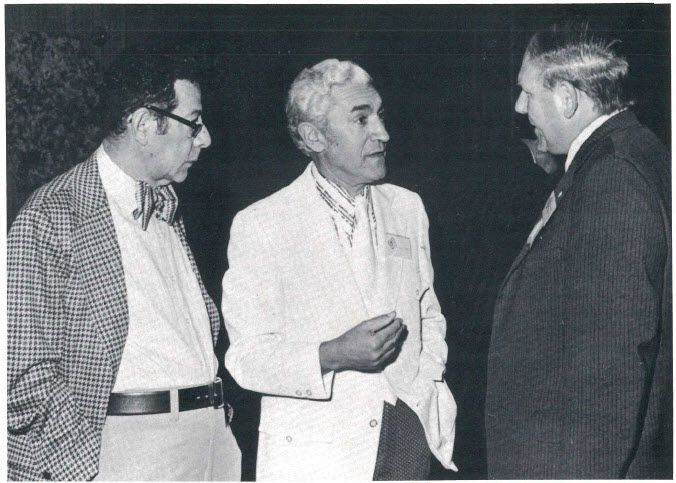
At an annual congress of the International Association of Professional Numismatists in the 1970s, Richard Picker looks on while Abe Kosoff talks with Donald Crowther.